The Philadelphia Zoo recently unveiled the newest additions to their
animal kingdom family and the adorable overload is simply off the
charts.
The zoo is home to a pair of black-footed cats, Ascari and
Aza, who gave birth to three kittens on April 8. After undergoing a
series of health checks to ensure that the zoo's first ever litter of
black-footed cats -- a species of wild cat hailing from southern Africa
and accustomed to arid climates -- were healthy, the trio made their
grand debut in late May.
Click play on this video from the Philadelphia Zoo
to see Drogon, Rhaegal and Viserion enter the exhibit for the first
time and then check out the slideshow below for even more black-footed
kitten cuteness.
In a move that will bolster tiger conservation in the country, the
Pilibhit Wildlife Sanctuary in Uttar Pradesh has officially become a
tiger reserve. This will be the state's third and the country's 45th
tiger reserve.
According to Pratibha Singh, the state's
principal secretary (forest and wildlife), the government has notified
the sanctuary as a tiger reserve, which is already home to 30 of the
state's 118 big cats as per 2011 central data.
The Pilibhit
forest division is spread over 73,024.98 hectares and shelters many
other endangered species. The core area of the tiger project will
comprise 6,279.8 hectares, while the buffer zone - the Khutar range in
Shahjahanpur - will span 12,745.2 hectares. The Pilibhit reserve lies
along the India-Nepal border, in the foothills of the Himalayas and the
plains of the 'terai' in Uttar Pradesh.
The process of
according the tiger reserve status to the cluster of fragmented forests
in Pilibhit was initiated in 2008, based on its special type of
ecosystem that has vast open spaces and sufficient feed for the elegant
predators.
Government officials said the move shows the state's
commitment to strengthen conservation efforts in spite of UP's large
population. Dudhwa was the state's first tiger reserve that came into
existence in 1987, followed by Amangarh Tiger Reserve in 2012.
Posted by Liz Langley in Weird & Wild on June 16, 2014
It’s official: Cats are mysterious. I got a cascade of questions from curious cat people this week, proving that even their owners can’t fathom them. Pet
cats resting atop and under a sofa in Fairview, North Carolina.
Photograph by Amy White & Al Petteway, National Geographic Creative
I hope these answers to your Ask Your Weird Animal Questions will make your feline a little more relatable.
Why do all my cats like the smell of my stinky shoes? They can’t seem to get enough! —Anne Deason Spencer via Facebook
In nature, scents are messages, so in general “animals tend to be attracted to smelly surfaces,” said Carlo Siracusa,
a veterinarian at Penn Vet’s Ryan Hospital in Philadelphia. Smelly
shoes are likely to come with odors, including pheromones, from other
cats or animals. “When a cat rubs on smelly shoes, he probably wants to ‘rewrite’ the
message on the shoes, adding his signature; he may also want to exchange
signals with the owner who is a member of the same social group.”
Can an FIV+ cat (one with feline immunodeficiency virus) live happily and healthily with a non-FIV+ cat? —Lisa Reddy via Facebook
Julie Callahan Clark, also of Penn Vet, said it depends on the relationship of the cats.
The virus, which lives only a short time outside the body, can’t be
transmitted by sharing water bowls or by mutual grooming and is
primarily transmitted by biting. “Therefore, if the cats know each other and have no aggressive
tendencies towards one another, they could coexist happily,” Clark said,
though a cat fight could transmit the disease. Clark noted that “transmission of FIV in multi-cat households is considered to be an infrequent event.”
Will clipping a cat’s claws make them not scratch things
as much? My husband says when you clip them, they scratch more to
re-sharpen them. —Ellen Sherman Jewel via Facebook
“Scratching is a complex behavior which serves many functions,” such
as keeping the nails sharp and functional and communicating with other
cats, said Siracusa. Barbara Sherman, of
North Carolina State’s College of Veterinary Medicine in Raleigh, added
that even declawed cats will scratch, and that this characteristic
behavior may have to do with stretching and “conditioning their limbs.”
“It’s usually done after a nap, so often we try to put a scratching
post for a cat near their resting site,” she said.
She encourages owners of indoor cats to trim their pets’ nails, which
they can learn to do with the help of a vet—and a few treats. This can
minimize damage to the home and injuries to the cat, as well as avoid
the surgical procedure of declawing, which provides no medical benefit to the animal, according to the Humane Society of the United States.
How can I stop one cat from clawing my door sills and the
other from urinating in the bathtub and sink and on floor mats? —Melissa
Dempster-Daly via Facebook
Sherman laughed and said this doorsill scratcher “has made a personal
choice.” Cats have a need to scratch and stretch, and there’s just
something about this surface the cat likes, she said.
In order to save your sills, provide the cat with an alternative,
like a scratching post, that she will like and use (it might take a few
tries). Once that need is met, then cover the doorsills with double-sided sticky tape or a similar product. “We’ve got to barter with the cat, to say, ‘We don’t want you to use
the sills anymore, but we want to give you what you need,’”
The cat that urinates outside the litter box may have an underlying
medical problem, she said. Cats prefer a loose, absorbent surface as a
latrine; if urination is painful, the cat might associate the litter box
with that pain and “may go to a place that’s very different and try it
and see if it’s less painful.”
Last, owners shouldn’t yell at or punish a cat for either behavior,
Sherman said, especially for urination. Cats may just be trying to
communicate something to you, so you have to learn how to listen.
Bottle feeds, toilet training - keeping a big cat at home is like having a baby. But is it safe?
Written By
Claire Webb
Giles Clark first took a tiger cub home when he was 16. Two
decades later, he finally understands why his house-proud mother wasn’t
quite so smitten. “Her newly decorated lounge was covered in chew-holes and scratches.
She still talks about the smell: the strongest cat urine you can ever
imagine.”
Back then, Clark was a fledgeling keeper at Paradise Wildlife
Park, a small zoo in Broxbourne, Hertfordshire. He’d donned a keeper’s
overalls as soon as he finished his GCSEs, after falling head over heels
for the big cats while on work experience there. “I just knew
immediately that’s what I wanted to do.”
Nowadays he runs the exotic carnivore enclosure at Australia Zoo on
the Queensland coast, having emigrated 15 years ago. It’s his job to
“socialise” the zoo’s big cats: a controversial practice that entails
removing cubs from their mother and hand-rearing them at home. His most
recent guests were a pair of week-old Sumatran tigers – which as a
species are critically endangered, with fewer than 500 left in the wild –
and a BBC documentary crew.
At first Spot and Stripe needed round-the-clock bottle-feeds. “As
with any baby, I had to make sure that everything was washed and
sterile. And not just bottles – with the number of towels you’re going
through, it felt like the washing machine was going constantly. I was
more exhausted than when my son was a baby.”
And like human parenting, tiger-rearing isn’t for the squeamish.
Another of Clark’s duties as foster dad was to massage the cubs’
bottoms. “Naturally mum would lick them to stimulate them to go to the
toilet, so I had to replicate that with my hand!” Watching him cradle
the mewling cubs and gently mop vomit from their chins when they’re
poorly, it’s clear his concern is as paternal as it’s professional.
“Very much so. You can’t help it. You never, ever forget in those first
couple of months how dependent they are. Everything you do has an impact
on them.”
While all this makes for cute, cockle-warming television, you can’t
help wondering why it’s necessary to remove them from their mother at
all? “By forming this relationship – I call it a friendship – with our
animals, we’re able to give them a much better quality of life,” insists
Clark. “They’re not stressed or frustrated like tigers you might see in
other facilities. We do a variety of things with our cats that normally
just wouldn’t be possible in captivity. We even play with them in a
purpose-built pool. We can only do that by having a really strong bond,
and you need to establish that when they’re very little.”
Three times a week his tigers are put on a leash and taken for a walk
in the bush. “It’s for mental rather than physical stimulation,” says
Clark. “They get to use their senses and mark territory.” Members of the
public can accompany the tigers on these outings, if they’re willing to
pay 400 Australian dollars for the privilege. “There are very few places around the world that have the same
philosophy as we do at Australia Zoo,” he says. “It’s a very hands-on,
interactive approach. You get to do things you don’t get to do at a more
traditional zoo.”
Australia Zoo was originally a Reptile and Fauna Park, opened in 1970 by Bob and Lyn Irwin, the parents of wildlife
presenter Steve “Crocodile Hunter” Irwin, who died in 2006 after being
hit by a stingray barb while snorkelling. During his lifetime Steve was
often criticised for his gung-ho methods and on one occasion for holding
his infant son too close to feeding crocodiles. The zoo was a pet
project.
Last November, though, it hit the headlines after handler Dave Styles
was badly mauled by a 114kg/250lb tiger while playing in the pool. He
spent ten days in intensive care after suffering serious puncture wounds
to the neck. The incident happened while the BBC were there filming for
this series, though a spokeswoman says no crew was present at the time
of the attack. She admits that Styles did have a camera attached to his
helmet, but says it wasn’t recording.
Though many tiger experts say it’s impossible to control big cats
through socialisation, Clark is sanguine. “In an ideal world, we
wouldn’t have tigers in captivity. But they’re disappearing and we have
to face the reality that unless we change – and rapidly – tigers in the
wild will be extinct by the time our children have left education. “In the past ten years we’ve put more than one and a half million
dollars into tiger conservation projects. So if it weren’t for my
tigers, the tigers in Sumatra would be in an even worse situation. It’s
that simple for me.”
Eager and full of energy,
about 350 ZooMontana members of all ages showed up Friday afternoon to
greet the two latest additions to the zoo's family: sister Siberian
tigers Jasmine and Sophie. The big cats arrived
by truck late last month from Dade City's Wild Things, an eco-tourism
zoo in Florida, but still had not been officially shown off to the
public.
HANNAH POTES/Gazette Staff
Jasmine, one of ZooMontana's new Siberian Tigers, nibbles on some grass inside her exhibit Friday at ZooMontana.
On Friday, members of the zoo got a special
sneak peek of the roughly 2-year-old felines. The zoo's director and
several volunteers were present to answer questions. "How do you tell them apart?" one child asked volunteer Julie Zimmerman. The question was a popular one. Although
the cats are roughly the same size, Jasmine is a lighter shade of
orange and features more stripes. She also has a small scrape on her
nose. Sophie, on the other hand, is more outgoing, said Zimmerman, who
has been volunteering at the zoo since 2004.
As kids
looked on, mesmerized by the giant creatures and their stripes, the two
cats stared back, looking perhaps just as curious. Another volunteer, Pat Donnelly, commented on it as she walked past. "These tigers are having more fun than the kids," she said. The arrival of the tigers comes after Prince, the Zoo's beloved Siberian, died of lung cancer in March. He was 18 years old.
The
zoo's director said the acquisition came quickly. After hearing about
Prince's death, "They contacted us and said 'We've got these animals, ' "
Ewelt said. Ewelt said they were initially looking at a tiger in Oregon, but that Sophie and Jasmine were a better fit. It
was only a couple months after the Florida zoo decided to donate the
two sisters that they were loaded onto the back of a climate-controlled
truck and were Billings bound. "You never know what you're passing on the highway." RBC Wealth Management in Billings footed the shipping costs, which hovered around $4,000, Ewelt said.
HANNAH POTES/Gazette Staff
A new tiger sniffs the grass inside the Siberian Tiger exhibit Friday at ZooMontana.
When
they arrived in May, Jasmine and Sophie were housed in a separate area
of the zoo, while preparations were made for them to be moved to their
habitat. On Monday, the cats finally made the transition. Although
the weather was much warmer in Florida, Ewelt said the cats haven't had
too much issue adjusting. As Siberians, he said, it's in their nature. He
added that they're looking forward to this winter, when they will get
to see Jasmine and Sophie play in the snow for the first time.
Mychael
and Jennifer Hoffman brought their two kids — Payton, 5, and Mason, 4
— to the zoo on Friday after receiving an email about the event. They came earlier in the day, stayed for four hours, left and then came back to see the tigers, Jennifer said. Jennifer said her kids loved Prince. "Literally, since the day Prince died, they've been crying." They
were looking forward to meeting the new tigers ever since they heard
about them a month ago. "They've both been very excited," Mychael said. "They are really cool," said Payton, who will be a first-grader at Elder Grove in the fall. While
Payton was reluctant to call favorites so soon, for her younger brother
Mason, it wasn't a problem; the answer was simple: Jasmine. "She has more stripes," he reasoned.
HANNAH POTES/Gazette Staff
Children and their parents gather round to see the Siberian Tiger exhibit Friday at ZooMontana.
In
the coming weeks, Ewelt said the zoo plans to fix a few cracked glass
panes around their habitat. He said the funding for which will come from
ExxonMobil, one of the exhibit's sponsors. He said in
the future they hope to be in the financial position to provide a
portion of their proceeds to conservation efforts, but for now, their
conservation efforts come in the form of education. He was touching on a question that volunteer Julie Zimmerman posed a little later: "How are you going to get kids to care about tiger conservation if they've never seen one?"
The
public will get the chance to see the tigers tomorrow. The zoo opens at
10 a.m. Tickets are $7 for adults, $4 for children 3-15 and free for
kids 2 and under. There are also discounts for seniors and military
members.
The
Pilibhit wildlife sanctuary in Uttar Pradesh today officially became a
tiger reserve, the state’s third, in a change that officials said would
earn it central grants and minimise man-animal conflict.
State principal
secretary (forest and wildlife) Pratibha Singh said the government had
notified the sanctuary, which has 30 of the state’s 118 big cats
according to 2011 central data, as a tiger reserve.
Central approval
for the tag came early this month, with sources saying Pilibhit BJP MP
and Union minister Maneka Gandhi helped speed up the clearance.“This is going to
be the 45th tiger reserve in the country and the third in the state,”
Singh said in a release. The other two are Dudhwa in Lakhimpur Kheri
district and Amangarh in Bijnore.
The new status
will bring much-needed funds for the Pilibhit reserve from the
centre-run National Tiger Conservation Authority (NTCA), state officials
said. India, with 1,706
tigers, has around 68 per cent of the world’s estimated 2,500 big cats,
Singh said citing figures from the NTCA.
The largest such
reserve in the country is the Jim Corbett Park in Uttarakhand, with over
200 tigers, while the Sunderbans in Bengal had 103 big cats in 2013,
officials said. The Pilibhit reserve, 225km from Lucknow, is spread over 1000sqkm with parts of it along the Nepal border. “The forests are
rich and diverse. The jungles are home to a variety of animals including
the tiger,” state chief wildlife warden Rupak De said.
Another official
expressed hope that the new status would help the Pilibhit reserve
increase its forest cover, improve anti-poaching measures and take steps
to ensure the big cats had more prey to feed on. “Although the
tigers have a large prey base, there has been too much interference by
people who live on the edges. Such matters should improve now,” the
official said.
Such man-animal
conflicts occur both ways. At least six persons were killed in 2012 by
tigers when they entered the park in search of firewood and forest
produce. At other times, the big cats enter hamlets on the fringes in
search of food and pounce on villagers. The last fatal tiger attack was
on February 19 this year.
The Akhilesh Yadav
government is learnt to have consulted Union minister Maneka — a
wildlife enthusiast and an ex- environment minister — on the Pilibhit
reserve and she promised all help for the park in her constituency.
It took the state
four years to win central approval. The process began during previous
chief minister Mayawati’s tenure in 2010. Sources said the in-principle
approval from came in 2008. But in 2010, a follow-up proposal from the
state was returned by the Centre, with sources saying the plan lacked
key details like clear demarcations of “core and buffer areas” in the
proposed reserve.
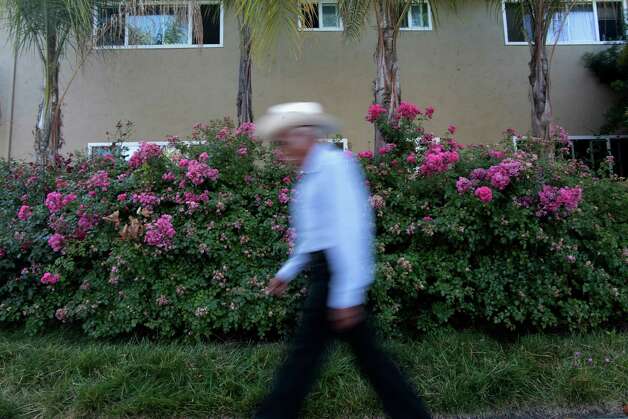
Mountain lion 46M hid behind bushes at this apartment building at South Rengstorff Avenue and California Street.
Photo: James Tensuan, The Chronicle
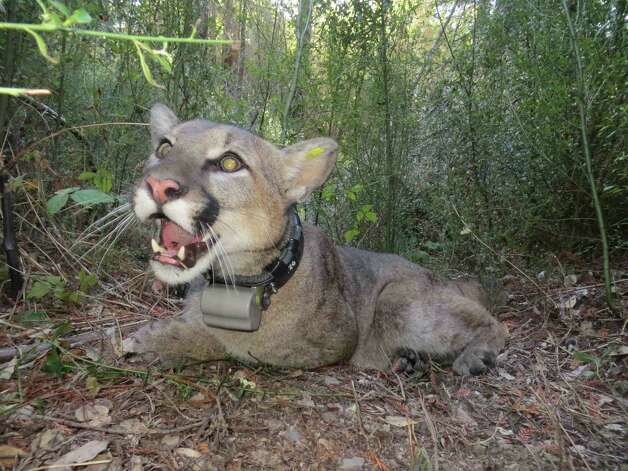
The mountain Lion waking up after she was collared in January.
Photo: Handout, Courtesy Santacruzpuma.org
The large male cougar that sent Mountain View
into conniptions last month before he was tranquilized and taken into
the woods was hiding behind a small hedge on a busy street for nine
hours as pedestrians and bicyclists passed by only a few feet away,
experts say.
The confused cat became trapped amid the hustle and
bustle of downtown and laid low until late in the afternoon when he
emerged from the hedge and slunk around apartment courtyards, dodging
cars and people for another 3 1/2 hours, according to Chris Wilmers, the lead researcher for the Santa Cruz Puma Project.
When
the animal was finally spotted, the news set off the kind of frenzy
that usually ends in death for mountain lions. This time, it had a
different outcome. "These young animals, they are exploring,
trying to find a vacant territory, and they are constantly going through
novel areas," said Wilmers, an environmental studies associate
professor at UC Santa Cruz and one of the Bay Area's foremost experts on
mountain lion behavior. "When they get into downtown areas, they
basically made a mistake - took a wrong turn - and found themselves in
the middle of urbanity and didn't know how to get out."
The
movements of the puma as he crept through town May 6 - a drama
documented by the GPS technology in the animal's collar - have given
scientists a crucial picture of how the fearsome predators behave when
they encounter people.
The data clearly show the cougar, known to
scientists as 46M, was not in town looking to feast on human flesh,
according to Wilmers, whose project is studying the effect habitat
fragmentation has on the big cats.
Instead, Wilmers said, it
shows how important travel corridors between wilderness areas are to the
feline carnivores. Human-cougar encounters are most frequent when
wildlife corridors are blocked by development, he said.
The
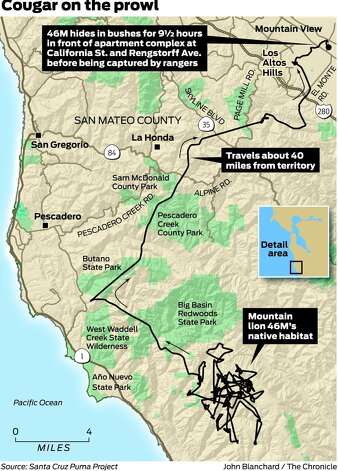
adventures of 46M actually began in January when the king-size kitty was
first captured and collared by researchers. He was with his mother just
south of Big Basin Redwoods State Park at the time, but Wilmers knew he
would be leaving her soon. Pumas typically leave their mothers to find
their own territory when they are 1 1/2 to 2 years old, and 46M was
about that age, he said.
Sure enough, the cat left his mother in
April and roamed for two weeks over the Santa Cruz Mountains, covering
about 40 miles, according to the GPS data plotted by Puma
Project researchers.
It was not an unusual trek. Male cougars
have been known to travel hundreds of miles before establishing
territory and settling down. But instead of finding new wilderness, this
young puma crossed Interstate 280 on May 5 and was soon traveling
through the backyards of tract homes, creeping by mansions and sidling
past condominium complex swimming pools in Los Altos Hills.
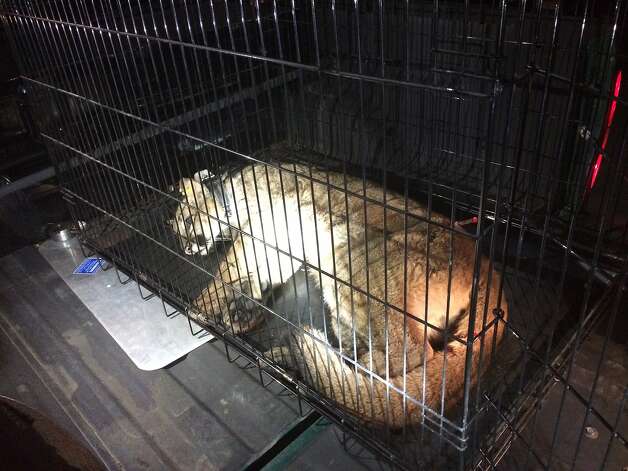
The mountain Lion in a cage after he was captured in May.
Photo: Handout, Courtesy Santacruzpuma.org
Playing field, parking lots
He loped across the playing field and parking lot at Egan Junior High School
in Los Altos and wandered through a Target store parking lot into
downtown Mountain View, where he evaded detection by moving mostly at
night, according to data from the animal's collar.
At 5:30 a.m.
May 6, the mountain lion crouched down behind a 2-foot-tall row of
bushes in front of an apartment building at South Rengstorff Avenue and
California Street and remained there for 9 1/2 hours, the GPS data show.
The
spot he chose is one of the most densely populated areas of the city, 4
miles from the nearest open space. There are 22 apartment complexes on
the block where he hunkered down and the sidewalks are normally bustling
with pedestrians, including children and dog walkers, who likely passed
within a few feet of the big cat. "My best guess at this point is
that he was looking for a way out, but he was so deep into the urban
area that he was not sure where to go to get back to open space,"
Wilmers wrote in a blog analyzing the incident.
Cougars, he said, can
crouch so that their bodies are only 8 inches off the ground and lay
motionless for hours, concealing themselves despite minimal cover. "Amazingly,
despite being walked and driven past by hundreds of people, nobody saw
him," Wilmers said. "Perhaps people will find it reassuring that he
didn't bother anyone."
The biggest danger at that point,
according to Wilmers, was that a dog would smell the cougar in the
bushes and investigate. Cougars are natural enemies of wolves and
generally avoid large dogs, but they will lash out when cornered.
The
confused and disoriented mountain lion emerged from behind the bush at 3
p.m., went up the steps and into the courtyard of the Parkview West
apartment complex across the street and from there hightailed it across
several streets in search of better cover. He was first spotted about
6:30 p.m at nearby Rengstorff Park, prompting a soccer team to flee the
field, panicked parents to grab their children and police to rush to
the scene.
The frightened feline was eventually cornered in a
nearby parking garage as a helicopter flew above and the tweets started
flying. Wildlife officials tranquilized 46M and relocated him to an open
space preserve west of Mountain View. He has since gone north into a
forested area west of Woodside and has avoided population centers,
Wilmers said.
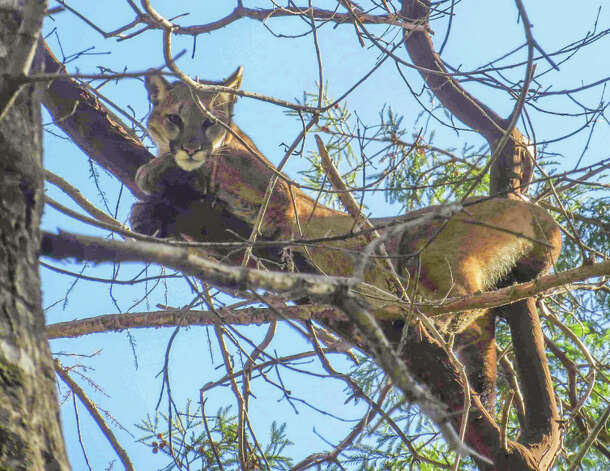
46M lounges in a tree during his urban trek in Mountain View last month. He was eventually cornered in a parking garage.
Photo: Handout, Courtesy Santacruzpuma.org
Other wayward cougars
Young
46M wasn't the only cougar to run into trouble since the Puma Project
began in 2008, according to Wilmers, who has collared more than 40
mountain lions in the Santa Cruz Mountains, a place where the animals
were thought to be extinct a few decades ago.
One young puma was
caught hiding in an aqueduct in downtown Santa Cruz about this time last
year. That cougar, known as 39M, was collared and released. He got run
over and killed by a car on Highway 17 several months later.
A
young collared female known as 11F was documented via GPS wandering
through people's backyards in urban neighborhoods east of the Lexington
Reservoir a few years ago. She eventually turned back after running into
a 20-foot wall on Highway 85 that she couldn't scale. She was
eventually put to death for killing someone's goats.
That mountain
lion was one of several to cross Highway 17. At least a half dozen
cougars have been hit and killed over the years between the Lexington
Reservoir spillway and the Cats Restaurant and Tavern in Los Gatos, and
at the notoriously treacherous Laurel Curve in Santa Cruz County.
Puma casualties
One
of the dead was a collared puma with a fetus in her belly. Another was
apparently hit by a car, lost its collar and was later photographed by a
trail camera with a giant bloody scrape on its haunch. That cougar was
eventually killed by trappers under a depredation permit after it, too,
killed a farmer's goats.
Another young male mountain lion
traveled through Santa Cruz County across the highway to Gilroy, then
went north almost to Pacifica before he turned around and settled in
Santa Clara County, Wilmers said. He said none of the carnivorous
felines seemed malnourished, and he doesn't believe the recent
encounters have anything to do with drought or global warming. "It's
the time of year," he said. "This is the time of year you are most
likely to see young animals dispersing from their moms."
It is
for this reason, he said, that the natural movements of wildlife must be
incorporated into municipal development plans. Wilmers said cougars are
often forced into populated areas when road and home construction block
their historical travel routes among the mountainous regions
of California.
California cougar facts
--
Mountain lions are called by more names than any other cat, including
puma, panther, catamount and cougar, depending on the region.
--
As many as 5,000 pumas live in California, but that is only an estimate.
The big cats are so elusive that no one has been able to get an
accurate count.
-- Thousands of the big cats were killed between
1907 and 1963, when bounties were offered for shooting them. In 1920,
the estimated cougar population in California was 600.
-- Cougar
hunting was banned in California in 1990 when the animals were given
special protected status under the California Wildlife Protection Act.
They can't be legally killed except when they prey on pets and livestock
or when declared a threat to public safety.
-- An average of
about 112 cougars are killed in the state each year primarily by
trappers or ranchers with depredation permits. Researchers say most
encounters are the result of human incursions into mountain lion
territory.
Attacks on humans
There
have been 17 verified mountain lion attacks on humans in California
since 1890, including six deaths. The fatal attacks include:
--
January 2004: Mark Reynolds, 35, was killed during a mountain bike ride
at Whiting Ranch Wilderness Park in Orange County. The amateur racer's
partially eaten remains were found after the same puma later attacked a
female rider, who was saved by fellow riders who drove the puma off as
it tried to drag her away.
-- December 1994: Iris Kenna, 56, was
attacked and killed while hiking alone near Cuyamaca Peak in Cuyamaca
Rancho State Park in San Diego County.
-- April 1994: Barbara
Schoener, 40, was attacked, killed and partially eaten by an 80-pound
cougar while jogging on a trail in the Auburn State Recreation Area in
the Sierra foothills.
Online extra
Santa Cruz Puma Project researcher Chris Wilmers analyzes the movements of 46M in his blog at http://santacruzpumas.org/blog.
Prosecutors say the businessman has 'developed' a taste for tiger parts and blood and smuggles in the animals from abroad
Caged tigers at a tiger breeding complex in Guilin, China.
A Chinese businessman has pleaded guilty to eating at least three tigers in the past year. The
man, known only as Mr Xu from the southwestern region of Guangxi, is
said to have 'developed a taste' for tiger penis and blood. The real estate developer and several friends bought the tigers - smuggled from outside of China - and then had them slaughtered.
They were caught when police raided a 'tiger feast' held by the country's rich to show their wealth.
In
China, tigers are considered symbols of courage, bravery, and strength
and traditional doctors prescribe tiger bones, eyeballs, and other parts
to treat a variety of ailments ranging from joint pain and poor
eyesight to impotence.
The feasts are allegedly popular amongst
corrupt government officials and elite businessmen who believe consuming
the big cats improves performance across a wide range of activities
from the boardroom to the bedroom. Often the partygoers watch the tigers being slaughtered first before sitting down to eat them.
A prosecutor in the city of Qinzhou said: 'Mr Xu has a quirky appetite for eating tiger penis and drinking tiger blood.' Another
14 defendants, including a smuggler, were tried with Mr. Xu and
confessed to having killed “more than 10 tigers over the past few
years.”
There is a ban in China on trading endangered species and the men are facing prison sentences of up to 10 years. There are around 4,000 tigers in captivity in the country but less than 50 in the wild.
Conservationists
say that Chinese demand for tiger products — meat, bones and skins — is
driving poaching in and around the country.
Tiger skins are also
considered a status symbol with hundreds of rugs sold every year. A
Siberian tiger skin can sell for up to £80,000.
DUBAI // Animal
rights activists are calling on internet regulators to block access to
classified websites that host advertisements selling tigers, lions and
cheetahs. The Middle East Animal Foundation has approached the
Ministry of Environment and Water with a list of Dubai-based sites that
host adverts selling anything from jaguars to Siberian tigers.
While
it is illegal to buy or sell animals without the correct paperwork, it
is not clear what the rules are with regards to hosting the adverts.
Site owners have previously claimed they are not doing anything wrong. “If there isn’t already a law, there certainly should be,” said Debbie Spalton, from the MEAF. “If
it’s illegal to sell without the correct documentation, surely the
website that is hosting these adverts must, by definition, also be
breaking laws. I don’t see how they can’t be.”
Last year, a
survey carried out by the International Fund for Animal Welfare (Ifaw)
showed 796 live animal advertisements posted on 11 websites. None
included documentary proof that those who placed them were complying
with the law, while only 20.7 per cent of the ads said the necessary
documents were available.
Certificates from Cites, the Convention
on International Trade in Endangered Specis, without which buying and
selling animals is illegal, are issued by the Ministry of Environment
and Water, and are issued only for legitimate breeding needs. However, many adverts on sites claim that animals do have paperwork, although there are no photographs to prove it.
One
advert on Dubailocalads.com, was offering cheetah, jaguar, white lion
and tiger cubs for Dh3,000 each. The cubs were said to be “home raised”
and from the third generation in captivity. “They are potty trained and have all papers,” the advert said. “They do love the company of kids and other pets.” The site administrators did not respond to a request for comment.
Another
site, Dubai Moon Souq, has only one advert for an endangered species, a
white tiger cub, for sale for Dh9,000. The owner of that site told The National two years ago that he was not aware that hosting adverts was wrong. “If
this is not allowed to be sold, we need someone from the municipality
or the police to come and tell us this,” he said at the time.
The local office of Cites has described the advertising of animals online as a legal “grey area”.
In
February, the UAE ratified the London Declaration on Wildlife Trade,
which was hoped would bring about tougher rules on the online sale of
big cats.
The ministry was unavailable for comment on what specific steps it was planning to take.
However,
Dr Elsayed Mohammed, the Middle East regional director of Ifaw, said
earlier this year he was aware of the authority drafting new rules in
this respect.
Ms Spalton said animals such as tigers or lions
currently being kept by private individuals should be rescued and given
to a proper breeding programme. “They belong in the wild,” she
said. “They don’t belong in a cage to be let out on party night at the
weekend and shown off to the neighbours. “They’re not a gimmick,
nor should they be ridden like a horse,” she said, referring to pictures
of a Gulf national riding on the back of a lion that circulated on
social media recently. “It’s a death sentence for an animal.
When they get older, they get out of control. Suddenly they’re not cute
cubs to be put in the back of a Lamborghini. “A lot of them end up in a sad situation and some of them get put down, because their owners can’t handle them any more.”
Obese Clouded Leopard Redefines The Term “Fat Cat”
Posted June 9th, 2014 by Creature Features
An
old and obviously overfed Clouded Leopard languishing alone at the
Chengdu Zoo in southwestern China is direly in need of a diet, a workout
and a purr-sonal trainer.
The creature, one of only about
10,000 of its species and considered to be Vulnerable by the IUCN
(International Union for the Conservation of Nature) illustrates what
can happen when indulgent zookeepers overdo it.
Clouded
Leopards can be found in the wild from isolated areas of Nepal eastward
to southern portions of the Chinese mainland. Scientists believe these
creatures fall somewhere in between Big Cats and Small Cats,
evolutionarily speaking, and despite their name they're not actually
related to true leopards.
In
this case, however, “Big Cat” most definitely applies, and not in a
good way. Ironically, the pictured animal's name is Xiaoyun (“Little
Cloud,” in Chinese) though like a mildly irritated Newman there's
nothing little about him.
Staff
at the Chengdu Zoo state that Xiaoyun has been a resident of the zoo
for some time and he's believed to be in his old age. He spends much of
the time sleeping and when he's awake, it's usually only to eat. As the
maintenance of aging animals is an essential responsibility of any
reputable zoo, it's a wonder staff at the Chengdu Zoo haven't managed
Xiaoyun's metabolic intake more thoughtfully.
Maybe now that
images of Xiaoyun's bloated state have gone viral on the Chinese
internet, action will be taken on this magnificent and rare creature's
behalf. (via Shanghaiist, BOLON, and WAP)
After decades of habitat loss and vehicular deaths, only 50 of the cats are left in a corner of Texas.
Ocelots are wild cats that can be found in South America, Central America, and the U.S.
Photograph by Joel Sartore, National Geographic Creative
Elaine Robbins
National Geographic
Published June 3, 2014
Last November in Texas, a feline twice the size of a house cat was struck dead on State Highway 100, just south of Laguna Atascosa National Wildlife Refuge in the Rio Grande Valley.
Leo
Gustafson, the refuge's assistant manager, went out to inspect the
corpse. He soon found himself gazing at the cat's beautiful tawny coat,
covered with spots, bars, and splotches—the perfect camouflage for a
thorn-scrub habitat of sun and shade. But the pattern had proved useless
as the ocelot tried to cross the four-lane divided highway.
Gustafson
noted the thick radio collar around the cat's neck and recognized the
individual as the four-and-a-half-year-old male that refuge staff had
been tracking. Over the past few months, they had watched with
trepidation as he crisscrossed a patchwork of cotton fields and
convenience stores, culverts and roadways, seeking to establish a
territory and find a mate.
"It's tragic, really," said refuge manager Boyd Blihovde. "Ocelots are so beautiful and so rare, and to lose so many of these animals to vehicular collision just seems senseless."
The
death of the cat wildlife biologists knew as OM276 (OM stands for
"ocelot male") also brought the species one step closer to extinction in
the United States.
Ocelots still inhabit Mexico and
every country south of it except Chile. But the last ones left in the
United States—an estimated 50 individuals, down from about a hundred a
decade ago—live in two separate populations in and around Laguna
Atascosa and on private land in neighboring Willacy County.
This
is the species' last foothold in a territory that once included Texas,
Louisiana, Arkansas, and Arizona. (Five ocelots have been sighted in
Arizona in the past five years, but researchers say the possibility of a
breeding population there is highly unlikely.)
An Unfriendly Environment
The
number one cause of ocelot deaths in the U.S. today is vehicular. Six
of the 14 cats tracked with radio telemetry by the U.S. Fish and
Wildlife Service and Laguna Atascosa biologists have been killed by
vehicles. As Blihovde puts it, "Wildcats and highways don't mix."
Yet cars and trucks aren't an ocelot's biggest foe. Habitat loss and fragmentation are.
Some
95 percent of the cats' native habitat in the U.S. has been converted
to agriculture or become urban sprawl. In the Rio Grande Valley—a border
area that's one of the nation's fastest growing regions—young males
like OM276 that venture outside the refuge must navigate a dangerous
man-made landscape.
Cause for Hope?
Now, after decades of inaction, some recovery measures are finally under way.
Such
crossings, accompanied by highway fencing, have proved successful
elsewhere in the U.S. In the 1980s, for instance, when Interstate 75
(aka Alligator Alley) was widened though the Everglades, Florida
invested $20 million to build 23 crossings. Today the state's endangered
panther population, which numbered no more than 50 in the mid-1990s,
has bounced back to an estimated 160.
Mountain lions (another name
for the panther) imported from Texas helped the Florida panther recover
by introducing genetic variability. So it's only fitting that Texas
ocelots may soon receive their own new pair of genes.
Researchers from the ocelot "translocation" team—which includes the U.S. Fish and Wildlife Service
and various universities and institutions in the United States and
Mexico—plan to appeal to the Mexican government for permission to import
breeding-age females from Tamaulipas, Mexico, where an estimated
thousand ocelots live.
Ocelots Need Room to Roam
Ultimately, the ocelot's recovery depends on finding enough room for the population to expand.
The
Fish and Wildlife Service says it wants to buy land or secure easements
to create habitat corridors. But to date the agency has purchased only
about 100,000 of the estimated one million acres (405,000 hectares) of
habitat the cats need to recover. In Texas, which is 95 percent
privately owned, landowner incentives to restore ocelot habitat may
offer the best hope to conserve the species.
In the face
of such grim realities, each new ocelot birth is significant. So on
February 14, when a juvenile never seen before took a selfie with one of the refuge's wildlife trip cameras, Laguna Atascosa staff felt like they'd received a valentine.
When wildlife biologist Hilary Swarts
tracked and radio-collared the animal a few weeks later, she confirmed
that it was a 10- to 12-month-old juvenile female. Then in late April,
another new juvenile, a 12- to 14-month-old male, was discovered on the
refuge.
Two new kids on the block are hardly enough to
pull the species back from the brink. But for an imperiled species like
the ocelot, every kitten is a sign of hope—and a step in the right
direction.
ABU DHABI // Donors
from the UAE, India, China and the United States have pledged a total
of Dh293.8million for the conservation of large wild cats.
Why big cats are in decline
Dr Alan Rabinowitz, chief executive officer of Panthera
and a renowned conservation expert explained why the numbers of various
species of big cats have been in decline. “The
killing of these big cats – whether it is out of fear, out of
retaliation because they take people’s life stock, or whether it is
purely out of a desire to sell the animal and gain money – is the major
threat for particular species like the tiger and the lion and the
jaguar,” he said.
Even in areas where people are not hunting them, big cats can suffer as their pray is eradicated. “The
other really big threat, sometimes a bigger threat even, is the killing
of the animal’s food,” he said. “You can wipe out a big cat population
or species by cutting off its food source just as fast as shooting it in
the head.”
With human population expanding, there is
also the loss and fragmentation of large cat species’ habitat, said Dr
Rabinowitz, whose work has lead to the establishment of several big cat
reserves around the world, and who is advocating the establishment of
biological and genetic corridors, giving animals access to their entire
range. “You need to save their homes and their
movement pathways so that they can have genetic connectivity and young
animals can move to new areas,” he said.
The 10-year initiative will work on protecting large
cat species across the world and will be implemented through Panthera, a
US-based conservation organisation founded in 2006.
Four
philanthropists, including Sheikh Mohammed bin Zayed, Crown Prince of
Abu Dhabi and Deputy Supreme Commander of the Armed Forces, have pledged
an equal share of the total.
Also contributing were Jho Low,
chief executive of Jynwel Capital and director of the Jynwel Charitable
Foundation Limited, Hong Kong, Hemendra Kothari, chairman of DSP
Blackrock India and the Wildlife Conservation Trust, and Dr Thomas
Kaplan, chairman of the Electrum Group of companies and founder and
chairman of Panthera.
The pledge was the first step in a campaign
targeting US$200 million [Dh734.6m) for wild cat conservation, which, Dr
Kaplan, explained, also helped to protect the animals that the large
carnivores rely on for foods, as well as eco-systems as a whole. “The
big cats represent not only the iconic and the charismatic megafauna in
the areas that they inhabit but they are a means by which one can
effect landscape-wide conservation,” he said. “By saving the big cats,
one can, with one step, save vast areas of precious, irreplaceable
habitats around the world.”
The UAE’s contribution to the cause
will be managed through the Mohammed bin Zayed Species Conservation
Fund, which has already provided almost Dh40.4m for more than a thousand
grass-roots conservation programmes around the globe in nearly five
years.
The UAE’s Dh73.5 million contribution was on top of an endowment to the fund previously made by Sheikh Mohammed. “Abu
Dhabi yet again has demonstrated that it is a cornerstone of exchange
between East and West and also as a bridge for working together to make
the world a better place,” said Razan Al Mubarak, managing director of
the fund.
Like the fund’s already established track record, the
new programme will have a global impact, said Ms Al Mubarak, who is also
the secretary general of the Environment Agency–Abu Dhabi. “We
are talking about the snow leopard in the Himalayas, we are talking
about the tigers in the Far East and South-East Asia, we are talking
about the cougars, the jaguars in the Americas, the cheetahs and lions
and leopards in Africa,” she said.
Together with his wife, Dr
Kaplan has also endowed the Recanati-Kaplan Centre at Oxford
University’s Wildlife Conservation Research Unit. “We anticipate
that the Emirates will be able to be a beneficiary of the programme
which was endowed by us at Oxford University in wildlife conservation
management, so that the next generation of local Emirati wildlife
conservation practitioners will be able to get the very best tools
educationally, in order to be able to fulfil their mission,” said Dr
Kaplan.
In the UAE and the rest of the Arabian Peninsular,
projects to study and protect cats such as the Arabian leopard, can
benefit from the initiative, said Dr Frederic Launay, acting director
general of the Mohammed bin Zayed Species Conservation Fund. Populations
of wild Arabian leopards still exist in the region – in Oman and Yemen –
although they are not well studied, said Dr Launay. Even less is known
about smaller local cat species such as the caracal and the sand cat. “Certainly these are the types of species that we try to increase the ... projects we have around,” he said. “The
challenge here in the UAE, and in the region in general, is that we
have got very few people who are actually working on those cat species.”
Global alliance to fund USD 80mn for wild cat conservation
Press Trust of India |
Dubai
June 2, 2014
Environmental philanthropists from India, China, the UAE
and the US have agreed to provide USD 80 million to fund the
conservation of tigers and other wild cats whose survival is under
threat.
The announcement about this unique global alliance was made at a private ceremony yesterday in Abu Dhabi, the capital of the United Arab Emirates.
The conservation of the wild cats will be done in association
with Panthera, a New York-based organisation dedicated to ensuring the
future of wild cats through scientific leadership and conservation
action.
The guaranteed, 10-year commitment to cat conservation,
undertaking unprecedented in its scale and scope, will fund the most
effective solutions for conserving big cats so as to reduce poaching for
local and international trade, retaliatory killing of large cats due to
human-animal conflict, unsustainable hunting of prey, and the loss and
fragmentation of habitat.
"The Wildlife Conservation Trust is delighted to join
Panthera's Global Alliance, an unparallelled example of environmental
collaboration," said Hemendra Kothari, Founder and Chairman of Wildlife
Conservation Trust and Chairman of DSP Blackrock India.
"Having led by example in tiger conservation in India, it is
heartening for the Wildlife Conservation Trust to be part of a truly
unique international coalition that shares both our passion and
commitment to the big cats - along with the determination to save them,"
Kothari said.
"The Wildlife Conservation Trust, Mumbai, works closely with
the forest staff of 90 national parks and sanctuaries spread across 17
states of India to conserve several endangered species in addition to
safeguarding India's threatened wildernesses", said Dr Anish Andheria,
President and Executive Director of the Wildlife Conservation Trust.
"By joining Panthera's Global Alliance to conserve wild cats,
WCT is attempting to attract the attention of committed international
agencies to the plight and conservation needs of Indian wild cats and
their habitats," he added.
"We are thrilled to welcome these impressive individuals to our
team. With this new and broad support, Panthera's vision of regional
and institutional partnerships has only just begun," said Panthera CEO,
Dr Alan Rabinowitz.
The multi-year pledges catalyze the plan to help conserve wild
cats, with a core focus on tigers, lions, snow leopards, leopards,
clouded leopards, jaguars, cougars and cheetahs.
As a result of this commitment India will be benefited by the protection and stabilising of tiger and Asiatic lion populations.
It will also create a community-based conservation projects for
safeguarding large cats, reducing killing and poaching of all large
cats and protecting corridors that connect large cat populations.
The urge to spot the tiger seizes C Gangadharan Menon, and he
heads to Tadoba Andhari Tiger Reserve. There, he not only feasts his
eyes on the fierce beast, but is delighted to find that the park is a
paradise for other animals, too
Tadoba Andhari Tiger Reserve Best from: Nagpur You need: 3 days
There’s only one principle that I have followed in my 35 years of
travelling into the wild: Never visit the same place twice. There’s so
much to see in India that you can’t see it all in one lifetime. (Is that
the reason why we Indians believe in rebirth, I romantically wonder.)
Of course, I did make an exception once. That was the Silent Valley in
Kerala.
I feel it’s time to make a second exception, for a tiger reserve
called Tadoba. (Usually, big cats don’t feature in my bucket list; even a
flying lizard is enough to send me into raptures. But this time, the
urge to spot the big cats suddenly overpowers me, and I decide to go
there in the oppressive heat of 43°C.) On hindsight, it was a pretty
good decision. Because it turns out to be the richest wildlife spectacle
that I have witnessed in our amazing land.
Spread over 600 sq km, Tadoba Andhari Tiger Reserve is a supreme
example of eco-tourism where locals and the forest department do a
wonderful job of protecting wildlife, and controlling close to a hundred
congenitally vocal tourists every day.
Day One: Soon after entering the core area near Khatoda Gate, we chance upon a sloth bear (below).
The glimpse is momentary as he is deep inside, foraging for termites
in a distant mound. The only other time I had seen a sloth bear was also
at Tadoba, 15 years ago.
Later, we drive to a lake named Telia, which for some unknown reason,
has strange rainbow-coloured shores. Here we wait for a tiger spotted
by another jeep three minutes ago. But no such luck.
Day Two:Since
most of the villages have been relocated outside the park long ago,
there is not a single instance of cattle grazing. Plentiful food,
coupled with abundant water in all the water bodies, have made Tadoba a
paradise for wildlife.
I see bisons (below), barking deer, chousingha, chital, sambar and
nilgais, all in heartwarming numbers. At Telia, on a small mound there
are four peafowl and a peacock, sunbathing. Bandu, our personal
guide-cum-driver, suddenly spots a slight movement in the grass.
It is a leopard lying in ambush. The sharp alarm call of a
spoil-sport langur is enough to scatter the peafowl in all directions.
The leopard slips away into the grasslands with, well, a sheepish grin.
Our wait at the nearby lake is cut short by swarms of flies that land on
the sweaty, exposed parts of our body. Bandu decides to set off to
Telia again, guided by some sixth sense. On the way, he refuses to stop
when we spot minor delights like birds and butterflies. Like a predator
hunting its prey, his eyes are fixed on a single target. And when we
reach the lake, right enough, there is a tigress cooling her heels in
the water.Pics/C Gangadharan Menon
Day Three: On
the way to Panchdhara, we come across a large group of wild dogs (below)
that soon split into two groups to prepare for an ambush.
A pack of wild dogs is so ferocious and merciless that it sends a
chill even down a tiger’s spine. Mahua trees are in full bloom. When the
mahua flowers and fruits fall down and fester, the langurs gather in
large numbers to eat them. The fermented concoction gives them a high,
and then they doze off in the shade till the effect slowly wears off.
It’s another matter that those who have had one fruit for the road
get up with a hangover! Our second tryst with a tigeress is in the
evening, near an evacuated village called Jamni. She emerges out of
nowhere and gets on the road in front of us. It casually crosses the two
jeeps in front of us and comes straight towards our jeep. And after
giving a piercing look at the frightened eyes of my jeep, she passes by
nonchalantly.
Day Four.The
last day of the trip is the best. It’s on that day that I drive through
the Tunnel of the Cicadas (below). Just as we emerge from the tunnel, on
the left is Wagdoh, the alpha male tiger in this neck of the woods.
Acknowledged to be the largest tiger in the country, he is a sight to
behold. He is deep inside the bamboo grove, and gives us glimpses of
his majesty through the fleeting bamboo curtains. And then he
disappeares suddenly. The next halt is the lake of Pandhar Pauni. When
we reach there, we see another tigress (above) lying on the grass on the
lakeshore, getting ready for a kill. Barely 50 feet away from her is a
female sambar deer, about to walk down into the watering hole.
The alert deer suddenly notices a faint movement in the grass as the tigress prepares for the big leap. All
of a sudden, the sambar bolts with a sharp call that makes even the
wild boar and spotted deer disappear in a flash. This tigress is fondly
called Maya by the guides. And there’s a rumour floating around Tadoba
that Maya is pregnant. Bandu gives that as the definitive reason why she
doesn’t give the sambar a hot pursuit. The news of pregnancy warms my
cockles. Because, any new birth, of any species in the forest, is the
surest sign of a forest in the green of health.
Plan now How to reach: Tadoba is about 175 kms from Nagpur by road. When to go: Though certain areas of the park is closed due to monsoon, a 20-km stretch between Moharli and Tadoba is kept open. Where to stay:MTDC
Resort at Moharli. Visit www.maharashtratourism.gov.in for booking your
accommodation. For safari bookings that have to be done 60 days in
advance, visit www.mahaecotourism.gov.in


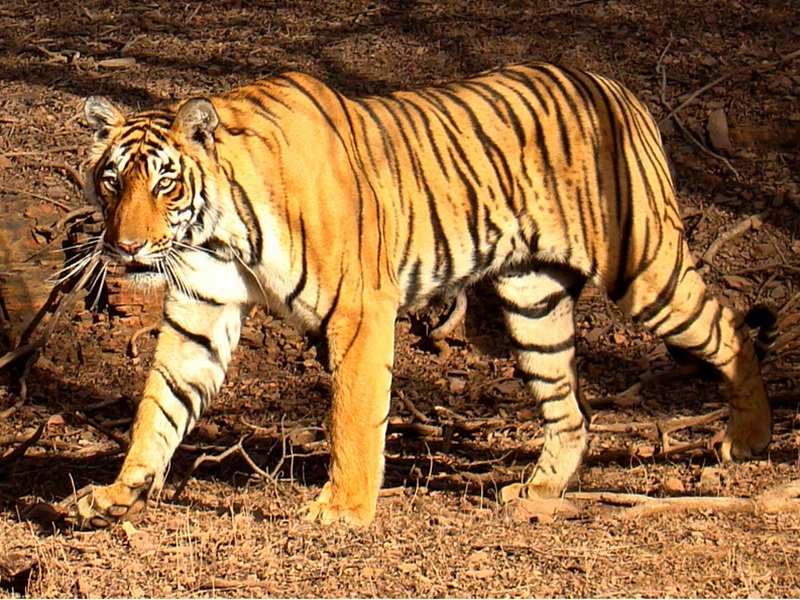


 European Wildcat (Felis sylvestris sylvestris) marking his territory


 ^YAWN^ It's Sunday... time to chill out with the tigers