Thanks to a unique feline blueprint
they're the planet's most successful survivors, reveals a new
documentary
Biologist Patrick Aryee gets up close to lions and tigers
The two-part show also charts their 11-million-year history
Big Cats: An Amazing Animal Family starts on Monday, 8pm, Sky1
By
Nicole Lampert for the Daily Mail
Published:
25 December 2015
They’re
the superheroes of the animal kingdom, the most powerful predators on
the planet whose extraordinary skills have given them valuable
advantages over other animals.
Humans
aside, they’re the most successful survivors on Earth, having adapted
to almost every conceivable environment from the harsh Siberian wilds to
Africa’s scorched savannah.
They
are, of course, cats. And while big cats have long been a wildlife TV
subject, you’ll never have seen a show quite like biologist Patrick
Aryee’s before. Yes, he gets up close and personal with lions and tigers
and talks about their hunting prowess.
Cheetah's in Kenya's Masai Mara Nature Reserve
But
his stunningly filmed two-part show Big Cats: An Amazing Animal Family
also charts their 11 million-year history and explores how the
‘blueprint’ common to them all has made them such survivors.
‘From
tooth to tail, cats are formidable predators with sensory superpowers,’
says Londoner Patrick, who was inspired to become a scientist after
watching David Attenborough talking about big cats on TV.
‘There
are 37 different species but there are certain traits that link them
all. They have excellent vision: in low light it is six times better
than a human’s. They have whiskers that can detect tiny movements in the
air, letting them home in on their prey.
'They’re
nimble; their spines are so flexible they can twist 180°. But what sets
them apart are their weapons; dogs’ claws can become blunt but cats’
are always razor sharp as they retract them when they don’t need them.
And they have a precise way of killing with a deadly bite to the back of
the neck.’
A clouded leopard, the first cat
The
story starts in the rainforests of south-east Asia 11 million years
ago. Scientists believe the clouded leopard was the first cat – and it
still exists today. ‘It’s an ancient predator, almost as much monkey as
cat,’ says Patrick, who sees them in Thailand.
‘But
it has those same attributes that made cats so powerful.’ From here
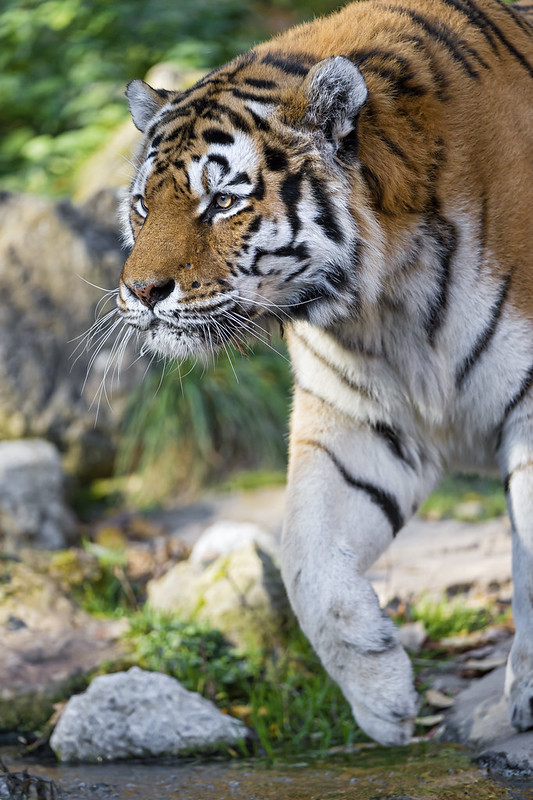
cats moved to the frozen wastes of Russia where today’s huge Siberian
tiger – twice as heavy as tigers in the tropics – can survive in -40°C.
‘Bigger bodies are better at retaining heat while their thick winter
coat and added layer of fat has adapted for life in the snow,’ says
Patrick.
Eight million years ago as land bridges opened up they moved from Asia to Africa, where the majestic lion emerged. ‘They
introduced the idea of a pride, when cats had been solitary creatures,’
says Patrick. He meets Kevin Richardson, a South African who’s part of a
pride – he hunts with them and even cleans their teeth.
Kevin puts
Patrick in a safety cage on the savannah to let him join the pride too.
‘I felt like dinner. The dominant male came so close I could smell his
breath. I was shaking and it was terrifying,’ says Patrick.
During
the Ice Age cats travelled from Asia to America. Patrick meets the
Canada lynx, which has the thickest fur of any cat and huge paws that
act like snow shoes. As the lynx moved on it adapted to each landscape.
In tropical Belize in Central America it became the margay, a treetop
hunter that leaps up to 13ft between branches.
The
puma, also called the cougar or mountain lion, emerged and spread
across California before crossing back into Africa where it evolved into
the cheetah, Earth’s fastest mammal. ‘So the cat renowned for its
lightning speed is an American immigrant,’ laughs Patrick. The cheetah’s
one disadvantage is that it’s small, making it vulnerable to lions and
leopards which target its cubs and steal its prey.
Cats
began to co-habit with humans 10,000 years ago when man started living
in settlements. It was a mutually beneficial relationship; cats kept
rodents away and in return they got warmth, security and a place to
nurture kittens.
‘Humans
have been disastrous for almost every other animal except cats,’ says
Patrick. ‘There are about 600 million domestic cats in the world. That’s
why I’d say, of all the great feline species, the domestic cat is the
majestic culmination of the cat story. It’s the ultimate cat.’
Big Cats: An Amazing Animal Family starts on Monday, 8pm, Sky1.
Perhaps the most popular pet on Earth, the family cat is a beloved
member of countless households. Millions of others abandoned or strayed
are flourishing independently outdoors, where they may pose serious
threats to birds and other small animals. But as familiar as the
house cat is, not many people know it has 38 truly wild relatives,
distinct species that include not only the iconic “King of the Jungle,”
the lion, and the world’s largest predator, the tiger, but also obscure
felids like the flat-headed cat, fishing cat, and oncilla. Wild cats
mostly live in exotic places most of us will never visit, but several
species survive, often covertly, within or around villages and cities in
many parts of the world (Famous Cougar That Was Holed Up Under L.A House Returns to the Wild). “Wild
Cats of the World,” by Luke Hunter; illustrations by Priscilla Barrett.
Published by Bloomsbury Natural History, 2015. Click the cover for more
information.
Cat enthusiasts — and anyone who appreciates wildlife and the wonders
of evolution — will be enchanted by a comprehensive new book that
shares the secrets of the felids. Written by President and Chief
Conservation Officer of Panthera, Luke Hunter, Wild Cats of the World profiles
all 38 known species, illustrated with 400 photographs of the
astonishing variety and beauty of this ancient and widespread family of
carnivores.
Hunter, a committee member of the National Geographic Big Cats Initiative,
published the book to illuminate and teach everyone of all ages about
the diversity of the cats and explain the importance of their
conservation, and how saving them can be beneficial to us.
Felids live in virtually any habitat, from desert to the subarctic,
Hunter said in an email interview with Cat Watch. They have been around
for about 30 million years and have out-lived many other branches in
carnivore evolution which died out in their wake.
LH: Sadly, all the reasons that cats are declining arise from people,
especially the conversion of wild habitats into farmland, pasture and
cities, and the loss of their prey species. Aside from these ‘indirect
threats’, cats are specifically targeted by people for a variety of
reasons. Many species are killed by herders and farmers around the
world, fearing for their livestock; the recent poisoning of lions in Kenya’s famous Maasai Mara Reserve by Masai herders is, unfortunately repeated every day somewhere in the world.
“All the reasons that cats are declining arise from people.”
“If I had to pick a favorite, it would probably be the lion.”
LH: If I had to pick a favorite, it would probably be the Lion. It is
such a formidable animal, there is nothing quite comparable to watching
a pride of lionesses walking across an African plain as they set out on
the hunt; except for healthy adult male elephants, virtually anything
is fair game to a large pride. And their sociality is unique. The fact
that lions are the only cats to live in large extended family groups
makes them a terrific subject for understanding the evolutionary forces
that shape cat behaviour and ecology.
Another great mystery in cat ecology is what happens during
dispersal, when sub-adult cats (typically) leave their mother’s home
range to seek their own range. It’s a critical period in the life of a
cat when many individuals do not make it, especially as dispersal
increasingly takes cats into human-dominated landscapes.
LH: It would be a bleak world indeed. African savannah would be a
tame, sad place without the sound of lions roaring at night. Many of the
world’s ecosystems have lost one or more of the cat species that
historically lived there, and all of them are less intact, less wild in
some way.
“Reintroducing cougars…would be overwhelmingly beneficial for people.”
LH: There is nowhere like iconic African savannah woodlands to see
wild cats, and few places can compete with famous African game reserves
like Etosha National Park (Namibia), Hwange National Park, (Zimbabwe),
Kafue National Park (Zambia) and the Serengeti-Mara complex
(Kenya-Tanzania).
To see less visible cat species requires more effort, but there are
amazing opportunities these days that simply were not possible a decade
or so ago. The Porto Jofre region on the Cuiaba River in Brazil’s
Pantanal during the dry season (August-October) now promises almost
guaranteed sightings of wild jaguars, as well as a chance to see ocelots
and pumas.
India’s Hemis National Park and surrounding valleys are the only
places I know where there is a reasonable chance of seeing snow leopards
in the wild, but only in the winter when wildlife moves down into the
valleys.
It is now possible to spot even the most endangered cat on earth, the
Iberian Lynx; Spain’s Sierra Morena mountains and Doñana National Park
have well-protected populations where the lynx have become fairly used
to tourists. Pages
from “Wild Cats of the World” show illustrations many wild species of
felids. Enlarge the image by clicking on it. Pages courtesy of
Bloomsbury Publishing.What special attributes are there that cats have that would delight and surprise us?
“The cat family…might have more members than we currently know.”
LH: Perhaps one of the most surprising things about the cat family is
that it might have more members than we currently know. During the
writing of this book, geneticists at Brazil’s Universidade Federal do Rio Grande do Suldiscovered
that the species we had long called the Oncilla was actually two,
separate species, the northern oncilla and southern oncilla. Even though
they look very similar, molecular analysis shows they are genetically
distinct and largely reproductively isolated.
LH: Because they often sit on the top of complicated trophic
systems–food webs–large cats can be particularly effective umbrellas for
biodiversity conservation. Cats require large tracts of mostly intact,
wild habitat so the conservation of a population of lions, tigers or
leopards boils down to effectively protecting those landscapes, and thus
all the other species that rely on them.
A forthcoming paper published by Panthera scientists demonstrates this effect in the jaguar. The Jaguar Corridor–a
network of protected areas and human-dominated landscapes connecting
them–turns out to be very effective in also conserving a large number of
co-occurring species, especially mammals.
Conserving cats = conserving millions of other species.
As I explain in the book, if we succeed in conserving robust
populations of cats, we also succeed in conserving literally millions of
other species and the intact, healthy ecosystems that are absolutely
vital to all life–including people.
Luke Hunter is the President and Chief Conservation Officer of Panthera.
Before joining Panthera, Hunter worked for the Wildlife Conservation
Society as the head of their Great Cats Program and he taught wildlife
ecology at universities in Australia and South Africa. Luke Hunter, Panthera, Naybandan Wildlife Reserve, Iran. Photo credit: Frans Lanting/Panthera.At Panthera, he is especially focused on developing and scaling
up solutions to widespread retaliatory killing of big cats by rural
communities, and on improving the protection of wild cat habitat. He
also works on reducing the impacts of legal recreational hunting on
leopard and lion populations in Africa; in the Brazilian Pantanal to
reduce the conflict between ranchers and jaguars; and in Iran on Persian
leopards and the last surviving Asiatic cheetahs.
He has written extensively about wild cats and their
conservation, publishing widely in both scientific journals and popular
media, including for Slate, The Huffington Post and National Geographic.
He has published seven books including Cheetah (2003), Cats of Africa: Behavior, Ecology, and Conservation (2006) and Field Guide to Carnivores of the World (2011), which has been translated into Chinese, French and German editions.
The back of a tiger could have been a blank
canvas. Instead, nature painted the big cat with parallel stripes,
evenly spaced and perpendicular to the spine. Scientists don't know
exactly how stripes develop, but since the 1950s, mathematicians have
been modeling possible scenarios. Now researchers assemble a range of
these models into a single equation to identify what variables control
stripe formation in living things.
This image shows simulations of
Turing stripes. On the left, stripes are evenly spaced, but their
direction is variable. On the right, a signaling gradient has made the
stripes align in the same direction.
Credit: Tom Hiscock
The back of a tiger could have been a
blank canvas. Instead, nature painted the big cat with parallel stripes,
evenly spaced and perpendicular to the spine. Scientists don't know
exactly how stripes develop, but since the 1950s, mathematicians have
been modeling possible scenarios. In Cell Systems on December
23, Harvard researchers assemble a range of these models into a single
equation to identify what variables control stripe formation in living
things.
"We wanted a very simple model in hopes that it would be big picture
enough to include all of these different explanations," says lead author
Tom Hiscock, a PhD student in Sean Megason's systems biology lab at
Harvard Medical School. "We now get to ask what is common among
molecular, cellular, and mechanical hypotheses for how living things
orient the directions of stripes, which can then tell you what kinds of
experiments will (or won't) distinguish between them."
Stripes are surprisingly simple to model mathematically (and much of
the early work on the subject was by Alan Turing of "The Imitation Game"
fame). These patterns emerge when interacting substances create waves
of high and low concentrations of, for example, a pigment, chemical, or
type of cell. What Turing's model doesn't explain is how stripes orient
themselves in one particular direction.
Hiscock's investigation focused on orientation--e.g., why tiger
stripes are perpendicular to its body while zebrafish stripes are
horizontal. One surprise from his integrated model is that it takes only
a small change to the model to switch whether the stripes are vertical
or horizontal. What we don't know is how this translates to living
things--so, for a tiger, what is the variable that pushes the
development of perpendicular stripes?
"We can describe what happens in stripe formation using this simple
mathematical equation, but I don't think we know the nitty-gritty
details of exactly what molecules or cells are mapping the formation of
stripes," Hiscock says. Genetic mutants exist that can't form stripes or
make spots instead, such as in zebrafish, but "the problem is you have a
big network of interactions, and so any number of parameters can change
the pattern," he adds.
His master model predicts three main perturbations that can affect
how stripes orient: one is a change in "production gradient," which
would be a substance that amplifies stripe pattern density; second is a
change in "parameter gradient," a substance that changes one of the
parameters involved in forming the stripe; and the last is a physical
change in the direction of the molecular, cellular, or mechanical origin
of the stripe.
Although this paper is based in theory, Hiscock believes that we are
close to having the experimental tools that can decipher whether the
math holds true in living systems.
Story Source:
The above post is reprinted from materials provided by Cell Press. Note: Materials may be edited for content and length.
Journal Reference:
Tom W. Hiscock, Sean G. Megason. Orientation of Turing-like Patterns by Morphogen Gradients and Tissue Anisotropies. Cell Systems, 2015; 1 (6): 408 DOI: 10.1016/j.cels.2015.12.001
A Smilodon tries to get a better bite on a sloth at the La Brea Tar Pits and Museum. Photo by Brian Switek.
As far as fossil cats are concerned, there is no greater artist than Mauricio Antón. He has a knack for capturing the essence of fossil felids – be it a Homotherium pinning its prey or Dinofelis taking a cat nap – and I love that so many of Antón‘s illustrations feature spots and stripes. The sabercats I saw in books and stop-motion documentaries were never so colorful. They always seemed to wrapped in a relatively plain, dun-colored coat, making Smilodon look like a lion with abnormally-long canines.
Unfortunately, short of finding a frozen sabercat comparable to the steppe lion kittens
announced earlier this year, we’ll probably never know the precise
span of sabercat shades. But maybe we can narrow the field a little.
Today’s cats, both big and small, might be able to help us predict the
presence of spots and stripes in their toothy, extinct relatives.
Today’s cats wear a beautiful array of coat patterns, from plain to
dense constellations of spots and stripes. These different color options
are largely dictated by two genes – Taqpep and Edn3 – the first of
which lays down the general pattern of spots and stripes while the
second controls local color differences, like hair banding. But these
patterns don’t follow family lines. Just have a look at Panthera,
the genus that includes most of the classic big cat species. There are
lions (spots giving way to “plain” coloration), jaguars (large,
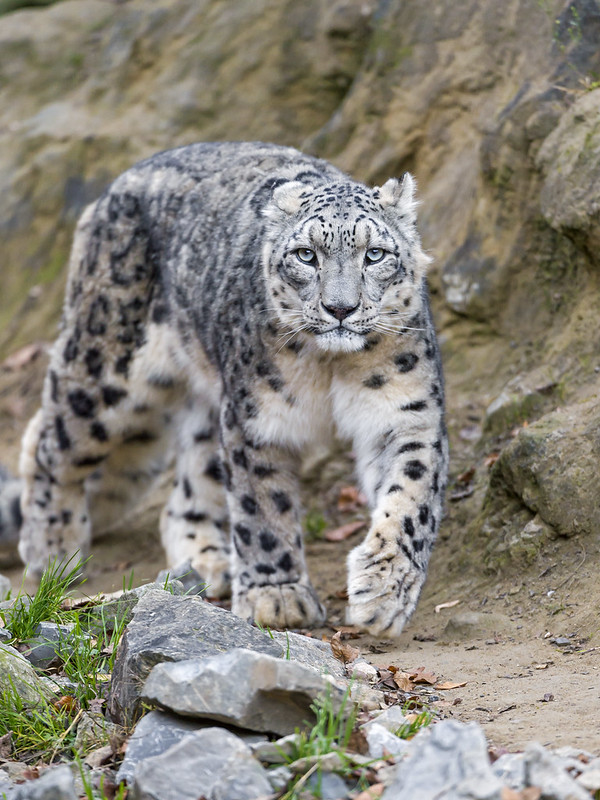
filled-in spots), leopards (large open spots), snow leopards (large open
spots), and tigers (vertical stripes) all within the same genus.
Something else is more important than felid family ties in determining
coat colors, and, in a 2010 study, ethologist William Allen and
colleagues suggested that the answer is “ecology.”
After pulling images of 35 wild cat species from the web – because
what else is the Internet good for other than cat pictures? – Allen and
coauthors analyzed how coat patterns related to different species’
habitat preferences and activity patterns. Cat coats, they realized,
“function as a background matching camouflage.” Cats in open, well-lit
environments are more likely to have relatively plain coats while those
living in forested habitats or active at primarily at night typically
have complex patterns of spots and horizontal stripes.
Cats in open environments, like mountain lions, are more likely to have “plain” coats. Photo by K. Fink.
There are some exceptions to this rule. Cheetahs, servals, and
black-footed cats have spotted coats despite living in the same type
grasslands as lions, while the elusive bay cat has a mostly-uniform coat
despite prowling forests. Maybe these discrepancies have something to
do with “microhabitats” or some sort of behavior not parsed out in the
study, Allen and colleagues wrote, but for the most part a cat’s coat is
more influenced by its ecology than who its related to.
The same probably held true for the sabercats. So while the forest-dwelling Dinofelis would be more likely to bear spots and stripes, Homotherium and other open-country cats may have lost their spots to be less conspicuous out in the grasslands.
So what about Smilodon? The cat is the ambassador for its
long-fanged relatives as well as the Ice Age in general. While we may
never know for sure, places like La Brea – where the sabercat is found
in abundance – suggest that the iconic sabercat frequented shrubby chaparral. If the ecological connection held, therefore, Smilodon may have worn more subdued hues like the modern mountain lions that live in southern California today, or perhaps it was decked in solid spots much like the cheetah, serval, black-footed cat trio in Africa.
Despite its common nickname “saber-toothed tiger”, though, we can be pretty sure Smilodon
didn’t have vertical stripes. Not only are sabercats and tigers distant
relatives, but, as Allen and colleagues found, tigers are the only cats
to have vertical stripes on their flanks. Perhaps the best we can hope
for is that some Pleistocene artisan somewhere was inspired enough by
the fossil cats to record their pelage palette for us to envision as Ice
Age world that we just missed.
SEBRING — Florida set a record
at the end of November: 36 panthers had been killed. Last week, another
milestone was established: the 38th and 39th big cats have met their
end.
The death of a 2½-year-old female and a 6-year-old male
continues the record-breaking trend. The male was found on C.R. 835 in
Hendry County; Florida Fish and Wildlife officials determined last
Tuesday the younger panther was run over by a vehicle near S.R. 82 in
Collier County.
All 39 panther deaths – 28 killed by vehicles – were in
Southwest Florida, where big cats live in the Everglades, Big Cypress
National Preserve and other protected wildlife areas.
None of those big cats died in Highlands County, but Gator
Howerton said Friday there are signs that panther territory is
expanding.
“We hunt coyotes,” Howerton said. “We may have seen one panther a couple of times.”
A rancher northeast of Sebring has lost several calves, and Howerton was asked to assess why.
“We’ve never able to determine what it was,” Howerton said.
“It was something bigger than a coyote. Maybe a bear, maybe a panther.
But if it was, there’s nothing we could do about it. They are
(federally) protected.”
Howerton thinks panthers are moving north into Highlands
County: “I have seen tracks, seen photos. They are tracking all around.”
For ranchers and hunters, that’s bad sign. For
environmentalists and conservationists, it’s good, Howerton said. “We
want to keep it natural and wild. We don’t want to see an imbalance.”
The nearest panther death to Highlands County appears to a
3-year-old known to researchers as K387, who died on State Road 29 near
Pollywog Road in Glades County the day before Thanksgiving.
Last year, 34 panthers were killed in Florida, compared to 20
the year before. In the three years before that, the numbers ranged from
24 to 27, commission statistics show.
“This is an all-time record for the most documented panther
kills in one year, and now we’re close to an all-time record for cats
killed by cars,” Jennifer Hecker told the Tampa Tribune. She directs
natural resource policy at the Conservancy of Southwest Florida, an
environmental group that seeks to protect Florida wildlife and its
habitat.
Although state officials maintain the mortality trend is in
direct proportion to the increase in the panther population, Hecker
argues more panthers are dying because of the loss of habitat. As more
people squeeze into the wilds of Southwest Florida, more roads are being
built and more panthers try to get to new habitats, she said.
It’s not a good combination, Lisa Stoner of Forest Animal
Rescue agreed. She and her husband, who have rescued 20 wild cats over
the years, recently moved their wildlife rescue organization from
Wauchula to Silver Springs in 2013.
“A few rogue males travel through Hardee County,” Stoner said.
But she contends there are no breeding pairs in Highlands and Hardee.
Admittedly without documentation, Howerton disagrees. He believes a few
mates may live near the Avon Park Bombing Range.
“They’ve been trying to build underpasses for the highways,”
Stoner said. But unchecked development is giving panthers – whose
territory ranges for 200 miles – no place to go.
“They are taking habitat from the animals,” Stoner said. “We keep building and expecting animals to go around.”
Animals don’t look for “Panther Crossing” and “Bear Crossing”
signs, Stoner said. “If we put underpasses a half a mile down the road,
they are not going to walk parallel to the road and cross.”
Instead, Stoner said, builders need to determine where animal
trails currently are and put underpasses at those points. Builders are
required to include sewers, water lines and other amenities, she said.
They should also be required to construct wildlife underpasses where
necessary.
THE days of lions killed for kicks by wealthy trophy hunters finally look numbered.
By
Stuart Winter
GETTY
President Obama backs big cats
President Barack Obama is giving the big cats more protection in the wake of the notorious slaughter of Cecil the lion.
America
is upgrading the legal status of lions that will stop hunters from
trying to ship heads, claws and skins back home after a safari at a time
when numbers of the iconic animal are plunging.
There are fears the so-called King of the Beasts could vanish from the wild before the end of this century.
FACEBOOK
Walter Palmer and his hunting friend pictured with Cecil
Conservationists
say Americans are responsible for 60 per cent of all lion hunts in
Africa, but until now they have not needed a permit to bring home a lion
trophy they have killed overseas. The White
House's move to strengthen the US Endangered Species Act will not only
put two types of lion on a new legal footing but will also ban hunters
who have broken wildlife laws in the past from importing trophies..
If we do not act on this crisis now, lions could disappear from the wild in our lifetime
Dr. Philip Muruthi
This will wound
hunters such as Cecil's killer Walter Palmer, the Minnesota dentist who
shot the black-maned lion with a bow and arrow during the summer. He
had pleaded guilty in 2008 to making false statements to the US Fish
and Wildlife Service about a black bear shot outside an authorised
hunting zone.
Officially, the Fish and Wildlife
Service are cautioning against linking the new orders with Cecil's
death, describing the action as a redoubling of efforts to ensure that
violators of wildlife laws do not benefit from importing wildlife
products.
Key to protecting lions is the way the
Obama administration has changed the animals' status under US law so
that one subspecies found in western and central parts of Africa and
genetically related to the Asiatic lion, numbering as few as 900
individuals, is now classed as endangered. This is the same footing as tigers, giant pandas and rhinos.
A second subspecies with a population as low as 17,000 animals and found in southern and eastern Africa is listed as threatened. In
short, this means a permit for importing a trophy or live animal for
the endangered lions will only be granted it aids survival.
For
threatened lions, the proviso for a permit is that any imports must
come from nations with sound conservation and use trophy hunting revenue
to sustain lion numbers and deter poaching.
British-based charity LionAid tonight welcomed the US moves. A
spokeswoman said: "The listing of African lions by the USFWS is a
welcome step forward for lion conservation. For the first time, lion
trophy hunting will be assessed as to whether it has a positive impact
on the conservation of the species.
AP
Cecil the lion
"Equally, it will not only be information from the lion range states that will be required: verification will be demanded. LionAid
believes that these stricter rules imposed on US trophy hunters, who
currently are responsible for over 60 per cent of African wild lion
hunts, will have a significant positive impact on lion populations which
have for far too long been hunted without due care to a species already
in catastrophic decline."
The African Wildlife Foundation also applauded Washington's measures. Dr.
Philip Muruthi, African Wildlife Foundation's vice president of species
protection, said: "This is a welcomed move by the US government and one
we hope will give some relief to Africa's lions, which face many
threats.
FACEBOOK
Zimbabwe authorities decided not to charge Palmer for the killing "If
we do not act on this crisis now, lions could disappear from the wild
in our lifetime, and that would have disastrous consequences."
AWF
chief executive Dr Patrick Bergin added: "We simply cannot afford
additional human-caused mortalities, which is why we are against the
sport hunting of lions. "A large percentage of
all lion trophies are imported into the US by American hunters. Both the
US government and American hunters have a responsibility to ensure
sport hunting does not negatively impact wildlife populations in
Africa."
About 600 stray and pet dogs in 13 villages in the buffer zone of the reserve now sport an identity collar around their necks.
Written by Milind Ghatwai
| Bhopal |
Published:December 22, 2015
A week from now, teams will fan out in the villages and trace the same
dogs to administer a booster dose to neutralise chances of the canines
contracting, and, more importantly, passing on the deadly diseases to
the big cats.
Vaccination of dogs has become a priority for Panna Tiger Reserve,
that rose from infamy to script a turnaround by successfully
reintroducing the wild cats.
About 600 stray and pet dogs in 13 villages in the buffer zone of the
reserve now sport an identity collar around their necks. This is proof
that they have been vaccinated for eight diseases like canine distemper
and rabies.
A week from now, teams will fan out in the villages and trace the
same dogs to administer a booster dose to neutralise chances of the
canines contracting, and, more importantly, passing on the deadly
diseases to the big cats.
The 600 dogs, most of them stray, were chased and netted over the
last fortnight by teams of five volunteers who collected blood samples,
vaccinated them and put collars on them for easy identification.
The vaccination drive, which has made some dog owners doubtful and
suspicious of the motive, was triggered by the death of a tiger in
August due to canine distemper virus.
Dr Sanjeev Kumar Gupta, the veterinary doctor at the reserve, told The Indian Express, “We are appealing to villagers for cooperation.”
There are 150 villages in the reserve’s buffer area.
(Left) Forest officials on the trail of a tiger in Kawal Tiger Reserve
in Adilabad district. (Right) A tiger at KTR.- Photos: By Arrangement
The arrival of a couple of wild cats within a span of three months
at the Kawal Tiger Reserve (KTR) in Adilabad district has already had
conservationists raising toasts.
It should be renamed as Kamal Tiger Reserve,” suggested an excited
tourist at the Kawal Tiger Reserve (KTR) in Adilabad district as he
animatedly discussed about the trend of tiger influx in the park.
The arrival of a couple of wild cats, a male and a female, within a span
of three months has already had conservationists raising toasts.
“More tigers will come as they feel safe here,” predicted KTR wildlife
researcher Jogu Yellam. “A lot of effort has gone into strengthening
anti-poaching activity,” he stated, giving reasons for tigers to arrive
at KTR in the coming months.
There is also the talk of urgency in developing tiger tourism even as
conservation efforts are strengthened at the facility. “Kawal should
soon become an ecological paradise and tiger tourism here should rival
the one at Tadoba Andhari Tiger Reserve in the neighbouring Chandrapur
district of Maharashtra, if not improving upon it,” observed K. Ashwin
Rao, a realtor from Hyderabad, also a well known eco-tourism enthusiast
from Hyderabad.
Even those who are not die hard wildlife enthusiasts are likely to
welcome development of tiger tourism at the place which is evident from
the excitement of Srinivas Reddy, a medicine and drug store owner from
Karimnagar.
He became the first tourist to have sighted a tiger in the wild from the
safari jeep on which he was moving in the jungles on December 20.
“The government should look into this aspect seriously as there is a lot
of potential for tiger tourism at KTR,” stated Mr. Rao from his
experience of the park.
“The management of the place should be professional, locals should be
trained to become naturalists before incorporating them in the scheme of
things,” he suggested some of the measures.
The conservation enthusiast also underlined the need for sensitising
tourists about some of the finer aspects of eco-tourism. The eco-tourism
enthusiast drew underscored the need for people maintaining silence and
refraining themselves from polluting the area.
“We have plans of increasing protection for the tigers and a Tiger
Protection Force unit has been sanctioned for Kawal,” revealed KTR’s
Jannaram Division Deputy Director B. Ravinder.
“In view of the vulnerability of the big cats, we will monitor the
movements of visitors too,” he added, while giving details of the
conservation plan.
KTR should soon become an ecological paradise and tiger tourism should
rival the one at Tadoba Andhari Tiger Reserve in Chandrapur district of
Maharashtra, if not improving upon it.
This petition made change with 1,358,111 supporters!
Dec 21, 2015 — Today
has been a historic day for lions. Our voices have been heard and USFWS
has listed two subspecies of lion as endangered and the rest as
threatened. Although we want to see ALL lion listed as endangered this
is a perfect starting point.
Thank you to each and every one of you that signed this petition and for speaking out against lion trophy hunting.
Cecil
did not die in vain. Because of him the world has opened their eyes to
the horrors of lion trophy hunting and change is being made. We will
forever be indebted to him.
"According to Adam M. Roberts, CEO of
Born Free USA and Born Free Foundation, "It has been a very long four
years waiting for this decision, with each year seeing more lions
slaughtered by hunters for trophies. This is a victory and we applaud
USFWS for agreeing that these animals deserve significant international
protection under the ESA: popularly considered one of the world's most
important conservation laws. There is now hope for future generations to
be able to witness the beauty of the lion in the wild."
The proposed “Catbridge” would be festooned with demonic-looking felines.
John Metcalfe
12.22.2015
Peter Shelton
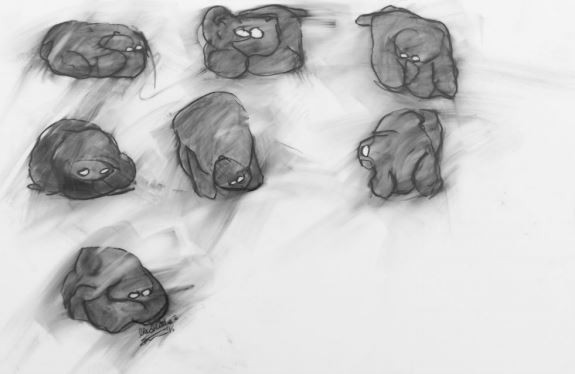
People afraid of cats might vigorously oppose this planned public artwork in San Francisco, as it’s populated with mutant felines whose peepers gleam in the dark.
The “Catbridge,” designed by L.A. sculptor Peter Shelton,
would appear on a downtown overpass as part of a convention
center-expansion project. It’s one of three finalists vying for
acceptance in early 2016; the other two feature objects that look like “simple freehand drawings” and “ocean encrustations,” respectively.
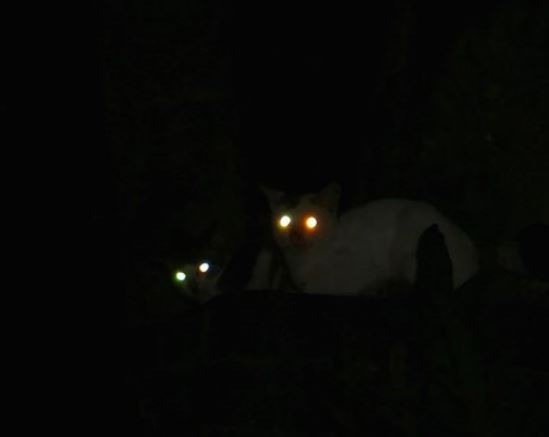
But let’s get back to the cats. In his proposal, Shelton explains he was inspired by the two-faced Roman god Janus and “kitties in the night” such as these: Here’s more from the artist:
For the Howard Street Bridge, I propose to render five to six
pedestal mounted cast bronze sculptures based on the abstracted forms of
cats. The cat is the consummately adapted urban animal that is as much
a part of the day scape and as of the night.
I envision these cat forms on pedestals roughly two feet in diameter.
The eyes of these cats would light up at night in keeping with the
concept of the multi-facing Janus figures of antiquity. These cats would
have at least two faces and two sets of eyes facing in both directions
of the bridge.
The glowing eyes of the cats would lead us up and over the otherwise
darkened bridge. It is important that the experience of the sculptural
installation is as credible and poetic during the day as it is at night.
It’d be worth getting this thing built if only to see the
neighborhood’s actual cats perform 10-foot vertical leaps of fear. Check
out these drawings: source
by Mindy Weisberger, Senior Writer | December 21, 2015
African lions will now be protected under the Endangered Species Act, announced today by U.S. Fish and Wildlife Service officials. Credit: Heidi Ruffler / USFWS
Two lion subspecies will now be protected by the Endangered Species
Act, the U.S. Fish and Wildlife Service (FWS) announced today (Dec. 21).
Panthera leo melanochaita, a lion subspecies living in eastern and southern Africa, will be listed as threatened, while Panthera leo leo,
a subspecies found in western and central Africa and in India, will
receive endangered status, FWS officials said. New genetic data prompted
the agency to recognize western and central African lions as subspecies
P. leo leo, and spurred their"endangered" classification.
"Subspecies" defines groups within species that are genetically
distinct but still capable of interbreeding. A 2014 proposal had
prompted the FSW to grant the western and central African lions
"threatened" status. But according to today's FSW announcement,
scientific information indicated that lions in those areas were actually
more closely related to Asiatic lions and that they should be
identified as such — P. leo leo. [In Photos: A Lion's Life]
And because P. leo leopopulations are significantly smaller than P. leo melanochaita, the agency determined that "endangered" status was more appropriate for the group. Only 1,400 P. leo leo individuals remain in the wild — about 900 in 14 African groups and around 500 in India. P. leo melanochaita's numbers are more reassuring, with an
estimated 17,000 to 19,000 animals living across southern and eastern
Africa, mostly in protected areas. That may seem like a lot, but
estimates of lion populations in the mid-20th century placed them at
around 200,000 individuals, FWS Director Dan Ashe said today at a news
briefing. Ashe went on to add that the expansion of human populations
and activities will only continue to threaten the lions and their habitats.
Established in 1973, the Endangered Species Act (ESA) was signed into
law to conserve species and their habitats by identifying which species
are most vulnerable to extinction
and enforcing policies to protect them. The U.S. agencies administering
the ESA are the U.S. Fish and Wildlife Service, which is primarily
responsible for plants and animals on land and in freshwater bodies like
rivers and lakes, and the National Ocean and Atmospheric
Administration's National Marine Fisheries Service (NMFS), which
oversees marine wildlife.
Under the ESA, species are listed as "endangered,"
which describes "any species which is in danger of extinction
throughout all or a significant portion of its range," and "threatened,"
identifying "any species which is likely to become an endangered
species within the foreseeable future." A 2013 list published by the FWS
identified 2,054 species worldwide as endangered or threatened, of
which 1,436 are native to the United States.
In a statement, the FWS cited decades of alarming and continuous
decline in African lion populations as one of the chief reasons for the
status change. Factors identified as the biggest threats to lions included habitat loss
due to agriculture, killings to prevent or retaliate against lions'
preying on livestock, and inadequate management of protected areas.
In July 2015, the death of the African lion "Cecil"
at the hands of an American hunter sparked waves of outrage across
social media channels, along with calls for stronger conservation
measures to protect African lions. During today's news
briefing, Ashe said that, while hunting is not responsible for the
recent sharp decline of African lion populations, steps must be taken to
ensure that revenue from hunting provides economic support for lion
management and conservation efforts.
Beginning in 30 days, the U.S. import of any live lion specimen,
products or hunting trophies will require a permit issued by the FWS,
Ashe said. During the application process, the agency will determine
whether the activity in question contributed to the enhancement of the
species in the wild. Tying economic gain to lion conservation, Ashe
said, would also encourage local communities to engage in developing
sustainable solutions for Africa's lions. Otherwise, "people will
continue to see them as a threat," he said, "and not a benefit."
The ESA ruling will be added to the Federal Register on Dec. 23, 2015, and will go into effect on Jan. 22, 2016.