Dhaval Shah, 30, was unfazed when the four cheetahs leapt on to the car
Shah and friend Upesh Mungra posed calmly with the family of African cats
Duo from Jamnagar in India described experience as 'exciting and scary'
By
Georgia Diebelius For Mailonline
Published:
24 November 2015
A quick-thinking photographer took a self paw-trait of himself and a family of cheetahs when they jumped on a car.
Dhaval Shah, 30, was unfazed when the four cheetahs leapt onto the jeep he was in with close friend Upesh Mungra, 31.
The pair watched as the big cats clambered on top of the car in the Masai Mara, Kenya.
Upesh Mungra (left) and Dhaval Shah (right) started taking their selfie photos with the cheetahs in Kenya
Close up photos taken of the cheetahs
show the moment that one of the cubs stood next to its mother, Malaika,
five, and licked its lips as it approached the pair
Clement Mwangi takes photos of Dhaval Shah and Upesh Mungra taking their selfie photos with the cheetahs
They both posed calmly with the animals and snapped away while cautiously moving behind them, just centimetres away.
One of the cubs stood next to its mother, Malaika, five, and licked its lips as it approached the pair.
Mr Shah, from Jamnagar, India, wearing a blue t-shirt in the pictures, said: 'We were lucky the cheetahs didn't bite us.
'It was amazing experience, a life time experience we couldn't even imagine because we were so close to Malaika and her cubs.
'It was very exciting and scary too but we loved it.'
The quick-thinking photographer took a self paw-trait of himself and the family of cheetahs when they jumped on the car
Shah was unfazed when the four cheetahs leapt onto the jeep he was in with close friend Upesh Mungra
Mr
Shah, who imports brass scrap from the UK and US, added: 'The cheetahs
were just six inches away from us, we were planning to touch them but we
were scared.
'They were sitting on top of the car for around 20 minutes, and we spent our time taking up to 50 pictures with them.
'We were on our first Masai safari and I would love my family and friends to experience it too.'
He was in the car with Mr Mungra, from Jamnagar, India, who was wearing the yellow shirt and also imports brass scrap.
And
in another set of fantastic photographs, Clement Mwangi, 35, captured
the fantastic moment the sun set with the cheetahs on the car.
The pair watched as the big cats clambered on top of the car in the Masai Mara, Kenya
They both posed calmly with the animals and snapped away while cautiously moving behind them
Mr
Mwangi, from Nairobi, Kenya, said: 'This specific evening was my second
day
out of seven and we had gone looking for any big cats to shoot with
the evening light.
'You don't always find what you are looking for, but I was lucky to stumble across this family of cheetahs.
'They like to climb on top of the cars for a better vantage point.
'On
this occasion they climbed on top of a vehicle with very brave men
inside, who decided to take a chance and take selfies with them.
'The
family is a mother called 'Malaika' - which is a swahili word meaning
'angel' and her three children. They are about two years old while their
mother is five years old.
'They
were keeping to their business of scouting the plains. They were
curious because we were right there, but not very bothered.
'It lasted about 35 minutes then they moved on after the driver switched on the engine and they jumped off the car.
'It was amazing, I wanted a good set of photos of big cats with the evening sun and I managed to get them.'
Mr Shah, who imports brass scrap from
the UK and US, added: 'The cheetahs were just six inches away from us,
we were planning to touch them but we were scared'
Shah said: 'It was amazing experience,
a life time experience we couldn't even imagine because we were so
close to Malaika and her cubs'
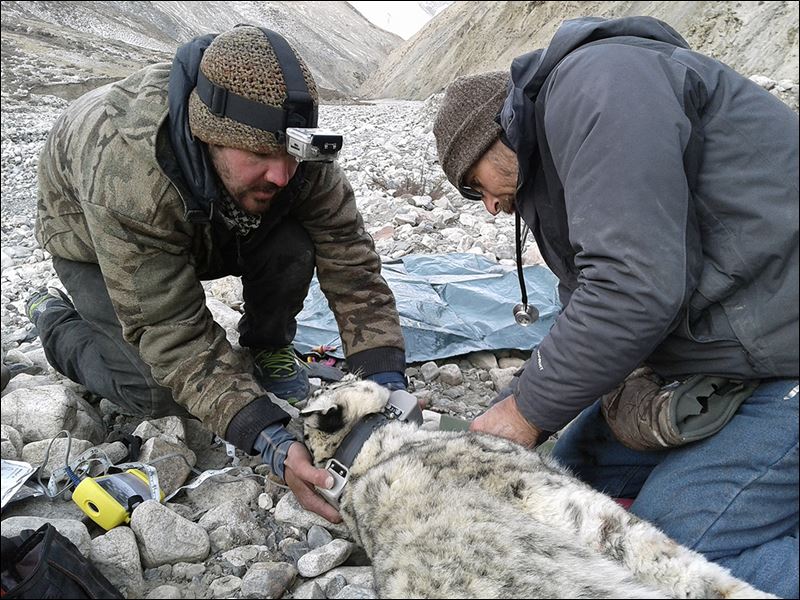
Shannon Kachel, left, the study’s principal investigator, and Ric
Berlinski, Toledo Zoo senior veterinarian, radio-collar at snow leopard
in Kyrgyzstan through a Panthera-supported conservation study.
A Toledo Zoo veterinarian is still giddy after participating in a
landmark conservation research effort with a notoriously elusive big
cat.
Dr. Ric Berlinski, senior staff veterinarian, recently returned from
eastern Kyrgyzstan in central Asia, where he helped trap a wild female
snow leopard and fit a GPS collar on her. She was the first ever to be
collared in the country, and one of only about 35 to ever be tracked.
“They live in some of the harshest environments you could think of a predator being in,” Mr. Berlinksi said.
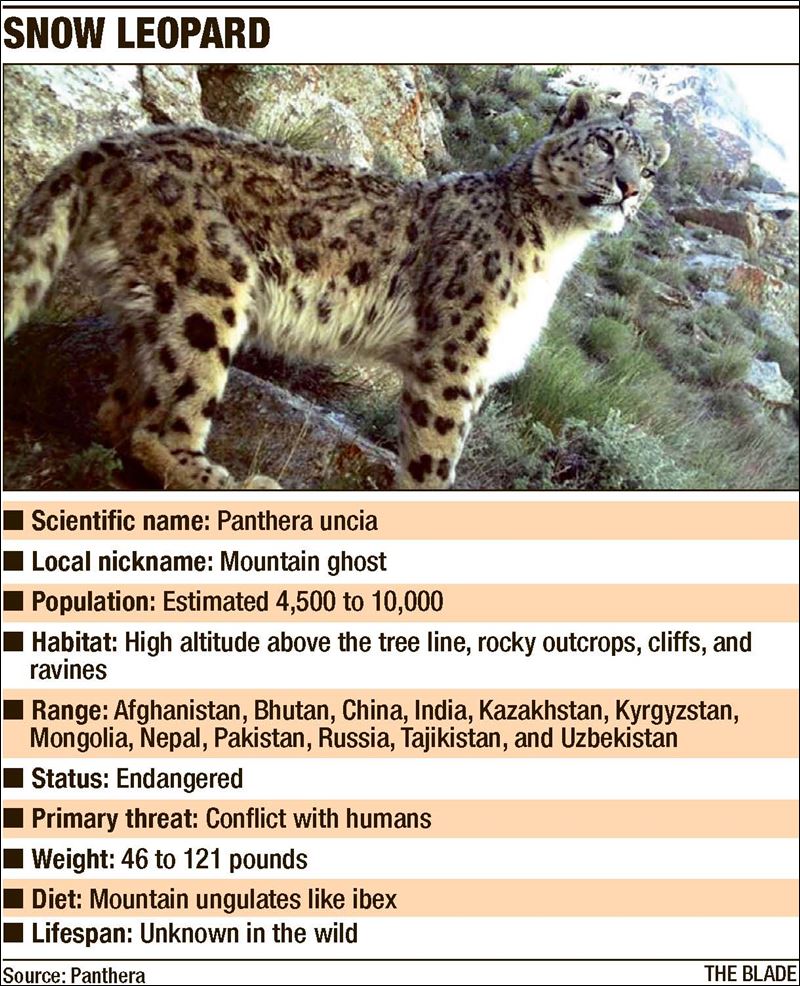
The endangered, solitary cats live at high altitude above the tree
line on rocky outcroppings and cliffs. Their superb camouflage and
secretive nature make them extremely difficult to find. Many locals have
never seen one and refer to them as “mountain ghosts.”
Dr. Berlinski said previously collared snow leopards were humanely
snared in areas near human settlements, primarily in Nepal, Afghanistan,
and Mongolia. The human-wildlife conflict changes the cats’ behavior,
most notably as they hunt readily available domestic sheep and goats.
“The study area we were in is very, very remote,” he said. “We have
snow leopards in their natural environment without that
human-encroachment factor, so we see a more natural pattern as to what
their range is and how they are obtaining their prey. It makes it very,
very valuable information.”
Jeff Sailer, executive director at the zoo, said the effort is an
example of the zoo’s dedication to preserving wildlife around the world.
“It’s a great opportunity for us. We’ve been known for our
international conservation work for decades,” he said. “It helps
reinforce our mission, which is conserving wildlife and connecting
people with wildlife.”
The veterinarian was invited to be one of three members of the
research team sponsored primarily by Panthera, an international
conservation group dedicated to big cat species. He traveled to the
Sarychat-Ertash State Nature Reserve in the Tien Shan mountains from
Oct. 5 to Nov. 5.
The team’s base camp was set in a valley at an elevation of 8,500
feet. Ten humane snares, fitted with transmitters to signal an animal
capture, were checked in person daily and monitored from base camp every
hour around the clock.
Dr. Berlinski was on duty monitoring the signals at 5 a.m. Oct. 26 when he heard the rapid beep indicating a capture. “My heart rate just took off,” he said. “Of course, she was in the highest snare we had set.”
The team made the arduous hike up to 11,000 feet where the snare had
captured a vibrant and healthy female estimated at 6 or 7 years old. Dr.
Berlinski was in charge of safely darting her, performing a physical
exam and drawing blood, then reversing the anesthetic and watching from a
safe distance to ensure she recovered. “I saw her get up and she was still a little wobbly,” he said. “I
snuck up again, and peeked over and she was crouched down looking at me.
At soon as she saw me, she was gone.”
The veterinarian said locking eyes with the leopard was both
thrilling and unnerving. Snow leopards are one of the smaller of the big
cats, but also one of the most powerful. “The one description I always give is that they are fluid power, and total defiance,” Dr. Berlinski said.
He noted he gets the same look from the Toledo Zoo’s female snow leopard. “If you’re standing in front of our exhibit and she locks eyes with
you, I’ll guarantee you that’s the same feeling I had when I locked eyes
with the wild cat,” he said.
The team named the wild cat Appak Suyuu, meaning “true love” in
Kyrgyz. In the few days the team had left after collaring her, the group
was able to track the cat and determine from footprints she was caring
for three cubs. “They’ll have one, maybe two, and out of those two, one will live
through the first year of its life,” he said. “For her to have three
that were between what we estimated at 16 to 18 months of age based on
paw size is incredible. That tells you she is one of the dominant
predators in the area.”
The group already knows that she and her cubs have traveled 20
kilometers, or about 12.4 miles, at 14,000 feet in a single 24-hour
period.
The collar should last 20 months before falling off. Being able to
track Appak Suyuu may allow researchers to recapture her before time
runs out and fit her with a new collar to collect additional data.
Despite the difficult conditions and even after experiencing
hypothermia, Dr. Berlinski said he would jump at the chance to do it
again. “The 40 or so minutes I got to spend with that cat made every second
worth it,” he said. “That was one of the most beautiful and remarkable
experiences I’ve ever had. I’d do every second of it over again.”
A centuries-old industry has come to an end: commercial bobcat trapping is no longer allowed in California.
As of Friday, recreational and commercial bobcat trapping is no longer allowed in California, ending a century-old industry.
Conservationist
Tom O’Key could not be happier. The law grew out of the grass-roots
fury of thousands of residents across the state over his discovery in
2013 of a bobcat trap set on his property near the edge of Joshua Tree
National Park.
On Saturday afternoon, O’Key hiked out to the site with a few cold beers to reflect on the accomplishment.
“For
the first time in history, there’ll be no bobcat trapping in
California,” he said in an interview. “That’s because people worked
together in the spirit of doing something right.”
O’Key
said he stumbled across the trap chained to a jojoba bush
and camouflaged with broken branches just north of the 720,000-acre
park, where the native cats are a dominant force of the ecosystem.
He
immediately alerted neighbors and contacted the San Bernardino County
Sheriff’s Department and newspapers, which triggered an angry tide of
complaints that focused attention on the practice of trapping, killing
and skinning bobcats to supply fur markets in China, Russia and Greece.
Assemblyman
Richard Bloom (D-Santa Monica) introduced AB 1213 -- the Bobcat
Protection Act of 2013 -- in response to petition drives, social media
campaigns and telephone calls to lawmakers from wildlife advocates who
decried it as a cruel trade.
In August, the California Fish and Game Commission voted 3 to 2 to eliminate bobcat trapping statewide for two reasons.
The
estimated 100 commercial bobcat trappers in the state could not afford
to pay the full cost of regulating the industry as required under the
Bobcat Protection Act. In addition, the commissioners could not
determine whether trapping jeopardized the species because they had no
current scientific data on the health of the state’s bobcat populations.
The regulations became effective on Friday – three days before bobcat hunting season had been scheduled to begin.
Now,
it is unlawful to trap any bobcat, or attempt to do so, or to sell or
export any bobcat or part of any bobcat taken in the state. Any holder
of a trapping license who traps a bobcat must immediately release it to
the wild unharmed.
In
addition, state wildlife authorities will no longer mark bobcat pelts
for personal use or issue shipping tags for commercial sale of bobcat
pelts taken in California.
Brendan Cummings, a resident of Joshua
Tree and public lands director for the Center for Biological Diversity,
described the new law as “a great moment in history. Fifteen years into
the 21st century, state wildlife management has finally entered the 20th
century.”
But O’Key was more impressed with the power of public pressure on behalf of a species.
“Anyone
who lifted a finger in defense of this animal over the past two years
ought to be mighty proud about that,” he said. “I know I am.”
Auto
accidents, rodenticides and shrinking habitat are killing urban cats
that largely occupy an area surrounded by highways and development, but a
proposed wildlife bridge could offer promise
By Adam Popescu on November 23, 2015
Liberty Canyon. Credit: Adam Popescu
Last
August, driven by the instinct to establish his own territory and find a
mate, P-32, one of only a handful of male mountain lions left in the
Santa Monica Mountains, navigated three freeways before being struck and
killed by a vehicle, the 13th lion to die on a highway in the area
since 2002.
There’s only around a dozen lions left in the Santa Monica Mountains,
the range running from the Pacific Ocean through Los Angeles, America’s
second-largest metropolis. The area cats are trying to escape because
they’re trapped on an island of habitat,
fenced in by freeways, hostage to urban development and isolated from
the rest of their population. The last documented fresh blood entered
the area in 2009, when a single male successfully crossed the U.S. 101.
That male mated once, and introduced much-needed fresh genes.
An adult male’s home range can extend over 500 square kilometers. The
Santa Monicas encompass about 700 square kilometers. There’s simply not
enough land for each of the several males left to establish new
territory and find mates and therefore not enough fresh genetic material
to keep this population stable.
To further complicate matters, inbreeding, lions killing one another
over territory and for mates and rodenticide from eating animals
infected by poison are also destroying their population. Sure, there are
neighboring mountains with viable lion populations—the Santa Susana
Range to the north, which borders Los Padres National Forest and Angeles
National Forest to the east—but they might as well be on the moon,
because lions can’t cross the freeway and simply can’t get in. NPS field biologist Jeff Sikich setting up remote cameras at a deer kill site. Credit: Adam PopescuHiding in plain sight
The kill was only a around 100 meters from the road, but you wouldn’t
know it from driving by. The scene was shrouded by a patch of bay trees
and thick chaparral, up a steep incline that weaved into a drainage,
muddy from just a few centimeters of rain the night before, the first in
months. There wasn’t much left of the victim—a young mule deer. Just
the head, hooves, entrails, an exposed rib cage and a patch of gray fur
that its killer licked off with a bristled, sandpaper-textured tongue.
With the incident captured on camera, the culprit’s identity was
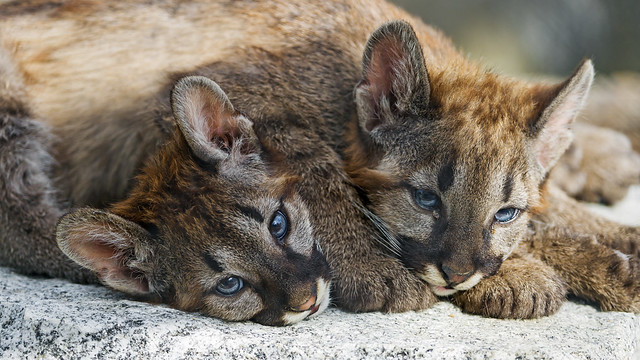
indisputable. “A female mountain lion with a cub,” says Jeff Sikich, a
National Park Service (NPS) field biologist who’s spent the last 13
years studying lions in the Santa Monicas.
Sikich, renowned for humane capture techniques, and a career that’s
included jaguar, leopard and tiger tracking, used the cats’ GPS radio
collar signature to pinpoint their position, and remote cameras to
capture the feeding. Popping the camera’s memory card into his laptop,
he rifled through images from the night before: a kitten with
leopardlike spots, centimeters from the camera. And its mother,
displaying muscled front shoulders and powerful limbs adapted for
running down big game. Her sculpted and proportioned body
counterbalanced by a long tail. All motion, grace, speed and strength.
Just because we don’t see lions doesn’t mean they don’t walk in our
midst—or that they don’t see us. Large, close-set eyes give them such
sharp depth perception that these ghost cats can gauge the exact
distance of any prey, even of humans.
Once these lions roamed our very backyards, the hills we jog, the
city itself. Now the Santa Monica lions, the only apex predator
operating within a megacity, live on borrowed time. “They’re looking for
a way out,” Sikich says. “Especially young males. Out of all the young
males we’ve followed in the Santa Monicas, and I think there’s been 16,
none have lived to the age of two. All have been killed either by being
hit on a freeway or running into the adult male in the Santa Monicas.”
Being trapped in a small area is also the source of anomalous behavior,
with fathers mating with daughters and granddaughters, and repeatedly
killing of relatives with dominant males slaying sons and brothers.
Normally, males kill cubs to bring their mothers back into estrus. But
it’s rare for them to kill their own offspring. Here, this incestuous
tragedy is common.
Sikich estimates the carrying capacity for the region south of the
U.S. 101, where his lions are trapped, is “one or two adult males,
roughly four to six adult females and kittens, 10 to 15 tops,” numbers
that “genetically cannot sustain a population in the future without
connectivity to areas in the north, across the freeway.” Sikich doesn’t
mince words when he says this group will die if something doesn’t change. Jeff Sikich retrieving images from the deer kill site. Credit: Adam PopescuConnecting urban wildlife
Genetic diversity among the Santa Monica cats is the lowest of any lion
population in North America, except for the Florida panther. The
precedence is troubling. In Florida decades of inbreeding led to
reproductive failure. Lions from Texas were introduced to buoy that
population, which has since stabilized. But biologists here have likened
translocation to a Band-Aid. Yes, there’s enough game to support local
lions, and despite being on our doorstep, ample habitat to keep them
here; Sikich says there’s no evidence that they’re even turning pets
into easy meals. The issue is that they’re stuck.
With no new DNA, the
clock’s ticking into the ultimate signs of inbreeding: sterility.
“Without increasing connectivity and building wildlife crossings,
mountain lions are definitely going to be lost here,” says wildlife
ecologist Seth Riley with the National Park Service at Santa Monica
Mountains National Recreation Area, who has led the NPS mountain lion
study since it began in 2002. Riley’s talking about the proposed
crossing at Liberty Canyon, a safe passage in an undeveloped stretch of
101, near Agoura Hills. The plan is to build a bridge between natural
habitats on both sides of the freeway. It’s been done in Montana and
Canada, but never on this scale—never over 10 lanes of pavement.
Liberty Canyon is ideal because it’s the most direct path between the
surrounding mountains, and GPS data has shown lions frequent the area.
This bridge will benefit other species, as well: bobcats, deer,
reptiles, all have shown genetic differentiation between populations
separated by freeways.The vision is in place. The
issue is cost. “It is expensive,” Riley admitted as cars whizzed by on
one of the world’s busiest thoroughfares—175,000 vehicles a day.
“Estimates are $30 million to get across 101, and then $50 million,
which would be the best thing, to cross 101 and a road right nearby.
Certainly a lot, although in the context of what it costs to do
transportation projects, it’s actually not that much.”
Earlier this year, the project received $1 million in state funding.
And the plan’s building support.
CalTrans, the transportation bureau
responsible for all state roadwork, and a coalition of local politicians
and 501(c)(3) nonprofits have teamed to search for financial backing.
But the biggest advocate could be a 46-year-old fundraiser with a
15-centimeter puma tattooed on her left bicep. Although NPS can’t lobby
for funds directly—they establish the need with research—she can.
Beth Pratt-Bergstrom is the National Wildlife Federation’s California director, and the founder of Save LA Cougars.
To hear her tell it, she’s “not your average tree hugger. I have an
MBA, I’m all about capitalism and the value of things. For too long we
haven’t incorporated the cost of maintaining healthy ecosystems and
wildlife, and this is a pretty cheap solution.”
Although it’s hard to equate such sums with frugality,
Pratt-Bergstrom has a tested plan: a combination of private
philanthropy, plus state and federal dollars already earmarked for
conservation. Which means it won’t be a ballot issue for taxpayers. This
mix of public and private has worked in the Great Lakes and the Everglades, where more than $100 million was raised, and recently in Silicon Valley, where tech tycoon Larry Ellison donated $50 million
for a wildlife sanctuary. “Fifty million should be scaring me off, but
it’s really a capital campaign rather than a wildlife campaign,” she
continues. “This is a chance for Los Angeles, an area that has long been
beat up as the environmental bad guy, to redeem itself and set an
example for the world.” Sikich showing remote cam video from the night before. Credit: Adam Popescu
So far, not much has been raised, about $1.3 million. That amount is due to another cat’s celebrity, P-22,
the lion, who in 2012, braved two freeways and the Hollywood hills,
before settling in Griffith Park an 20-square-kilometer islet east of
downtown where he’s now the lone prisoner.
Pratt-Bergstrom says with fundraising only starting in September, she
has yet to press her foot on the gas. Still, the wheels seem greased.
CalTrans is making improvements to the proposed site, installing and
modifying fencing to direct wildlife away from the freeway, and the
Mountains Recreation and Conservation Authority, a local land management
agency, is vegetating the existing undercrossing. A $200,000 CalTrans
environmental design study has been funded, and it’s expected the
project could break ground in 2019.
California State Sen. Fran Pavley, whose Agoura Hills home is just
minutes from the proposed crossing, has helped organize focus groups and
project support, describing it both as an opportunity for the public
and our responsibility. “Now, we need local, regional and national
financial backing,” says Pavley.
“There’s no bad guy here,” Pratt-Bergstrom says. “CalTrans wants to
do this, the land is fine, this is really a matter of raising the funds.
When we talk about the value for this crossing and whether the price
tag is worth it, most of us in California, we’ve voted on conservation
in ballot measures, we want mountain lions in the landscape. Without
this happening, mountain lions will disappear.”
How long can the Santa Monica lions wait before the effects of
isolation are reversed? If the construction begins, will it be completed
in time? Because if one or both of the local males die, it’s curtains
for the Santa Monica lions.
The Cat Generator does what it says on the tin: infinitely generates unique cat faces out of nothing.
Google's Deep Dream neural network tends to hallucinate in dog faces,
because the database it trained on had a disproportionately high number
of dogs pictures in it. But what if that database had been full of cats
instead? You'd end up with something like this: a neural network that
can dream about an infinite number of imaginary felines.
The Cat Generator is a coding experiment by Alexander Jung,
which uses neural network analysis on a data image set to randomly
generate images of individual cats from the ditital ether. The resulting
cats look a little weird close-up, but as thumbnails, these all look
like real kitties of varying breeds, color, and manginess.
An excellent start. Of course, the ultimate goal for a project like
this should be to give the computer access to the Impact font and
randomly generate LOLCats forever. Make it happen, Mr. Jung!
A friend’s encounter with a mysterious feline creature shows how
unpredictable and thrilling the countryside could be with a little
rewilding
‘Other big cats seen in the countryside are also escapees or illegally kept pets.’
Photograph: Jean-Christophe Verhaegen/AFP/Getty Images
Last
Wednesday, at dusk, a good friend of mine went to close his curtains
overlooking the Norfolk countryside. About 100 metres away an animal
stood, motionless, in a field. At first my friend, a farmer and
wildlife-lover, assumed it was a deer, but then it moved.
The creature bounded off with feline grace. It had an unusually long
body and a distinct tail. My friend, a smart, sane man who has 20:20
vision and knows the difference between muntjac, doberman and panther,
is convinced it was a big cat.
The idea that big cats roam the British countryside is often seen as a
great urban myth, propagated by crypto-zoologists and conspiracy
theorists, to be filed alongside sightings of the Loch Ness monster. Most eyewitness accounts of big cats are a kind of collective delusion, argues George Monbiot, reawakening “genetic memories” of ancestors facing sabre-toothed tigers; they answer today’s unmet need for wildness.
I agree with Monbiot on all important issues, but on this more
trivial matter his theory seems less plausible than the likelihood that
hundreds of sensible individuals are not deluded but have seen real big
cats.
This has been proved in Norfolk
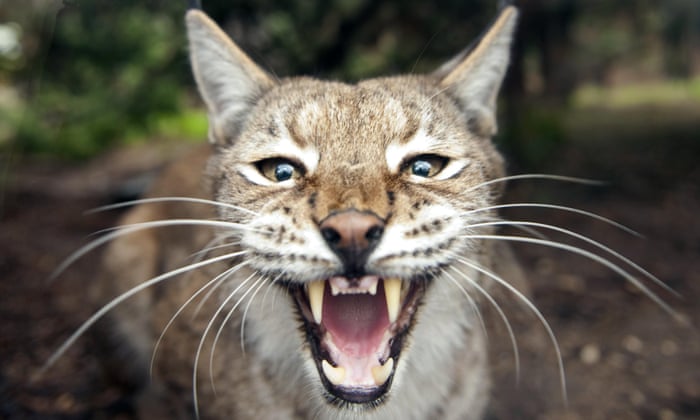
where in 1991 a gamekeeper shot dead a 27kg (59lb) lynx a mile from
where I grew up. For years, reliable locals spotted what we called “the
Beast of Booton”, but the truth was only revealed when police records
were published in 2006: a constable visited a gamekeeper to ask what was
in his freezer. “Oh, only some pigeons and a lynx,” the keeper replied.
That lynx probably escaped from a wildlife park that has now closed.
Other big cats are also escapees or illegally kept pets.
Many big-cat witnesses emphasise not what they’ve seen, but the
alarmed responses of dogs or horses around them. These animals are
not deluded. It is poignant that my friend may not see another big cat
in his life. “It was good but I want more,” he says. “I want it to be
within 10 metres and growl at me.”
Big cats in our countryside stimulate our senses and spark our imaginations. They show how rewilding, and reintroducing the harmless-to-humans lynx,
if done properly, would inspire us to spend more time in the wild. Our
countryside can still offer such thrilling unpredictability.
Cats are getting a new album with music created especially for their enjoyment.
One man's mission to make music for animals has
resulted in an album especially designed for cats, and the proof is in
the purrs.
More than 8000 investors have got behind US composer
David Teie's idea to create music especially designed for the listening
pleasure of cats.
"I know, it sounds like a joke. But it's 100 per
cent real," Teie says on his Kickstarter page, which has gained over
US$195,000 in support for the project.
In 2008, Teie wrote two songs that the Washington Post said "would have been major hits on the cat-music Billboard charts, if there were such a thing."
He
says the songs brought out positive reactions from 77 per cent of cats
that heard them, while human music spurred virtually no interest in the
felines.
Teie, who says he has been a cellist in the National
Symphony Orchestra for more than 20 years, has spent the last 12 years
studying what types of music makes different species tick and why.
"For
example, it's because we heard our mother's pulse in the womb that we
like drums in our music; the sound intrigues us because it evokes
heartbeats. It's no coincidence that our mother's resting heart rate is
almost exactly the same pace as music we find relaxing."
His first
project was composing music for monkeys, in which he wrote songs at
higher pitch and faster pace than human music, because of their
high-pitched voices and fast pulse.
For his next project, cats seemed like the obvious choice, he says.
Using musical instruments, Teie has incorporated sounds like chirping
birds, the sucking of milk and purring and matched it to the frequency
range which cats use to communicate.
He then tested it on some of the internet's most famous cats, whose owners sent him videos.
Teie
plans to make the music available free of charge to animal shelters,
animal hospitals, and veterinary clinics, saying he wants to bring the
beauty and comfort of music to as many species as possible, and would
like to look at albums for whales in captivity and troubled dogs next.
Rewards
for pledging to Music for Cats include a digital download of the album,
CDs, with the US$1000 option of signed CDs and a song being named after
your cat having sold out.
Tune into Big Cat Week, including Cougars Undercover, a groundbreaking special that reveals the private life of a secret predator, premiering Friday, Nov. 27, at 9/8c.
Safari Live features two expert guides who will lead
the way to stunning wildlife, in real time. Go deep into South Africa’s
Sabi Sands Park and come face to face with the best of Africa’s
wildlife, including lions, leopards, elephants, buffalo and many more.
The Lakeshore Killers centers on three male lions
coming into their prime with much to prove. Viewers will get a
bird’s-eye view of their survival tactics, including adapting their
hunting skills in surprising ways.
Cat Fight reveals the secret tactics of the animal
kingdom’s most ferocious feline fighters and brings you closer than ever
before to adrenaline-packed fights from Africa, the Americas and
beyond.
Tune in to The Ultimate Predator to find out which
cat is the one to rule them all — the giant tiger, the powerful jaguar,
the speedy cheetah or the socialite lion?
Big Cat Games pits the world’s most ferocious land
predators against each other in a series of trials that will determine
once and for all who is king of the cats.
Wild Yellowstone
Then cap off the 10-day Thanksgiving event with Wild Yellowstone,
a groundbreaking documentary that gives viewers a peek into the
national park in ways it has never been seen before. Using cutting-edge
camera stabilization, drone, time-lapse and infrared technologies,
filmmakers captured some incredible footage of Yellowstone’s stunning
animals and vistas.
The two-hour film features the national park in summer and in
freezing winter--an extraordinary world of fire and ice, ever changing
and always testing its animal inhabitants.
The National Tiger Conservation Authority (NTCA) has asked the
court to relax the norm of taking its approval every time it proposes to
change the land-use pattern in a particular area, saying the process is
way too lengthy.
(HT file photo)
The government wants the Supreme Court to exempt it from taking
permission every time a process is initiated to relocate villagers
living inside core tiger habitats and wildlife sanctuaries to forest
fringes or outside buffer zones.
Given the pressure on land reserved for wildlife because of illegal
human encroachment, the top court monitors relocation of villages tucked
inside sanctuaries. The displaced people are often rehabilitated on
satellite areas bordering the main forest zone. The status of these
redeveloped areas thereby changes from forest to non-forest.
The National Tiger Conservation Authority (NTCA) has asked the court
to relax the norm of taking its approval every time it proposes to
change the land-use pattern in a particular area, saying the process is
way too lengthy. Every proposal is screened by the court-appointed
centrally empowered committee (CEC) before the nod is given.
An exemption will provide states power to change the land-use pattern
from forest to revenue and help develop the area for relocation of
people from deep inside forests.
Since villagers living in core areas resist eviction, the NTCA says
authorities should be allowed to undertake development work in the
relocated villages without approaching the top court or CEC.
“…the deprivation of development benefits to tribals shall only be
counter-productive to forest, wildlife and tiger conservation as it
shall generate a lot of angst and disillusionment and prevent people
from opting from relocation,” reads the NTCA application.
The plea is significant because more than 45,000 families live in
core areas of tiger habitats spread across the country and only 169 of
751 identified villages have been relocated since 2000. This excludes
those living in wildlife sanctuaries and national parks.
The government is under pressure to relocate these villages, some of
which have been there for centuries, following reports of growing
human-animal conflict. Also, there are reports of poachers hiding in the
settlements and villagers harming big cats as well.
The friction was best highlighted when villagers inside Sariska tiger
reserve poisoned ST1, a male tiger, in November 2010 for killing
livestock. ST1 was brought from Ranthambore in the world’s first tiger
translocation programme launched in 2008 after big cats were wiped out
of Sariska.
If the top court agrees to the NTCA’s application, this will mean
amending its 15-year-old order that prohibits states from making any
changes in the land-use in and around tiger habitats. The order, it is
believed, not only slowed the relocation process but also precluded the
possibility of villagers, who are by and large tribals, from becoming
absolute owners.
In 2008, the court permitted a change in the legal status of forest
land to rehabilitate three villages in Maharashtra’s Andheri wildlife
sanctuary.
Based on that order, the environment and forest ministry approved in
2009 a proposal to change the status of forest land used for relocation
and rehabilitation of villagers. But the court order prevented states
from moving ahead.
Posted by Cassia Pollock on Tigers similar to this one. Image from wikimedia commons.
Exotic animal rescuers from the Lions, Tigers and Bears sanctuary in Alpine are en route on Sunday to Los Angeles to drop-off three tigers surrendered in a cross-country rescue trip to Ohio.
The tigers were surrendered under restrictions outlined in
state legislation in Ohio introduced a couple years ago, according to
LTB founder Bobbi Brink. SB 310 regulates the private ownership of
exotic animals, which Brink said had gone unregulated in Ohio until
recently.
The three exotic felines are being transported to The Shambala Preservein Acton,
where they will live out the remainder of their lives. Another
tiger has already been dropped-off at a sanctuary in Nevada, Brink said.
Since 2012, the rescue team from the foothills east of San Diego
has relocated more than 60 captive big cats and bears out of Ohio to
sanctuaries across the U.S. — more than any other sanctuary or
transporter, according to LTB.
“It takes a lot of coordination and the collaboration and
cooperation of many to put together a rescue like this,” Brink said. “It
takes all of us sanctuaries coming together to do the right thing for
these animals, to really give them an opportunity for a new life.”
The rescue mission is the third in three consecutive months for the sanctuary.
LTB is the only accredited sanctuary in the country that has a
fully self-contained animal transport hauler that has onboard first-aid
for both animals and humans, an anesthesia machine, safety transport
cages and other things needed to transport the big cats across state
lines, Brink said.
Brink said there are five states where the sale and breeding of exotic animals is unregulated.
Exotic animal trading is the fourth largest international crime, behind human trafficking, according to Brink. source
It is likely tigers and leopards are moving closer to human habitation
because of canine distemper virus affliction.— File PHOTO: M.A. SRIRAM
Man-animal conflict creates suspicions of big cats getting afflicted by CDV
In view of escalating man-animal conflict involving
tigers around Bandipur-Nagarahole belt, the authorities are wondering if
the Canine Distemper Virus (CDV), which spreads from dogs and can be
deadly for big cats, has been affecting wildlife.
The
virus is contagious and has no cure once it affects tigers or leopards,
though the dogs have chances of survival. The afflicted wild animal
gets disoriented, loses fear of human beings and tends to lurk closer to
human habitation. This leads to the cats not only being sighted more
often on the forest fringes, but it also makes them susceptible to
poaching.
The suspicions of CDV stems from an
increase in the number of tigers and leopards being spotted in human
landscape along the forest fringes. While two people were killed in
Hediyala in tiger attacks in the last one month, two others were injured
in separate attacks and four people had lost their lives to tiger
attacks around Bandipur in 2013.
Though it is only a
remote possibility, nothing can be ruled out until a scientific study is
conducted. The serum and viscera of the ‘man-eater’ of Bandipur shot
dead at Hediyala on Thursday has been collected and would be sent to the
laboratory for analysis, said a senior Forest Department official.
CDV
in big cats was first observed in Russia, and Sumatra in Indonesia,
while the Serengeti National Park lost one-third of its lion population
to the deadly disease in the 1990s.
The source told
The Hindu
that if the test proved positive then the feral dog population would
have to be inoculated but the exercise would be humungous in scope.
For
the record, there are more than 250 villages on the fringes of Bandipur
and about 150 villages along Nagarahole border, and the rate of
interaction of domestic animals with wild animals is high. The standard
procedure in a zoo is to inoculate the captive animals twice or thrice a
year.
The subject has also been a topic of
discussion among tiger experts in the past, but the scientific community
is divided over the subject as one group dismissed it as a remote
possibility and a waste of resources which could be better channelised
to handle proven threats.
However, the National Tiger
Conservation Authority protocol mandates that the blood of the dead
animal be examined to rule out CDV or other diseases.
Recent
studies have shown that smaller, fragmented tiger populations face
higher risk of local extinction due to CDV. There are several sites in
India, and even within Karnataka that hold small isolated populations
that are embedded in a matrix of dense population of humans,
livestock,domestic and feral dogs. Though there are no recorded
incidences of CDV in large wild cats it would be good to assess the risk
of CDV. Perhaps,we also need to do this on leopards and the leopards
that are frequently captured by the forest department provide an ideal
opportunity.
The world's wealthiest hunting organization, Safari
Club International (SCI) and professional hunting groups, met behind
closed doors with the South African Department of Environment (DEA) and
representatives of other African nations last week to discuss policies
for managing wildlife.
According to a media statement from the
DEA, the 14th African Wildlife Consultative Forum, that was held in
Limpopo from 9 to 12 November, is an annual SCI-sponsored initiative
which “provides an important platform for African countries to enhance
existing co-operation between governments, including hunting industries
of participating countries".
It
goes on to say, the "AWCF is further a platform for sharing experiences
in wildlife management and hunting in particular and will include
preparations for the upcoming CITES CoP 17 meeting in South Africa next
year".
In other words, the meeting is about the SCI persuading
African governments, individually and through CITES to adopt policies
incorporating the conservation ‘benefits’ of trophy hunting.
SCI already heavily influences government policies to a number of African nations.
In
2013 Zambia issued a ban on hunting lions and leopards because of
declining populations due to over-harvesting by trophy hunters. Zambian
Tourism and Arts Minister, Jean Kapata at the time cited that “big cat
numbers were too low to have a sustainable hunting industry.”
However,
after intense pressure from the SCI, Zambia reversed the ban. Zambia’s
Green Party president Peter Sinkamba told The Times of Zambia: “Much as
we are aware that the PF [Patriotic Front] government is facing serious
budget deficit challenges, it is extremely outrageous to resort to
unleashing safari hunters on to limited populations of big cat species,
regardless of the fact that safari hunting is allegedly most
profitable.”
A similar scenario occurred in Namibia. In 2010 the
country issued a hunting moratorium on big cats and placed the hunting
industry under review.
It was reported that in some areas whole
populations of leopard and cheetah were being wiped out. Hunting
operators were running leopard and cheetah hunts with dogs, as well as
canned hunts - in some cases canned hunts with dogs.
But the
moratorium only remained in place for one hunting season. In 2011
Namibia in partnership with SCI launched a census “to manage the
sustainability of the leopard population.” A questionnaire was
distributed to 1 500 farmers to assess the distribution and relative
abundance of leopards throughout Namibia. There were only 400 replies.
These, however, were extrapolated which produced a flawed national
estimate of leopards of over 14 000.
Nambia has a CITES trophy
hunted export quota of 250 leopards per year, a questionable figure,
according to experts of the International Union of Conservation of
Nature (IUCN), because it is based on “insufficient ecological
information and lack of scientific data”.
Unsurprisingly the pro-hunting census-takers recommended the quota “remain at the current level.”
The
USA will not allow imports of trophies of cheetahs as it has deemed
that cheetah hunting is not conducive to the conservation of the
species. Namibia together with SCI has repeatedly petitioned the USA to
lift the ban but the country has declined each request.
It is
little wonder then that journalists and conservationists, who were not
invited to the forum in Polokwane, are concerned that South Africa will
succumb to the cash-waving advocates of trophy hunting despite the DEA
insisting that “claims of excessive interference by American hunters in
South African government policy are not true.”
Ban Animal Trading
South Africa (a registered NPO fighting for the rights of animals)
demanded that the minutes be made public, something the DEA have since
done but the link is simply a summary of the proceedings and lacks any
meaningful detail.
Ian Michler, who produced the film Blood
Lions, has stated, “Given the non-transparent nature of the conference,
it’s hard not to infer a conspiracy between hunters and governments in
proposals that will be presented to CITES in the public’s name.”
It
is expected that CITES will deliberate on issues such as ivory and
rhino horn trade and revision of trophy hunted export quotas at the next
Conference of the Parties in Johannesburg in 2016.
Karen Trendler
of the NGO Working Wild says “it is of grave concern that issues of
this nature and importance are discussed at closed meetings with what
appears to be predominantly pro-hunting representation.”
The
common-held mantra that trophy hunting benefits conservation has come
under fire recently, especially following the death of Cecil the lion.
Many
leading wildlife experts like National Geographic Explorer in Residence
Dereck Joubert and Kenya’s conservation doyen, Richard Leakey, agree
that trophy hunting is not good for conservation because it fuels
corruption at the highest government levels, causes the loss of healthy
animals that are still key for reproduction and social cohesion but,
most importantly, contributes to the decline of Africa’s wildlife
populations already in a free-fall from rampant poaching.
It’s time politicians and legislators realise it too.