Thursday, October 29, 2015

Wild lynx set to be reintroduced to Highlands in 2016

Bringing back the lynx, which vanished from the UK more than 1,300 years ago, could generate tens of millions of pounds in benefits, a study has shown. Photgraph: Neville Buck/PA

Bringing back the lynx, which vanished from the UK more than 1,300 years ago, could generate tens of millions of pounds in benefits, a study has shown. Photgraph: Neville Buck/PA

16:12Wednesday 28 October 2015

Wild lynx could once again prowl the forests of Aberdeenshire and Argyll after an absence of 1,300 years if a new rewilding proposal gets the go-ahead.

Landowners, farmers, gamekeepers and conservation groups are being asked to give their thoughts on reintroducing the once-native lynx to parts of Scotland and England.

This consultation document, and the research it quotes, makes an overwhelmingly strong case for reintroduction of these amazing cats

Dr Paul O’Donoghue
Conservationists claim bringing back the deer-killing cats could offer huge benefits for the economy as well as the environment. They maintain the distinctive-looking predators pose no danger to people and are “little to no threat for pets or livestock,” but could generate millions of pounds in eco-tourism opportunities and control of exploding deer populations.

The Lynx UK Trust has suggested trial reintroductions in Aberdeenshire, Argyll, Northumberland, Cumbria and Norfolk over a five-year period.

Other organisations have previously suggested lynx could play an important role in “rewilding” parts of the UK, including the Scottish Wildlife Trust, Trees for Life and Rewilding Britain.

The Cairngorms National Park Authority has also examined the effects of bringing back the short-tailed cats, as well as bears and wolves. Of the three top predators, lynx were considered to have the least negative impact on farmers.

But the National Farmers Union (NFU) Scotland has major concerns over the plans.
 

Government nature agency Scottish Natural Heritage has also said reintroduction schemes are “complex” and require “considerable planning” to meet UK and international guidelines.

But the trust insists the plan has widespread backing and could generate millions of pounds from eco-tourism. Up to 91 per cent of people who responded to a poll carried out by the charity earlier this year said they support the move, which is aimed at balancing out deer overpopulation and its damaging effects on forestry and agricultural crops.

A report for the charity by consultancy firm AECOM looks at the impacts of reintroducing the Eurasian lynx at two proposed sites - Kielder Forest in Northumberland and Thetford Forest on the border of Norfolk and Suffolk.

The findings show bringing back the lynx would generate £65.7 million from eco-tourism, creating rural jobs, while also improving crop yields and woodland management by keeping down deer.
The plan would cost £1.4 million over 25 years for the two sites, but would deliver £47 of benefits for every £1 spent.

“Our cost-benefit analysis shows that the argument for reintroducing lynx to the UK is compelling from an economic, social and environmental perspective,” said Chris White, senior environmental economist at AECOM.

“At a time when the UK needs to think laterally and creatively to realise economic benefits, this is an idea that should be fully explored, especially for the potential eco-tourism and job opportunities in rural communities.”

Dr Paul O’Donoghue, chief scientist for Lynx UK Trust, said: “This consultation document, and the research it quotes, makes an overwhelmingly strong case for reintroduction of these amazing cats; they fit into the modern UK environment beautifully and can deliver a huge range of benefits for all of us, but of course we have to get the process right; this is a unique and ever-evolving project and we really want to get stakeholders involved in helping to shape it.”

But Andrew Bauer, deputy director of policy for NFU Scotland, said: “Whilst the prospect of lynx reintroduction has left some breathless with excitement, there are good reasons why the farming community is more wary.

“In some parts of Europe the impact of lynx is moderate – very distressing and damaging for those who lose lambs, but not a widespread problem.

“There are other parts of Europe where the impact is far greater – with official reports concluding that tens of thousands of lambs are being predated each year in Norway alone by species such as lynx and wolves.

“Farmers are quite right to question why and how lynx, absent from Scotland since medieval times, should be reintroduced.

“Alongside trumpeting the benefits, those who advocate lynx reintroduction should be up front about the potential impacts on Scotland’s hugely important sheep farming industry and the potentially very significant cost to the public purse.

“Anyone who is concerned about lynx reintroduction should take heart from the fact that any such proposal would be subject to a considerable level of scrutiny.”

Lynx Trust UK intends to formally apply for the necessary reintroduction licences in coming months, with the first animals due to be brought in next year.

source

***

Farmers and landowners' views sought on return of lynx

  • 28 October 2015
Farmers and landowners have been asked for their views on a proposal to bring back lynx to parts of Scotland and England.

The Lynx UK Trust has suggested trial reintroductions in Aberdeenshire, Argyll, Northumberland, Cumbria and Norfolk.

It said the plan has public support and research it commissioned sets out benefits of the big cats' return.

The National Farmers Union (NFU) has previously raised concerns.

Scottish Natural Heritage, which is funded by the Scottish government, has also said reintroductions were "complex" and needed "considerable planning" to meet UK and international guidelines.
Lynx became extinct in the UK 1,300 years ago.
The Lynx UK Trust said 91% of 9,000 respondents to a survey it carried out were in favour of lynx being brought back to help control deer numbers.

AECOM, consultants the trust commissioned to examine the benefits of lynx, have suggested that the cats could benefit eco-tourism as well as prevent deer from damaging crops.

The trust said it now wants to hear views from landowners and farmers.

Dr Paul O'Donoghue, of the trust, said: "Lynx reintroduction is a big step for all of us in the UK and this is the opportunity for a wide range of groups to really understand what it could mean, how they could be affected, and to tell us and the statutory agencies how they feel about it."

'Big concerns'

Other organisations, including the Scottish Wildlife Trust, Trees for Life and Rewilding Britain, have separately said lynx could form an important part in "rewilding" areas of the UK.

The Cairngorms National Park Authority has in the past weighed up the pros and cons of bringing back the big cats, and also wolves and bears.

Of the three predators, lynx were deemed to have the least negative impact on farmers' businesses.
The potential of bringing back bears has also been looked at in the past
NFU countryside adviser Claire Robinson said reintroductions raised "big concerns" for farmers in England.

She said: "Any species introduction, particularly if it has not been in this country for hundreds of years, can have a massive impact on the many benefits that the countryside delivers.
"The environment has changed drastically and we do not know how lynx would behave in the current environment.

"But the biggest concern we have would be the impact on farm animals with lynx preying on lambs, poultry and outdoor piglets - those animals are farmers' livelihoods."

 source

10,000-year-old Cave Lion Cubs Found Perfectly Preserved

Wed, 10/28/2015
Lauren Scrudato, Associate Editor

Perfectly preserved remains of two ancient lion cubs have been found in Eastern Russia, according to the Academy of Sciences of Yakutia.
Photo: Academy of Sciences of Yakutia

The 10,000-year-old cave lion cubs were unearthed completely intact thanks to the region’s permafrost deposits. Prior to the discovery this summer, only carcass fragments and individual bones had ever been recovered.

The Eurasian cave lion, or Panthera leo spelaea, was known as one of the largest cats in history, averaging 5-10 percent higher than today’s lions. These lions, a close relative to the modern Afro-Asiatic lion, roamed from Russia’s far east to the British Isles, as well as northwestern Canada and Alaska. Adults stood at a shoulder height of about 4-feet, and were known to stalk other big predators like horses, reindeer and possibly young mammoths.

Researchers are unclear of how the species became extinct, but theories of a decline in prey, possibly due to human hunting or climate change may have played a role.

These big cats have been seen in Paleolithic cave paintings, clay figurines and ivory carvings.
The Sakha Republic of Siberia, also known as Yakutia, is famous for many other ancient mammal finds, as BBC reported last year.

The Academy of Science of Yakutia plans to present the lion cubs with a few other notable finds, including a woolly mammoth, woolly rhinoceros and ancient bison in late November. Researchers will then divulge more information on the preliminary studies conducted on the pair of cubs.

source

These 15 adorable black cats are anything but bad luck


Black cats have the lowest adoption rates and highest euthanasia rates, and often stay in shelters far longer than their lighter-colored counterparts.

Cultural superstitions may have stigmatized black cats as being "bad luck," but not all cultures believe this. In Japan, black cats owned by single women are thought to bring many suitors. In England, they are given as a wedding present to bring good luck to the bride. In Germany, a cat's direction on the road can signify good or bad fortune. Right to left is unlucky, but left to right signifies good things ahead.

Oct. 27 was National Black Cat Day so celebrate with these dark-colored felines.

Black-cats-1Image: WATFORD/Mirrorpix/Corbis

Black-cats-7Image: kiciarandagia/RooM the Agency/Corbis 
Black-cats-8
Image: Rommel/Masterfile/Corbis
Black-cats-3
Image: Ragnar Omarsson/Etsa/Corbis
Black-cats-9
Image: Radius Images/Corbis
Black-cats-12
Image: Yann Arthus-Bertrand/Corbis
Black-cats-2
Image: Mitsuaki Iwago/Minden Pictures/Corbis
Black-cats-4
Image: Masataka Komori/Aflo/Corbis

Black-cats-6
Image: Tim Bird/Corbis
Black-cats-10
Image: S. Deissner/F1 Online/Corbis
Black-cats-5
Image: Valentin Weinhäupl/Westend61/Corbis


source

Forget Your Superstitions—Black Cats Are The Best

It’s black cat season, and we’re ready to celebrate.
Forget Your Superstitions—Black Cats Are The Best
Illustration by Liz Riccardi
Black cats are the unofficial mascots of Halloween, and whether you celebrate it all year ‘round or just one day, it’s high time to pay tribute to these spooky sweethearts. Cats in general have gotten a bad rap over the long haul, for a variety of utterly silly reasons. Sure, they’re furry little tyrants who shed on our clothes with glee and sharpen their claws on expensive objects with abandon. We’ll admit that they’re occasionally thankless creatures whose bodily waste can be linked to mental illness. And who hasn’t wondered what exactly our cats are staring at off in the distance, or why they insist on knocking the citrine off our carefully arranged altars? Logically, we know that these adorable freeloaders aren’t actually minions of Satan.

That hasn’t always been the case. Over the centuries, cats have had a wildly varied place among humans; they’ve gone from being worshipped à la Bast to murdered en masse as scape-kitties for causing the Black Plague. There are all sorts of gruesome myths about cats of all stripes, but black cats have borne the brunt of our historical ambivalence. In the 17th Century, cats were associated with witchcraft in both Britain and the new-fangled colonies across the ocean, which culminated with the grotesque Salem witch trials of 1692. Sure, a witch could technically claim any cat as her familiar in the eyes of the hysterical anti-witchcraft brigade, but black cats seemed especially suspect. According to John Bradshaw’s Cat Sense: How the New Feline Science Can Make You a Better Friend to Your Pet, one especially horrific “exorcism” in Scotland involved roasting a black cat alive for four days and nights. What the fresh hell is that about?

On the other hand, black cats have their defenders. Sailors were huge fans of having black cats on board their ships for luck. Cats in general have gathered plenty of high-profile fans over the years, from Queen Victoria to Mark Twain and Hemingway. The black cat has been adopted as a symbol of counterculturalism, from the screeching black cat of the Industrial Workers of the World and anarcho-syndicalists to traditional American tattoo motifs as seen in designs by Sailor Jerry.

Even though we’ve generally moved past these sorts of follicular follies, the media can’t resist a good trend piece. Every Halloween, we’re treated to hair-raising reports about the collective misfortune of black cats. There are inevitably stories about the well-intentioned humans who fear their black cats might be nabbed for nefarious purposes, jerks who adopt cats just as Halloween props and return them afterwards, and those who claim that people adopt black cats at a lower rate because they don’t look as good in selfies. Cat lovers shouldn’t believe the hype, according to Dr. Emily Weiss, the Vice President of Research and Development at ASPCA.

First of all, black cats and dogs aren’t being adopted at a lower rate than animals of other colors. “In fact, they adopt more of them than any other color, but where that myth is probably coming from is that there’s simply more of them coming in,” Weiss says. The data the ASPCA has collected simply doesn’t back up the anecdotal evidence, catchy as it may be for headlines. Weiss adds, “I’m not sure if people really do still have superstitions about black cats, but there sure is a myth that people have some superstitions about black cats!” And that selfie theory that was floated in 2014 is “just really kind of silly,” she says.

However, a gruesome urban legend has proven to be particularly difficult to shake, and that’s the fear of black cats being used for ritual sacrifice. Some shelters have elected to limit adoptions of black cats during the Halloween season in the off chance that a would-be adopter is just looking for a feline victim. Of course, this idea sounds familiar to anyone who was around during the Satanic ritual abuse panic of the ‘80s, which somehow convinced otherwise logical adults that everyone from your local preschool teachers to Dungeons and Dragons fans were probably suckling at the teat of Satan himself.

Dr. Weiss doesn’t pussyfoot around the topic. She says that they at the ASCPA believe that it’s much more likely that limiting adoptions of black cats on or around Halloween could keep those kitties from finding their forever homes. “The likelihood that [the cat] won’t get a home increases by limiting access to those cats,” she says, and points out how shelters are taking advantage of the ubiquitous Halloween imagery to promote black cat adoptions, instead.

“We’re not denying that cruelty exists,” she says. “In fact, that’s what the ASPCA is founded upon, is to fight that cruelty, but what we are saying is that…we are taking a myth and turning it into something that is potentially hurting animals at a much greater rate. So let’s get them home.”
Plus, black cats go with everything.

source

Are Putin's tigers 'lost'... or simply roaming free of modern technology?

By The Siberian Times reporter
28 October 2015

Kuzya and Ilona shake off their electronic tags, but all signs show they thrive in wild.
Siberian tiger is among the rarest big cats on the planet. Picture: Svetlana Sutyrina

The GPS collars have stopped bleeping on two of the tigers released by President Vladimir Putin to roam free in Russia's nature. For some six weeks, the Department for Wildlife Protection has not received signals from the big cats. Is this a reason for alarm? After all, the tigers are endangered. Among the rarest big cats on the planet.

Kuzya 'lost' his collar first: the device simply stopped transmitting signals. Despite this, the tiger was traced by wildlife cameras on a grand tour of the Russian Far East, and effortlessly crossing frontiers.

Putin's Siberian tiger cleared of eating Chinese takeaway dinner

Putin's Siberian tiger cleared of eating Chinese takeaway dinner
Kuzya was traced by wildlife cameras on a grand tour of the Russian Far East, and effortless crossing frontiers. Pictures: 'Tiger' special inspection

The tiger's journey took him through Primorsky region, into neighbouring Khabarovsk, before pawing it to China where he appeared on photo trap cameras, pausing only to become the star of an Australian documentary. Soon he was back in Russia, in the Jewish Autonomous Region.

And even if Ilona's tag is not working, the evidence suggests she is now safe in the Khingansky Reserve. Or so it seems from photo traps, her footprints, and marks on trees, old-style monitoring. Environmental official Nikolay Stepanov said only the third tiger, Borya, was in constant e-contact with his watchers.

Tigress Ilona

Tigress Ilona

Tigress Ilona
Even if Ilona's tag is not working, the evidence suggests she is now safe in the Khingansky Reserve. Pictures: Khingansky Reserve

'The president released them in Amur region in order to restore their population,' he said. 'The number of predators has considerably dropped. Today there are about 500 (Amur tigers) left in the Far East. It is expected that Ilona, Kuzya and Borya will breed - but they haven't yet had any cubs.'

Two of them, at least, may get the chance to do what nature intended without being spied on. Borya has now also gone to the Jewish Autonomous Region. The three tigers were released by President Putin in Arkharinsky district in May 2014.

The Kremlin leader has spearheaded the campaign to save the endangered species from extinction.

source 

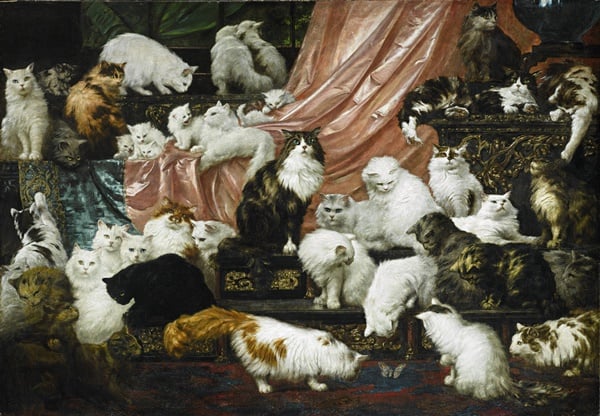
Happy #NationalCatDay ! Is this the world's largest cat painting to be sold ever?

Carl Kahler, My Wife's Lovers.Image: Courtesy Sotheby's

Carl Kahler, My Wife's Lovers (1891).

Sotheby's to Sell Possibly the World's Largest Cat Painting—Let the Bidding Begin!


Image: Courtesy Sotheby's

While all eyes will be on the contemporary art auctions during the second week of November, one work coming up at an auction might steal the show the week before.

On November 3, in its upcoming 19th century European art auction, Sotheby's will showcase the ultimate homage to the beloved cat: a painting that is six feet tall and eight-and-a-half feet wide, and weighs a whopping 227 pounds.

Entitled My Wife's Lovers, by Austrian artist Carl Kahler, the work is estimated to sell for $200,000–300,000. Polly Sartori, head of 19th century European paintings, drawings, and sculpture says that anyone who comes to see any of the works in the upcoming auction, which go on view Friday, won't be able to avoid the piece.

“It's hard not to see it, we're putting it right in the center of the gallery," Sartori told artnet News over the phone. "The picture is so large and so heavy, we had to make a special wall to hang it; when we originally put the painting up on a normal wall, it pulled the nails right out of the wall."

It has become increasingly apparent in recent years that cats not only rule the Internet, but have also maintained a steady following in the art world in real life. There have been shows at the Metropolitan Museum of Art ("Balthus: Cats and Girls"), the Brooklyn Museum ("Divine Felines: Cats of Ancient Egypt"), and the Museum of the Moving Image ("How Cats Took Over the Internet"), and the Walker Art Center has a yearly festival devoted to Internet cat videos.

There's also CatConLA, the comic con of the cat world; a book of cats starring in famous paintings from art history; and a series of drawings reimagining prominent politicians as cats. And billionaire Mark Cuban even claimed he has hawked a few of his own cat doodles.

With this work though, perhaps some of that fervor will spread to the tony world of the auction house. Over 5,000 people have viewed the video showcasing the painting since the auction house posted it last weekend.

“For a 19th century [work], that's extraordinary," said Sartori. “We knew we had a total winner about two months ago, when we had it just leaning up in our cataloging area, and many of our staffers would take a photograph in front of it and post it on Instagram and we hadn't even posted our press release yet!"

The behemoth work dates back to 1891, when San Francisco art collector and cat lover (obviously) Kate Birdsall Johnson commissioned the Austrian artist to paint her 42 cats, (rumor has it she owned anywhere from 50 to 350 cats at any given time, and they had their own floor in her Sonoma County mansion). There is no concrete evidence as to how long it took the artist, who had never painted a cat before, to create the work. But it is estimated that it took over 3 years, for which he was paid $5,000. 

The title is attributed to Ms. Johnson's husband, who obviously had a dry sense of humor.
While Sotheby's has yet to put on an all cat art auction, it certainly isn't out of the question, according to Sartori.

“Well you never know," said Sartori. "There's a handful of 19th century artists who painted cats, and we certainly do have collectors who. every time we get a cat picture, come in for them. So, we'll see. We like to do themed shows, so a cat show might be a fun idea."

Keep in mind that Thursday, October 29 is National Cat Day.


Winnie the Kitten will melt your heart (video)

Caught on camera: Leopard goes window shopping in the city


By Earth Touch 
October 28 2015


Nothing to see here, just a leopard enjoying some early morning window shopping. CCTV cameras captured this brazen cat strolling past a furniture and decor store in Mbombela, South Africa on Monday morning. This store opens at 9am, but this curious cat showed up five hours early (to avoid the queues, we assume).
 
So could there be a leopard cruising around the city? Although rare, the sighting is perhaps not all that surprising. The furniture store is situated near the Crocodile River – follow this perennial watercourse east for 40 kilometres or so and you'll find yourself in the country's famed Kruger National Park, the perfect habitat for this big cat. Leopards are highly adaptable and have large home ranges, so our guess is that this urban visitor is probably just passing through.
And this isn't the first time that a wild predator has wandered into a South African city. In 2013, wildlife officials darted and removed a hyena from the streets of Johannesburg, and last year, the body of a serval was discovered on a city sidewalk.

We're holding thumbs that this interloper finds its way safely back to the wild where it belongs.


source

Tuesday, October 27, 2015

How to do the dishes (cat style!) video

Scientists find link between cat's fur colour and aggression


Researchers have found calico cats are more aggressive than other cats.

Is your feline companion a bit catty, the sort to bite and scratch when you go to pick them up?
Then it's like to be black and white, toroiseshell, or grey and white, according to new research.

Veterinary scientists at the University of California have conducted a study that apparently show a link between a cat's fur colour and its level of aggression.

The study was published in the Journal of Applied Animal Welfare Science, which used 1,274 cats to identify a link between appearance and behaviour.

Researchers used a survey to test whether calico cats - who have a spotted or particoloured that is predominately white - are 'significantly more aggressive towards people' than other types of cat.

One aspect of the study was a questionnaire given to cat owners, which asked them to detail how often, and to what extent, their pet was aggressive during a typical day, how it reacts when handled and its behaviour at the vet.

The survery results appeared to confirm calico females, black and white and grey and white cats were regularly 'more aggressive towards humans'.

Research said the ideal feline was a black, grey or tabby cat

When examined, the study also found black and white cats were particularly aggressive when handled, grey-and-white cats during a trip to the vet and calico females in everyday contact with humans.

The University of California study comes a month after researchers at the University of Lincoln found cats, unlike dogs, do not need humans to feel protected.

In particular, experts found cats don't suffer from separation anxiety and any noise they make when their owner leaves is more likely to be out of boredom or frustration.

- Stuff
source

Your Daily #Cat

Closeup of a lion cub 

Closeup of a lion cub by Tambako The Jaguar

Lions Are Disappearing Across Africa

by Tia Ghose, Senior Writer   |   October 26, 2015
A lion relaxes on the grass.
Credit: Billy Dodson | African Wildlife Foundation
Lions are disappearing from most of the African continent, and the decline is especially evident in West Africa, according to new research.

The lion population has has been in decline since 1992, largely because of conflicts with native herders and declines in lions' prey species, the new survey found. Almost two-thirds of the more than 8,000 lions studied live in populations facing decline. West African lion populations are likely to drop by half in over the next two decades, if conservation measures aren't stepped up, the study found.

"A lot of the African bush is now silent of the lion's roar," said study co-author Luke Hunter, president of Panthera, an organization dedicated to the conservation of big cats. "We're losing that characteristic emblem of African wilderness." [In Photos: The Biggest Lions On Earth]

 
Apex predators

Past studies of African lion populations have produced a spotty picture of the apex predators' numbers. For instance, a 2013 study found that lion populations had plummeted in Uganda, and a 2014 study suggested they faced being eliminated from West Africa. But in other areas, lions were doing well. The lion had virtually disappeared from some parts of South Africa, but after reintroduction and conservation efforts, the iconic predator prowls in 50 areas where it was once scarce, Hunter said.

To get a more complete picture of the African lion's fate, Hunter and his colleagues looked at 8,221 lions in 47 different populations across Africa going back to 1990. They found steep drops in the lion population in western and central Africa. Over the next 20 years, those regions can expect to lose half their lions if current trends continue, while much of East Africa can expect to lose a third of their lions at the current pace, the researchers reported in a new study published today (Oct. 26) in the journal Proceedings of the National Academy of Sciences.

But it isn't all bad news for the big cats: In South Africa, Botswana, Zimbabwe and Namibia, lion populations have been steady or increasing. Most of those lions were in fenced-in reserves, and the countries had thriving wildlife tourism economies and thus had devoted significant resources to conservation.
 
Factors driving lion decline

Two factors are driving the decline in lions, the researchers suspect. First, pastoralists who manage herds of animals may trap and kill the beasts because they threaten their livestock.
"If they're killing livestock, people really move heaven and earth to get rid of them; they just hunt them down," Hunter said.

Second, poachers use wire snares and other traps to indiscriminately capture lions' traditional prey species — everything from zebra to wildebeest — and then sell that bushmeat in commercial markets in bigger cities. With fewer animals to hunt, lions are struggling to survive, the study found.
The trophy hunting that took down Cecil the lion is, at most, a small contributor to lion population declines, Hunter said.

"Even if trophy hunting of lions was banned today, it still wouldn't avert the decline, because the factors driving the decline are much bigger," Hunter said.

In general, lions tended to fare better in areas with low population densities, such as Botswana and Namibia, countries that also have thriving wildlife tourism economies. These countries' lion populations are likely doing well because they don't butt up against as many people, and because those countries pour more money into creating fenced-off reserves and deterring poachers, Hunter said.
 
Saving the lion

Protecting lions in densely populated areas such as West Africa — which also hosts some of the poorest countries in the world — will be a bigger challenge, as many of those countries have scarce resources to address even the human population needs, Hunter said.

But those countries still have options, Hunter said. One of the simplest measures is to teach people methods to protect their herds, such as building better fences or moving their livestock into sturdy corrals at night, Hunter said. These efforts have the benefit of enriching the local human populations as well, he added.

To maintain prey species, regions with struggling lion populations need to fund more conservation workers to patrol wildlife refuges and to remove snares when they see them. Although that's a pricey endeavor, it will benefit species other than lions, from elephants to rhinos, Hunter said.

In addition, while African countries could devote more resources to conservation, Western aid groups may need to increase support if they want to see the iconic symbol of Africa survive, he said.


source

Large, violent animal packs shaped the ecosystems of the Pleistocene epoch

Wide variety of data used to reconstruct an ancient era
Date:
October 26, 2015
Source:
University of California - Los Angeles
Summary:
Intense, violent attacks by large packs of some of the world's biggest carnivores -- including extinct lions much larger than those of today, and sabertooth cats -- limited the population sizes of mammoths, mastodons and other species, and prevented widespread habitat destruction in the Pleistocene Epoch.

Violent attacks by carnivores are illustrated.
Credit: Painting by Mauricio Anton

For years, evolutionary biologists have wondered how ecosystems during the Pleistocene epoch survived despite the presence of many species of huge, hungry herbivores, such as mammoths, mastodons and giant ground sloths. Observations on modern elephants suggest that large concentrations of those animals could have essentially destroyed the environment, but that wasn't the case.

Now life scientists from UCLA and other universities in the U.S. and England argue that the ecosystem was effectively saved by predatory animals that helped keep the population of large herbivores in check. Their findings, reported this week in the journal Proceedings of the National Academy of Sciences, show that intense, violent attacks by packs of some of the world's largest carnivores -- including lions much larger than those of today and sabertooth cats -- went a long way toward shaping ecosystems during the Pleistocene epoch.

The research could have implications for animal conservation efforts today. The paper notes that many of today's endangered species evolved during or before the Pleistocene epoch, and under very different conditions from today's.

"Recreating these [Pleistocene] communities is not possible, but their record of success compels us to maintain the diversity we have and rebuild it where feasible," the researchers write.

Led by Blaire Van Valkenburgh, a UCLA evolutionary biologist, the researchers found that, because of their larger size, the ancient carnivores were very capable of killing young mammoths, mastodons and other species, which prevented those animals from destroying ecosystems in the Pleistocene, which ended about 11,700 years ago. The paper suggests that the extinction of the largest of the "hyper-carnivores" (such as lions, sabertooth cats and hyenas) during the late Pleistocene almost certainly was caused by the disappearance of their preferred prey, including young mega-herbivores (the mammoths, mastodons and giant ground sloths).

"Based on observations of living mega-herbivores, such as elephants, rhinos, giraffes and hippos, scientists have generally thought that these species were largely immune to predation, mainly because of their large size as adults and strong maternal protection of very young offspring," said Van Valkenburgh, who holds an appointment in the UCLA College's department of ecology and evolutionary biology.

"Data on modern lion kills of elephants indicates that larger prides are more successful and we argue that Pleistocene carnivore species probably formed larger prides and packs than are typically observed today -- making it easier for them to attack and kill fairly large juveniles and young adult mega-herbivores."

The scientists used several different techniques and data sources to estimate information about the Pleistocene animals. Among them:
  • Examining fossils of their teeth and applying the ratio of tooth size to body mass of today's animals. (This led the researchers to estimate that the extinct species were between 50 and 100 percent larger than today's tigers, African lions and spotted hyenas.)
  • Synthesizing data on the relationship between the age and shoulder height of the extinct animals versus shoulder height and body mass of today's elephants.
  • Analyzing data on 50,000 instances of kills in the wild to estimate the typical and maximum sizes of the prey of Pleistocene carnivores.
Many scientists had thought that the populations of mammoths, mastodons and giant ground sloths were limited through evolution by changes in reproductive timing in response to shortages in resources like food and water.

Today's large predators benefit their ecosystems in part by providing carcasses that feed an array of smaller species. The same was true during the Pleistocene, when keeping mega-herbivore populations in check meant that there was more vegetation for smaller mammals and birds. The predators might even have had indirect effects on river ecosystems, because the banks of the rivers were not being denuded by mega-herbivores and less likely to erode.

The study's co-authors are Matthew Hayward of Bangor University College of Natural Sciences in England, William Ripple of Oregon State University, Carlo Meloro of Liverpool John Moores University in England and V. Louise Roth of Duke University.

Story Source:
The above post is reprinted from materials provided by University of California - Los Angeles. The original item was written by Stuart Wolpert. Note: Materials may be edited for content and length.

Journal Reference:
  1. Blaire Van Valkenburgh, Matthew W. Hayward, William J. Ripple, Carlo Meloro, and V. Louise Roth. The impact of large terrestrial carnivores on Pleistocene ecosystems. PNAS, October 26, 2015 DOI: 10.1073/pnas.1502554112


University of California - Los Angeles. "Large, violent animal packs shaped the ecosystems of the Pleistocene epoch: Wide variety of data used to reconstruct an ancient era." ScienceDaily. ScienceDaily, 26 October 2015. <www.sciencedaily.com/releases/2015/10/151026171412.htm>.

If I Fits, I Sits. You Got a Problem With That?

lions funny image If I Fits, I Sits. You Got a Problem With That?

source

Monday, October 26, 2015

As Tiger Numbers Dwindle, Will Smugglers Target a Different Cat?

A new study reveals dramatic growth in the commercial trade of the rare clouded leopard.


Picture of a clouded leopardThe Houston Zoo is home to several clouded leopards, including this one. Only about 10,000 remain in the wild.
By Rachael Bale, National Geographic

Among wild cats, clouded leopards are increasingly coveted—and bred in captivity—for commercial purposes, according to a new study from University of Oxford’s Wildlife Conservation Research Unit. They’re being sold into the pet trade, to tourist attractions offering cat encounters, and to other such profit-driven businesses.

Researchers Neil D’Cruze and David Macdonald reviewed import and export records filed with the Convention on International Trade in Endangered Species of Wild Flora and Fauna (CITES), the body that regulates international wildlife trade, and found a 42 percent increase in the commercial trade of live clouded leopards from 1975 to 2013.

Clouded leopards are native to Southeast Asia and named for their distinctive spotted coats. They’re one of the smallest big cats, weighing up to 50 pounds and growing up to three feet long. They belong to an entirely separate taxonomic group from snow leopards and “regular” leopards, such as African and Indian leopards.
Some 10,000 clouded leopards remain in the wild.They face a high risk of extinction.
The reason for their new popularity has much to do with the decline of tigers, now estimated to number no more than 3,200, whose bones, feet and other body parts are highly prized in traditional medicine and for warding off evil.

Some 10,000 clouded leopards remain in the wild, with no single population larger than 1,000 individuals, spread from Indonesia to the foothills of the Himalayas and into China. They face a high risk of extinction, according to the International Union for Conservation of Nature Red List, a widely accepted international list of the conservation status of species.

The biggest threat these cats face is deforestation, but the illegal trade is also a grave concern, especially given their growing commercial appeal.

CITES lists clouded leopards as an Appendix I species, which means that only ones bred in captivity can be traded legally.

Picture of leopard skinAt John F. Kennedy International Airport in 2014, officials displayed a confiscated clouded leopard skin and other illegal wildlife products. The illegal trade in the body parts of clouded leopards poses a growing threat to the species.

And that has the researchers worried. They found more than 200 clouded leopards have been legally traded—almost all for commercial reasons—since CITES first began regulating the trade in 1975. And they noted that the CITES records documenting these imports and exports were incomplete and contradictory.

Those irregularities “point toward the possible laundering of wild-caught animals,” the study says. The legal trade in captive-bred animals can serve as a cover for illegal trade activity, such as poaching and passing off wild-caught animals as captive-bred, D’Cruze said.
Another fear is that private owners are turning to clouded leopards now that tigers are so hard to come by. On-the-ground contacts the researchers worked with observed clouded leopards at tiger farms in Southeast Asia—and even at a lion park in South Africa.

“Are clouded leopards going to be the next target if we are not able to step in and save tigers?” said Neil D’Cruze, one of the study’s authors and head of research at World Animal Protection, a London-based nonprofit.
Legal trade in captive-bred animals can serve as a cover for illegal trade.
In some places, including Myanmar, the trade in clouded leopard teeth, bones, and skins far outpaces that of tigers, the traditionally favored source of big cat parts for spiritual and medicinal purposes.
More research is needed, the study concludes, to figure out if clouded leopards are indeed being targeted on a broader scale as a substitute for tigers and tiger parts on a broader scale.

Lynx at Night Canada lynx (Lynx canadensis) sits primly on the shore of Loon Lake in Ontario, Canada in 1906. These 11- to 37-pound (5 to 17 kilogram) cats live in boreal forests across Canada and down into the northern United States.


Delicious In a picture taken in 1997, a bobcat (Lynx rufus) gets ready to gobble down a muskrat in Idaho.


Ear Tufts Photographer Frans Lanting caught a photo of this caracal (Caracal caracal) with a camera trap in Kavir National Park, Iran, in 2011.


Smallest of the Small Black-footed cats (Felis nigripes) crouch at their burrow in the Okavango Delta, Botswana, in an image from 2011.


Not Amused The jaguarundi's stubby ears don't seem very catlike, but its haughty expression will be familiar to many a cat owner.


Rescued This oncilla (Leopardus tigrinus), otherwise known as a little spotted cat or tiger cat, gazes from the bars of a cage after being rescued from poachers in Peru in 2009.


Bushy Tail European wildcat (Felis silvestris) pauses in a grassy field in Moldova in 2009.


One of the Last The Iberian lynx (Lynx pardinus) is perhaps the most endangered wildcat in the world.


Peekaboo pampas cat (Leopardus colocolo) peers from behind a tree branch in the Cerrado ecosystem in Brazil, in 2008.


Surprise A male fishing cat (Prionailurus viverrinus) triggers a camera trap on a fish farm in Sam Roi Yot, Thailand (map).


On Patrol serval cat (Leptailurus serval) trips a remote camera in Zakouma National Park, Chad, in 2006.


Curious Cat An ocelot (Leopardus pardalis) poses on a tree root in Ecuador's Amazon rainforest in 2004.


Baby Steps An eight-month-old male European lynx (Lynx lynx) steps around a dead roe deer in the Jura Mountains of Switzerland in 2011.


Eyes Wide Open The margay (Leopardus wiedii), or tree ocelot, displays huge eyes as it prowls through a forest in Gamboa, Panama.

Cats and Computers (Thanks for the warm bed) video

Seamus and Angus: A Real Life Bromance (video)

Lions saved from Peru circus start new life in South Africa after help from UK charity

The creatures are being nursed back to health after years of abuse
 
SIMEON TEGEL Lima


The traffic cones last a day, the giant bags of catnip a few minutes, the footballs just seconds. In a temporary compound in a dusty, down-at-heel suburb of Lima, the toys, and the stimulation they provide, are among the first treats that 24 lions rescued from Peruvian circuses have ever experienced.

The big cats were seized, with the aid of local authorities, by Animal Defenders International (ADI), a British charity that first campaigned for Peru’s ground-breaking 2011 national ban – which the UK and US have yet to match. After years of abuse, often being fed a meagre diet of chicken feet, and only ever briefly escaping tiny cages to provide a spectacle for circus-goers, the creatures are being nursed back to health.

In November, with nine more lions from Colombia, they embark on the final stage of their journey, on a chartered plane, to a new life of relative freedom in a South African sanctuary. The airlift is thought to be the largest ever of big cats. All were born into captivity, says ADI President Jan Creamer, with many having been declawed. Others have wasted muscles and broken teeth, the result of being “disciplined” with crowbars. A couple are nearly blind due to a lack of veterinary treatment.
That means none have the hunting skills needed to be released into the wild. Instead, their new lives at the private Emoya Big Cat Sanctuary, in Limpopo province, will be the perfect finale to a story that might have seen them otherwise being put down.

Several of them who arrived badly underweight are piling on the pounds. The lions, which are social animals, are also being carefully introduced to each other to allow them to form prides. They are also being microchipped to allow easy tracking of them at Emoya.

 source

Your Daily #Cat

Sitting and posing caracal 

Sitting and posing caracal by Tambako The Jaguar