Poaching, habitat loss, inbreeding and hybridization. These
are just a few of the threats faced by many wild feline species around
the globe. Here are six of the world’s most endangered feline species
and subspecies—some of which may not survive into the next century.
1. Amur leopards
Photo: Camera-trap photo of an Amur leopard, © WWF-Russia/Institute of Sustainable Use of Natural Resources
Let’s start with the good news: The population of critically endangered Amur leopards (
Panthera pardus orientalis) has increased an amazing 50 percent in the past five years, according to new surveys
by WWF Russia. But here’s the bad news: Even with that increase in
population, there are only 48 to 50 Amur leopards remaining in the wilds
of Russia, with maybe eight to 11 more across the border in China.
Although much of the leopards’ range in Russia is theoretically
protected, the big cats still face a variety of perils, including
poaching, the destruction of their forest habitats and climate change.
Amur leopards were not recognized as their own subspecies until 2001,
when genetic tests revealed their distinction from other leopards, which
may have slowed efforts to protect them. Luckily, conservation efforts
over the past 12 years have worked. According to WWF Russia, the
leopards have not just increased their population, they have also
increased their range, spreading out into habitat beyond the small
pockets they have occupied over the past decade. The leopards may have
even started crossing the border into North Korea, a country where they
have not been seen for decades.
Unfortunately, another potential threat has arisen. Amur tigers (
Panthera tigris altaica),
also critically endangered, have doubled their population in the same
region where Amur leopards live. The two big feline species will
probably not compete with each other for food—they prey on different
animals—but they do compete for space. At least three leopards have been
killed by tigers in recent years. It’s too early to tell whether the
problem will grow in the future, but the situation will need careful
monitoring.
2. Iberian lynxes
Photo courtesy of the Iberian Lynx Conservation Breeding Program
Habitat loss and two diseases that were introduced into Spain and Portugal by humans have taken their toll on the Iberian lynx (
Lynx pardinus). Fifty years ago the species numbered about 4,000 animals. Today its wild population is between 100 and 200 cats.
Luckily, a few dozen additional lynx reside in a captive breeding program, which for the first last month froze the embryos and egg cells
from two females for use in future breeding efforts. The two
females—one of which had already given birth to 16 cubs—were both
suffering from health problems and were about to be sterilized to
preserve their quality of life.
Before the operations scientists flushed their ovaries, preserving not
just fertilized embryos that the cats would not have been able to bring
to term but also other egg cells. This is the first time that embryos
from this species have been cryopreserved, and the effort’s success
increases the hope that Iberian lynxes will survive, at least in
captivity.
3. Asiatic cheetahs
Asiatic cheetahs (
Acinonyx jubatus venaticus) once roamed
throughout the Middle East and central Asia before hunting all but wiped
them out. Today the last 100 or so Asiatic cheetahs live in Iran, where
they face habitat degradation, poaching and the loss of their prey from
overhunting by humans. Scientists don’t know exactly how many Iranian
cheetahs remain, but a long-term camera-trap survey has so far managed to count 20 of the big cats,
including seven females. Unfortunately, one of the females was killed
by shepherds earlier this year, supposedly to protect their flock from
predation.
Camera trapping is currently suspended during livestock season, but the
Iranian Cheetah Society is still out with handheld digital cameras. This week it announced
that the country’s only known cheetah cubs are doing well in
northeastern Iran. The four cubs are roughly a year and a half old and
will probably leave their mother in the next few months. The survival
rate for Asiatic cheetah cubs is unknown, but bubs in Africa have a 95
percent mortality rate during their first 17 to 18 months so this is
great news for the Iranian subspecies.
The full counting effort is expected to continue, but it won’t be
easy. The few remaining cheetahs are spread out over thousands of
kilometers, making it extremely difficult to track and locate them. The
count is also hampered by a lack of equipment, funding and trained field
members, although it has support from multiple international
organizations.
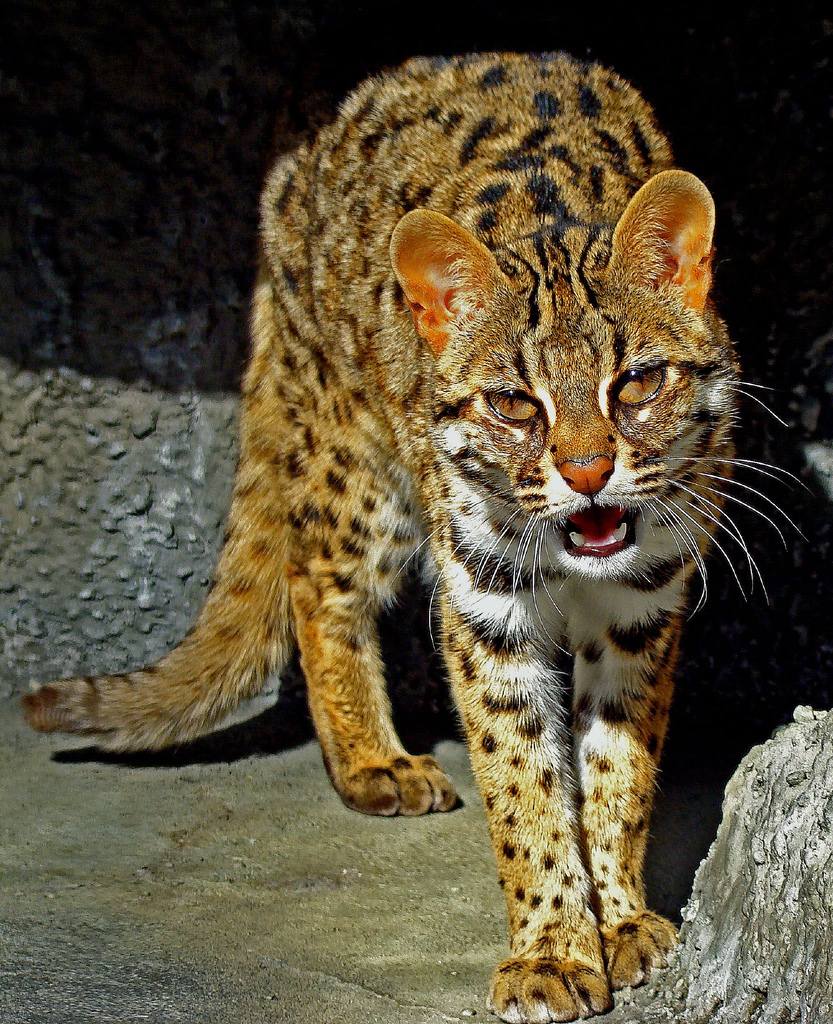
4. Iriomote cats
The last 100 or so critically endangered
Iriomote cats (
Prionailurus bengalensis iriomotensis)
live exclusively on the 284-square-kilometer Japanese island from which
they get their name. These forest-dwelling felines—which aren’t much
bigger than domestic cats—probably didn’t face many threats until the
human population started to expand on the island. The modern age brought
development, predatory domesticated dogs, diseases from domesticated
cats, invasive cane toads and wild boars, new roads and, perhaps worst
of all, automobiles. So many Iriomote cats have been killed by cars that
the island is covered with signs warning drivers to watch out for
them—which makes it kind of ironic that one of the few chances you’ll
ever get to see an Iriomote cat is in a 60-second video shot in 2010
by a passing motorist.
5. Scottish wildcats
A hundred years ago more than 100,000 Scottish wildcats (
Felis silvestris grampia)
roamed the Scottish Highlands. Fabled for their ferocity and often
referred to as Highland tigers—although they are not much bigger than
house cats—the wildcats are now almost completely gone. As I wrote last year, the native wildcats were done in by the introduction of feral and domesticated cats (
Felis catus),
which not only competed with the wildcats for prey but also bred and
hybridized with them, diluting their gene pool to the point where few,
if any, remain. Some scientists estimate that there may be fewer than
100 Scottish wildcats left. Even so, the scientists fear that only a
handful of the remaining wildcats are genetically pure. A breeding
program has been put in place, and new DNA technology might help
identify the best and purest prospects for breeding, but in all
likelihood the Scottish wildcat will fade away in another couple of
generations, if it even takes that long.
6. South China tigers
Photo: A South China Tiger at Shanghai Zoo photographed by J. Patrick Fischer. Used under Creative Commons license
It’s hard to say how many South China tigers (
Panthera tigris amoyensis)
remain in the world. In the 1950s there were an estimated 4,000 members
of this subspecies, but they didn’t last long after the Communist
government of China declared the cats an “enemy of the people” in 1959.
Today the subspecies is considered “critically endangered, possibly
extinct in the wild.” No sightings of wild South China tigers have been
confirmed since the 1970s, when the last known tigers were collected and
brought into captivity. Although reports of wild tigers turn up from
time to time, none of the sightings have yielded conclusive proof. The
most noteworthy event occurred in 2007, when a farmer said he took
several photographs of a wild South China tiger, but they were later
proved to be frauds.
The only South China tigers that we can verify live in captivity.
Breeding efforts over the past 40 years brought the subspecies’
population up to around 100. A few of those cats actually live in South
Africa at a reserve set up by the organization
Save China’s Tigers,
which runs a program to breed and teach captive-born animals how to
survive in the wild. Although the effort has successfully bred more than a dozen new tigers in South Africa, it has also earned its share of criticism, most recently in 2011, when one of its tigers broke through an electrified gate and killed another.
The Chinese government says it intends to eventually create a
national reserve to allow these rare tigers to live in the wild, but
whether that happens or not remains to be seen.
Next?
Sadly, several more cat species could easily join this list. The
Javan leopard (
Panthera pardus melas) and the
Arabian leopard (
Panthera pardus nimr) are both critically endangered, with populations of about 250 and 200 cats, respectively. The
Asiatic lion (
Panthera leo persica) numbers about 400, all of which live in a single forest in India. Only about 160 wild
Florida panthers remain, although scientists today debate whether or not they should continue to be listed as their own subspecies.
Indonesia’s
flat-headed cat (
Prionailurus planiceps)
was declared endangered in 2008, with no single population larger than
250 adults. As pressures increase, more felines will suffer. And as time
progresses, we will probably have a few extinctions to report, because
for too many of these species their nine lives are drawing to a close.




 Yawning lion


