Monday, May 26, 2014

Easy, tigers! Woman keeps two big cats in her garden and treats them like normal pets

... by stroking, nuzzling and even KISSING them 

  • Janice Haley, 57, keeps two pet Bengal tigers, Janda and Saber, in the back garden of her home in Orlando, Florida
  • Janda is a female orange Bengal, weighing 400 pounds, while Saber is a white Bengal male weighing 600 pounds
  • Each day Mrs Haley hand feeds the tigers their meat and says Saber can't get off to sleep without suckling her finger
By Jennifer Newton
While most people tend to use their garden as a place of relaxation, Janice Haley chooses to use her backyard as a place to keep her two pet tigers. Saber, a 600 pound male white Bengal tiger and Janda, a 400 pound orange Bengal female live in a cage at the back of Mrs Haley's unassuming suburban home in Orlando, Florida. Each day, the 57-year-old hand feeds the tigers as well as stroking and feeding them and says Saber, the younger tiger, can't get off to sleep without suckling on her finger. 

Mrs Haley quit her job as an admin assistant to spend more time working outdoors around 20 years ago and then took a tiger training course, which she spotted in her local newspaper. Two years later she arrived home with Chuffer the tiger cub and was immediately bitten by the tiger bug.  In 2002 she bought Janda, who is now 12, to live with Chuffer. After Chuffer's death in 2007 she then introduced Saber, who was only two weeks old at the time.

Scroll down for video
Janice Haley, pictured lying down with her pet tiger, Janda at her home in Orlando, Florida

Janice Haley, pictured lying down with her pet tiger, Janda at her home in Orlando, Florida

Janda the tiger, pictured, is now 12 and went to live with Mrs Haley in 2002. She weighs over 400 pounds

The two tigers are hand fed chunks of meat by their owner Mrs Haley, who cares for them in her back garden


Mrs Haley, keeps two tigers in a cage in her back garden. Here she gives Saber, a white Bengal tiger a kiss


Cara Yeatts leans back and relaxes with Saber in his enclosure at his owner's home


Mrs Haley treats the two tigers like ordinary pets by stroking and cuddling them


Janda, left, was put out of place when Mrs Haley introduced Saber, right, to the enclosure but they now get on most of the time

Janda, left, was put out of place when Mrs Haley introduced Saber, right, to the enclosure but they now get on most of the time


The tigers even get on with other pets such as puppy Buddy, who is pictured bonding with Janda

Mrs Haley pictured with her husband David
Mrs Haley, seen here with Saber in 2007 when she first took him in after the death of her other tiger, Chuffer
Mrs Haley pictured with her husband David, left, spend all their free time caring for their pets. Right, Mrs Haley, is seen with Saber in 2007 when she first took him in after the death of her other tiger, Chuffer


Mr and Mrs Haley's unassuming suburban home in Orlando, Florida, where the tigers live
Mr and Mrs Haley's unassuming suburban home in Orlando, Florida, where the tigers live source

Your Daily Cat

Friday, May 23, 2014

Tiger Overload (Video)

The Time My Mom Got Me A Tiger (VIDEO)


When Todd Bieber was a young boy, all he wanted for his birthday was a tiger.

Now, years later, that wish finally came true. The filmmaker recently uploaded a video to YouTube telling the story of his mother, who fulfilled his childhood dream by helping him sponsor a Tiger named Simon from T&D's Cats of the World. in central Pennsylvania.

T&D's Cats of the World is actually an exotic wildlife rescue organization, not limited to just big cats. In this case, though, they rescued Simon and a few other tigers who were used as "photo babies" until they were too big and deemed dangerous. After T&D's took them in, Bieber's mom made a list of things the animals needed, sponsored Simon in her son's name and let him go deliver the items in person.

Bieber's gift is no small responsibility: the tigers will eat 20 to 30 pounds of meat every day and live for 12 to 20 years. Although he doesn't "own" Simon, he does have an opportunity to be a part of his health.

To see the whole story unfold and the other incredible animals housed at T&D's, check out the video above.

source

Painted Cats? (Video)

Your Daily Cat

Big Cats are a lot like Little Cats (Videos)


Thursday, May 22, 2014

Your Daily Cat


Chitwan National Park starts special research on tigers


Tigers
File photo 
 
CHITWAN, MAY 22 - The Chitwan National Park (CNP) has started research on tiger activities including reproduction from a special way. The park started research with the support from different donor agencies.
Assistant Conservation Officer at the Park, Tikaram Poudel, said that the park has started research on tiger activities in the park through camera trapping method till four years. As many as 15 cameras have been used to capture the activities of tigers .
The research has been limited to Khoriya Source to Dumariya and Bankatta to Bote Simara of the Park.
Poudel said that different activities of tigers including regular activities, behavior, breeding condition, health condition and relation to other animals, would be enquired from camera trapping for four times once a year till four years.
The park said that the research will be completed after four years after collecting the pictures trapped through cameras.
This is the first time, the country has started such type of special research. As per the recent census, there are 120 tigers in the park. RSS

source

I see the moon!

There's a Full Moon Tonight!

Wednesday, May 21, 2014

Your Daily Cat

World's Oldest Cat Is A Party Animal, Eats KFC

Posted:

Who needs health when you've got nine lives?
The world's oldest living cat has a taste for KFC and kebabs. Poppy, now blind and deaf and feisty as ever, is pretty much the coolest cat to grace the Internet since yesterday. Guinness World Records crowned her the oldest living cat at the young age of 24 -- or 114 in human years, according to SWNS.

She was born in February, 1990. Her family isn't sure exactly how she was able to hold on for so long, but one of her secrets is eating KFC chicken, kebabs, fish and chips and canned cat food, NBC News reports.

Just look at that birthday cake!

oldest cat

"Poppy is definitely the top cat and she is still quite feisty," said Jacqui West, Poppy's owner, at her home in Bournemouth, England. "If one of the other cats tries to eat her food she will bite them on the ear."

oldest cat

Poppy has a long way to go if she wants to be dubbed the OLDEST CAT OF ALL TIME, however. Creme Puff, who lived in Austin, Texas, made it to 38 years and 3 days, and died in 2005. The average cat lives about 15 years, NBC News reports.


source
Party on, Poppy.

Monday, May 19, 2014

Your Daily Cat

Snubbing lion hunters could preserve the endangered animals

Date:
May 14, 2014
Source:
University of California - Davis
Summary:
A change in longstanding cultural practice in Tanzania is saving some endangered lions from being killed by hunters. For hundreds of years young men from some ethnic groups in Tanzania, called "lion dancers" because they elaborately acted out their lion killing for spectators, were richly rewarded for killing lions that preyed on livestock and people. Now when a 
lion dancer shows up he might be called a rude name rather than receive a reward.


A Tanzanian lion dancer does the lion dance, which captures the adventures of the lion killer.
Credit: Adi Swami


For hundreds of years young men from some ethnic groups in Tanzania, called "lion dancers" because they elaborately acted out their lion killing for spectators, were richly rewarded for killing lions that preyed on livestock and people. Now when a lion dancer shows up he might be called a rude name rather than receive a reward, according to a new UC Davis study.
Some villagers are snubbing the lion killers, calling them "fakers" and contemplating punishing them and those who continue to reward them, said Monique Borgerhoff Mulder, anthropology professor at UC Davis. That's because the lion hunters are killing lions that are not a threat to people or livestock and live in a national park.

This surprisingly rapid change in a long-standing cultural practice has positive implications for efforts to save lions, said Borgerhoff Mulder, lead author of "From avengers to hunters: Leveraging collective action for the conservation of endangered lions." The paper was published in the May edition of the journal Biological Conservation.

Traditionally, after killing a predatory lion using only a spear and shield, the hunter would travel from village to village, perform the dance and be showered with gifts including livestock and even a night with young women in the village.
"This change in behavior offers an intriguing solution to the problem of illegal hunting insofar as the community is policing itself," Borgerhoff Mulder said. "It is a real opportunity to work with a community that is changing its customs in a way compatible with a conservation goal."

A change coming from within the community will also be more long-lasting than rules and regulations from the outside, she said.

The study interviewed 198 households with 73 reporting being visited 128 times by dancers between 2001 and 2010. The households rewarded 96 dancers (75 percent) and did not reward 33 (25 percent). Although most households are still rewarding the dancers, 96 percent stated that the nature of lion killing had changed, and 72 percent said that the young men were killing lions just to acquire wealth. "The hunters are going deep into the national park, the border of which is 8 to 10 miles away," Borgerhoff Mulder said. "People are saying they are cheats and are not going to give them gifts any longer. The community has found a reason for policing itself. This is a rare instance of wildlife conservation and community actions working in tandem."

Story Source:
The above story is based on materials provided by University of California - Davis. Note: Materials may be edited for content and length.

Journal Reference:
  1. E. Fitzherbert, T. Caro, P.J. Johnson, D.W. Macdonald, M. Borgerhoff Mulder. From avengers to hunters: Leveraging collective action for the conservation of endangered lions. Biological Conservation, 2014; 174: 84 DOI: 10.1016/j.biocon.2014.03.012


University of California - Davis. "Snubbing lion hunters could preserve the endangered animals." ScienceDaily. ScienceDaily, 14 May 2014. <www.sciencedaily.com/releases/2014/05/140514153237.htm>.

Sunday, May 18, 2014

For now Rocky's just a big cat, not bobcat, can go home


Who's the daddy of a 38-pound hybrid bobcat that was wandering around in early April? The answer to that question may never be known, but for now, this big kitty gets to go home to his owner. VPC


STAFFORD TOWNSHIP, N.J.— Who's the daddy of a 38-pound kitty that was wandering around this area in early April? The answer to that question may never be known. For that reason Rocky, a cat who's supposed to be a cross between a bobcat and a Maine coon but was suspected of being a purebred bobcat, can go home. That was Municipal Court Judge Damian G. Murray's surprise ruling Friday as Rocky's owner, Ginny Fine, waited to hear results of a DNA test on her 3-year-old feline.

If the DNA test had revealed that Rocky was pure bobcat — males can weigh as much as 40 pounds while male Maine coon cats can tip the scales at more like 25 pounds — Fine would not have been allowed to have him back. New Jersey bans residents from owning "potentially dangerous species" as pets, which includes nondomestic cats, and she would have had to qualify for a special permit generally not issued to nonprofessionals.

But a bobcat hybrid is just considered a big kitty under state law. Elsie (one of her domestic cats) has been walking around the house, looking in all the rooms for him. ~~Ginny Fine, Stafford Township, N.J.

Murray revealed the results of a mitochondrial DNA analysis performed on Rocky's blood at the Northeast Wildlife DNA Laboratory at East Stroudsburg University in Pennsylvania."The mother was determined to be a bobcat," Murray said, noting that the DNA test revealed Rocky's mother was 98% lynx rufus, or bobcat. Mitochnodrial DNA is inherited exclusively from the mother, so the DNA test revealed nothing about Rocky's father.

The test could not determine who Rocky's father was, and the Montana breeder from whom Fine obtained Rocky was not required to keep records of the animal's lineage, Murray said. "The bottom line is Rocky goes home," the judge said. The ruling caught Fine off guard. But she's ecstatic despite having just pleaded guilty to letting the animal get loose and being fined $1,000. "I'm shocked," Fine said later. "I was not expecting that."

She said her house cats, Elsie and Checkers, will be happy to see Rocky, who has been declawed.
"They miss him terribly," Fine said. "Elsie has been walking around the house, looking in all the rooms for him."


Fine hopes to pick up Rocky on Monday from the Associated Humane Societies' Popcorn Park Zoo in Lacey, N.J., where the big cat has been kept since April 7. Officials there already had determined that Rocky has a domestic temperament, something Fine had told the judge.

Animal control officers brought Rocky to Popcorn Park Zoo a day after Fine had lured him back home. He had gotten loose March 25. Murray ordered that Rocky be kept in an enclosure that officials from New Jersey's Division of Fish and Wildlife will inspect periodically. "It is something I don't have a problem doing if I can have the cat back," Fine told the judge.

Outside the courtroom, she said the enclosure already has been constructed with money donated by people who want to see Rocky return home. Animal Control Officer Kelly Karch said it will be inspected Monday In imposing the $1,000 fine, Murray said the hunt for Rocky incurred labor expenses for police officers, who were "all over this town, hunting through the woods" for Rocky. It was the second time Rocky had run away.

Fine also had to pay $216 in restitution to Stafford Veterinary Hospital for tranquilizer medication used during an attempt to capture Rocky the second time. But Rocky is still not out of the woods: Murray said he could be subject to seizure in the future if his father can be determined to be a bobcat.


Your Daily Cat

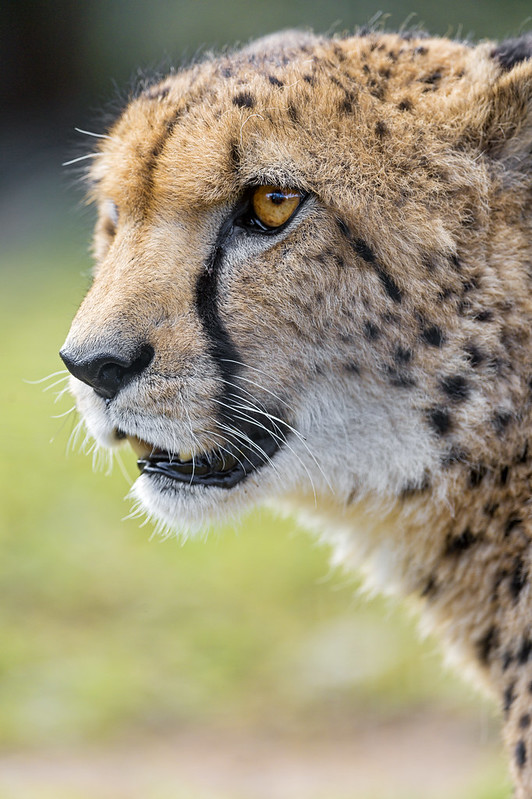
Profile of a Cheetah

Tigers in Grand Rapids: 3 big cats have arrived at John Ball Zoo


Name: Nika. Sex: female. Age: 9. Weight: 260 pounds. Nika was born at Connecticut's Beardsley Zoo in Bridgeport, Conn., then five years ago moved to Potter Park Zoo in Lansing. There she gave birth to three female cubs - Kira, Savelii and Ameliya. Ameliya remains at Potter Park with her father, Sivaki. The other two cubs recently moved to Bramble Park Zoo in Watertown, S.D. (Photo courtesy of Carolyn R. Schulte, www.flickr.com/photos/carolynrschultephotography)

 Name: Yuri. Sex: Male. Age: 3. Weight: 450-plus pounds. Yuri, which means "George" in Russian, is named after Curious George because he's inquisitive. He's the one with the horseshoe-shaped marking above his right eye. (Photo courtesy of Catherine N. Stolz)

Name: Kuza. Sex: Male. Age: 3. Weight: 450-plus pounds. Kuza is Yuri's brother and also comes from to Grand Rapids from Rosamond Gifford Zoo in Syracuse, N.Y. Unlike Yuri, Kuza is cautious and timid. When the tigers got a cardboard box with meat treats for their first birthday, Yuri ripped into it while Kuza shied away. (Photo courtesy of Catherine N. Stolz) 

Part of John Ball Zoo's new Crawford Tigers of the Realm exhibit is scheduled to open June 14, 2014. A trail and lower habitat area is slated to open in 2015.

Krapinka was the last tiger on exhibit at John Ball Zoo. The female Amur tiger in 2009 was moved to Roosevelt Park Zoo in Minot, N. D. In this 2007 photo, she strolls through the zoo's old tiger exhibit as preschoolers from Legacy Christian School in Culterville watch. (MLive.com file)

Urod was 17 years old when he died at John Ball Zoo in 2006, leaving one female tiger who was moved out of the zoo three years later.

Nicole, an Amur tiger born at John Ball Zoo in 1998, died in March at the Oregon Zoo. (Photo by Michael Durham/Oregon Zoo)

Yuri, left, and Kuza toy with a snowman. The two 3-year-old male Amur tigers have moved to John Ball Zoo in Grand Rapids and will be part of a new Crawford Tigers of the Realm exhibit set to open in June. (Photo courtesy of Catherine N. Stolz)

By Matt Vande Bunte
on May 16, 2014
GRAND RAPIDS, MI – Three tigers now are living at John Ball Zoo.

Tigers will return to John Ball Zoo Barb Snyder talks about the upcoming return of tigers to the John Ball Zoo.
 
Nika, a female, and two males, brothers Kuza and Yuri, moved this week to the Kent County zoo at 1300 W. Fulton St. They will be quarantined for a couple weeks before the zoo’s new Crawford Tigers of the Realm exhibit opens next month, spokeswoman Krys Bylund said.

The exhibit in the zoo’s Idema Forest Realm is scheduled to open to the public Saturday, June 14.
Nika, a 9-year-old, came from Potter Park Zoo in Lansing. She is unrelated to the two male tigers now at John Ball Zoo.

Kuza and Yuri are 3-year-old brothers who came from Rosamond Gifford Zoo in Syracuse, N.Y. Each weighs about 450 pounds.

The new arrivals are Amur tigers, which are native to Siberia and have a life expectancy of 14 years for females and 16 years for males.


Barb Snyder talks about the upcoming return of tigers to the John Ball Zoo.