Wildlife expert reveals why big cats are slowly dying in Kenya's Maasai Mara
By Sanskrity Sinha
Lion population in Mara has fallen by a third in last two decades.Marko Djurica/Reuters
The
Maasai Mara game reserve in Noarok County, Kenya, has been witnessing
what experts call an age-old conflict between its indigenous people and
predators. Lions have been the worst affected as their population in
Mara has declined by a third in the last two decades.
While
the Maasai people – ancestral inhabitants of the region after whom the
reserve has been named – have claimed their safety as the primary reason
for killing animals, experts state that there is more to it than meets
the eye. The most recent attempt to kill lions in Mara, located about
300km southwest of Kenya's capital Nairobi, was made in December 2015
when two tribesmen allegedly poisoned and killed eight lions,
which included seven from the famous Marsh Pride. These lions were
featured on the BBC wildlife programme Big Cat Diary in 2007.
Two of the lions of the pride died due to poisoning. Another
Marsh Pride lioness called Siena, whose two-year-old cub was among
those poisoned, has unfortunately not been seen since the incident.
To understand the reason behind the killing of lions and other wild animals in Maasai Mara, IBTimes UK
exclusively spoke to travel and wildlife expert Brian Jackman, an
award-winning journalist and author. He is a patron of Tusk Trust, of
which Prince William is the royal patron.
Jackman talked
about solutions, including granting the national park status to the
reserve and empowering local people to reap benefits from the presence
of lions through eco-tourism such as the conservation safari offered by Tusk Trust's long-standing partner, The Ultimate Travel Company.
Excerpts from Brian Jackman's interview: Brian JackmanBrian JackmanWhat
are the wider problems surrounding incidences like the poisoning of
lions in Maasai Mara in early December? Why do tribesmen want to kill
the endangered species? Is it just for their safety or is there more to
it?
Every night, tens of thousands of cattle
encroach into the reserve when visitors are safely out of sight – but
the likelihood of a conflict between predators such as lions and hyenas
is greatest at this hour. Not only is this illegal, but it is inevitable
that cattle would be killed by lions when deliberately driven into
harm's way.
When two cows were killed in early December, tribesmen
retaliated by leaving poison [in food] that killed the world's most
famous lions. This makes no sense. The Masai Mara is after all a
national reserve, of vital importance not only to the Masai [people],
but to Kenya and the world at large. This sorry state of affairs is
testimony to the appalling management of the Reserve, run by the Kenyan
equivalent of a local council when ideally it should have been made a
national park many years ago.
[According to International Union
for Conservation of Nature (ICUN) national parks are state-owned and
have stricter regulations for conservation and protection, where as
reserves may or may not be owned by the state and the level of
protection is determined by local laws.]
On 4 January,
as the Kenya-based animal welfare and rescue organisation David
Sheldrick Wildlife Trust reported, a lioness with a snare around its
neck was found in the Mara. Could it be an attempt to kill or capture? Maasai tribesmenReutersIt
is extremely doubtful that this was an attempt to kill or capture a
lion. Snares are widely used by poachers employed by the illegal trade
in bush-meat. Their targets are other species – mostly antelope,
wildebeest and zebra; but lions are sometimes caught by accident and
elephants also suffer horrible injuries when caught by the trunk.
Lioness
Sienna from the famous Marsh Pride is missing since the poisoning
incident. What could have happened to her? If dead, why was her carcass
not found?
Sienna, aged 11, was one of the Marsh
Pride's best-loved matriarchs and has never been seen since the
poisoning incident in which the veteran lioness Bibi was killed. The
most likely explanation is that she wandered off before collapsing and
her carcass eaten by hyenas [Jackman does not see involvement of
poachers].
What Kenya should do to end the conflict between people and predators?
What
needs to be done to protect the lions of the Masai Mara sounds simple:
Uphold the law and stamp out corruption. As one of the seven natural
wonders of the world, the Mara ought to be a national park, but politics
have made this an impossible dream – until now. Maybe it is time for
President Uhuru Kenyatta to step in and save the Mara and its lions
before they are lost forever. A lioness walks in front of her cubs at the Maasai MaraReutersAdditionally,
it is worth pointing out that schemes are already in place whereby
livestock owners are compensated for the loss of animals due to
predation. I also believe it would be helpful if more land was set aside
exclusively for grazing in the Greater Mara beyond the borders of the
National Reserve, in the same way that private conservancies have been
established to protect wildlife and promote responsible eco-tourism.
Africa's
lion population is dwindling. Could you throw some light on the general
plight of lions being harmed across the continent?
Back
in the 1960s Africa still had around 200,000 lions. Today there are
fewer than 25,000 and the population is likely to fall again by half in
the next 20 years. This decline is reflected in the Mara, where the lion
population has fallen by a third in the past 20 years, although lions
are increasing in the surrounding wildlife conservancies. The main
causes are loss of habitat, conflict between lions and livestock
herders, and trophy hunting in countries where it is still allowed, such as Zimbabwe and Tanzania. The only glimmer of good news is the recent discovery of between 100 and 200 lions in a remote part of Ethiopia where they were not known to exist.
Kittens are photographed on the set during a taping of Kitten Bowl III in New York. (AP Photo/Mary Altaffer, File)
Cats to compete in Kitten Bowl
By Leanne Italie Associated Press
February 04, 2016
On the field, the four-legged fur balls of the Hallmark Channel's Kitten Bowl III were all business.
But off? Well, let's just say there were some impurr-prieties dogging these feline paw-thletes.
"Sometimes we get into an issue or two. They tend to like to really
delve into the catnip, and that type of thing sometimes gets a little
out of control," quipped Boomer Esiason. He is the Feline Football
League commissioner for the Super Bowl Sunday event on Feb. 7.
It was Esiason's second turn as commissioner. He kept his tongue firmly
in cheek in fending off any appearance of influence peddling this time
around with the fielding of his own team of kittens. They are the Boomer
Bobcats.
"I'm not like that. I'm above all of that, and my quarterback Ben
Roethlis-purrger -- we like to call him Big Ben -- is just so cute and
cuddly. I'm telling you he's going to knock everybody's socks off this
year."
Big Ben's human doppelganger is Pittsburgh Steelers QB Ben Roethlisberger.
In addition to Esiason, Hallmark got some help from host Beth Stern and
the North Shore Animal League America. The league supplied nearly 100
rescue kittens to fill up Hallmark's bite-size football field. It was
decked out with scratchy goalposts and plenty of cat toys to keep the
action moving when the event was taped in October.
All of the tiny footballers were later adopted. A few were taken home
for fostering by Stern herself. Her husband is radio personality Howard
Stern. He is the official cat namer of their family that includes six
resident felines and a steady stream of fosters.
Beth Stern, a spokeswoman for North Shore Animal League, is the master of the cat-human selfie on Instagram. Her secret?
"With the selfie I have to look good, of course. So I always have to put
the iPhone up high. But I can never get a bad angle of the kittens,"
she said.
Human wranglers ringed the elevated Kitten Bowl set. They sent little
slackers trying to escape back on the field. Hydration came in metal
water bowls on the sidelines, along with a couple of handy litter boxes.
Esiason is an NFL most valuable player and four-time Pro Bowl
quarterback. He was happy to help out worthy kittens. But back home,
it's all about the dogs. He has two, to be exact. He used to have a cat,
a Himalayan with bright blue eyes called Frankie, named for his college
roommate.
He said he's got nothing but love for the adorable, feisty participants in the Kitten Bowl.
"The kitten players," Esiason offered, "are so much easier to deal with than human players."
Mr
Chua, with a preserved specimen of the leopard cat, estimates that
there are no more than 20 of them living on mainland Singapore, in the
nature areas. He found a larger population of leopard cats on offshore
Pulau Tekong, which is 32 times smaller than the mainland.ST PHOTO: ALICIA CHAN
A leopard cat kitten on Pulau Tekong. PHOTO: COURTESY OF MARCUS CHUA
A leopard cat on Pulau Tekong.PHOTO: COURTESY OF MARCUS CHUA
Leopard cats are critically endangered but a study finds them thriving on Tekong
By Audrey Tan
February 4, 2016
When night falls on the military training ground of Pulau Tekong,
camouflaged figures emerge from the foliage - silent and invisible. They
skulk through the vegetation, each individual on its own mission.
These are not soldiers, but leopard cats - the last remaining wild
cat species found in Singapore. (Leopards have gone extinct here, and
the last tiger in Singapore was shot in the early 1930s.)
These nocturnal animals, which have unique coats that help them blend
into the shadows of surrounding vegetation, were found here in larger
numbers during the early 20th century.
But they are now critically endangered in Singapore due to the loss of their natural forest habitats.
Mammal researcher Marcus Chua, 31, estimates that there are no more
than 20 leopard cats living on mainland Singapore, in the nature areas
located within the Safti Live Firing Area, as well as at the Central
Catchment and Bukit Timah nature reserves.
But nature is resilient, and Mr Chua's latest study, published in
science journal Mammal Research last month, has given conservationists
reason to cheer.
Mr Chua found a larger population of leopard cats on Pulau Tekong, a
23.5 sq km island that is 32 times smaller than mainland Singapore. Data
collected shows that they are thriving there. He recorded at least 29
leopard cats on the island, identified through unique coat markings that
distinguish the animals in the same way human beings are differentiated
through fingerprints.
About leopard cats
• Urbanisation has made the leopard cat a critically endangered
species in Singapore, but it is found widely in Asia. In Singapore, they
"deserve conservation focus", said Dr Sonja Luz, director for
conservation and research at Wildlife Reserves Singapore. "Leopard cats
are Singapore's last extant wild feline species," she added.
• Leopard cats are common victims of the illegal wildlife trade. They
are hunted for the pet trade, for their bones, which are used in some
Asian traditional medicines, and for their fur. It takes around 16
leopard cats to make one fur coat, said mammal researcher Marcus Chua of
the Lee Kong Chian Natural History Museum.
• Leopard cats are often involved in human-animal conflict in farming
communities. The cats prey on poultry, prompting villagers to kill
them.
• Leopard cats can breed with domestic cats to produce, for instance, the popular domestic bengal cat.
SOURCES: WILDLIFE RESERVES SINGAPORE, INTERNATIONAL UNION FOR CONSERVATION OF NATURE, MARCUS CHUA Audrey Tan
Using camera trap records and mathematical algorithms, the population
of leopard cats on Pulau Tekong was put at about 89 individuals for
every 100 sq km - the world's highest.
Leopard cats appear to be doing better on Pulau Tekong than on the
mainland as they do not have to compete with other animals, such as
civets, which also prey on rats, birds and insects, said Mr Chua, who is
curator of mammals and birds at the Lee Kong Chian Natural History
Museum. There are no civets on Pulau Tekong.
On the importance of the animals, he said: "Leopard cats are meso
predators, which means they are in the middle of the food chain. They
are prey for bigger animals like pythons, and also help to regulate the
population of smaller animals like rats and birds."
A leopard cat captured on camera at the Central Catchment Nature Reserve. PHOTO: COURTESY OF MARCUS CHUAAnother encouraging find from his study is that leopard cats are
resilient animals, and able to adapt to human-modified landscapes
despite the loss of their natural lowland rainforest and swamp forest
habitats.
Pulau Tekong is located off the north-eastern coast of Singapore. The
island is covered mainly by secondary forest. Most of it dates back 40
years, although the vegetation growing on a 6 sq km patch on the
southern part of the island is younger. That area, connected to the
original island by two bridges, was reclaimed in 1987.
On the eastern end of the island is an oil palm plantation, which has
been changed even more by human intervention. Yet, Mr Chua's study
found that most of the leopard cats - 13 of them - were recorded in the
plantation. In comparison, eight individuals were recorded in secondary
forests located on each of the original and reclaimed parts of the
island.
Mr Chua said that the fruiting trees in the plantation attract
smaller animals like rodents, turning the plantation into a "buffet
table" for the leopard cats. "What I also found surprising is that the
leopard cats were also found in the reclaimed part of the island," he
said.
However, Mr Chua said that although oil palm plantations appear to be
a good place for leopard cats to find food, forests - for shelter and
breeding - are still important for their survival. His study, funded by
Wildlife Reserves Singapore (WRS), was done over two years, from 2010 to
2012.
Dr Sonja Luz, WRS director for conservation and research, said his findings were encouraging.
"This research provides valuable information on their habitat use,
ranging patterns, diet and basic population genetic analyses, which
helps us better understand their tolerance levels and conservation
requirements...," she said. "Further research to genetically assess the
similarity of the Singapore population with neighbouring countries'
populations will also be needed to formulate an effective conservation
action plan," she added.
More should be done to stop the use of endangered
species in traditional Chinese medicines, with snow leopard, tiger and
rhinoceros DNA still being found in remedies, according to a leading
pathologist.
More should be done to stop the use of
endangered species in traditional Chinese medicines, with snow leopard,
tiger and rhinoceros DNA still being found in remedies, according to a
leading University of Adelaide pathologist.
In an article published in the journal Forensic Science Medicine and Pathology,
Professor Roger Byard, from the University's School of Medicine, has
shown that traditional Chinese medicine has been identified as a
significant driver in the illicit global wildlife trade. Furthermore,
most of the policing surrounding the illegal trade is associated with
species collection; the use of animal products in medicines is often
overlooked.
"Rhinoceros horn is used to "cure" disorders ranging from cerebral
haemorrhage to AIDS, selling for as much as US$50,000 per kilogram; the
powdered bones of tigers and mole rats are used to treat arthritis;
shell extracts of freshwater turtles are used to treat cancer; dried
geckos are used as an aphrodisiac; monkey skeletons are used to treat
general pain; and moon bears are milked for their bile through catheters
in order to provide people with a treatment for digestive illnesses,"
says Professor Byard.
"The World Health Organization has suggested that 80% of people in
developing countries rely on traditional medicines, and it has been
estimated that 13% of traditional Chinese medicines contain animal
derivatives.
"Approximately 50% of the reptiles used in traditional medicines are
on lists of threatened or endangered species. And the effectiveness of
many of these animal products in treating disease has not been
established," he says.
Professor Byard would like more to be done to control the use of endangered and threatened animals in traditional medicines.
"Wildlife crime has been estimated to cost between US$10 and 20 billion per year globally," says Professor Byard.
"While much of the crime involves the illegal collection of uncommon
species, or the use of rare materials such as ivory and rhinoceros horn
for decorative purposes, one area that is being largely overlooked is
that of traditional medicines.
"Surprisingly, even a Chinese medicine product purchased over the
counter in Adelaide, Australia, was found to contain traces of snow
leopard.
"Clearly any controls on the importation and sale of such a
preparation have failed. It is also uncertain what steps are taken by
authorities once such a preparation is brought to their attention.
"This illegal and very damaging trade needs to stop, however,
unfortunately, for a number of species, it may already be too late," he
says.
Story Source:
The above post is reprinted from materials provided by University of Adelaide. Note: Materials may be edited for content and length.
Journal Reference:
Roger W. Byard. Traditional medicines and species extinction: another side to forensic wildlife investigation. Forensic Science, Medicine, and Pathology, 2016; DOI: 10.1007/s12024-016-9742-8
The United States’s only wild jaguar has sneakily roamed around forests and remained elusive and out-of-sight — until now.
Rare footage showing “El Jefe,” the only known wild jaguar in the
country, was released on Wednesday for the first time, showing the big
cat exploring his natural habitat.
The 41-second clip shows the spotted jaguar stalking around at night,
walking through a river and exploring a forest in the Santa Rita
Mountains near Tucson, Ariz.
While the never-before-seen video was less than a minute long, it took
three years of intense tracking to compile the footage from
motion-capture cameras around the wooded area, Chris Bugbee, a biologist
with Conservation CATalyst said in a statement.
AP
While El Jefe has been spotted several times on motion-capture cameras, this is the first time he has been seen on video.
“Studying these elusive cats anywhere is extremely difficult, but
following the only known individual in the U.S. is especially
challenging,” he said.
The group even relied on a specially trained dog to sniff out the elusive endangered animal's feces.
While the jaguar has been captured in photos more than 100 times in the
last three years, this is the first time he’s been seen in motion on
video.
HANDOUT/REUTERS
The video is 41 seconds long, but took three years of intense tracking to put together.
Research showed that “El Jefe” — Spanish for “The Boss” — is an adult
male jaguar in prime condition, and currently the only known one in the
United States after “Macho B” was euthanized for a trapping injury in
2009.
Wild jaguars used to live around the American Southwest, near the Grand
Canyon, southern California and even near Louisiana more than 150 years
ago. Now the United States has been reduced to just one jaguar, after
years of government population control programs and habitat loss.
The big cats — only smaller than tigers and lions — primarily wander into the United States from Mexico.
AP
In the video, El Jefe is spotted roaming around the Santa Rita Mountains, just 25 miles away from Tuscon, AZ.
Researchers can only hope to find a second, female jaguar to accompany El Jefe and increase the endangered species’ population.
The last verified female jaguar in the U.S. was killed by a hunter in 1963 at Arizona’s Mogollon Rim.
But a Canadian coal mining company could ruin El Jefe’s home forever,
with plans to build a site right through the jaguar’s territory, driving
the big cat out.
“The Santa Rita Mountains are critically important to jaguar recovery
in this country, and they must be protected,” Bugbee said.
He's no stranger to the media limelight, though: Trail cameras have
photographed the male more than a hundred times over the past three
years, and schoolchildren named him El Jefe—which means "the boss" in
Spanish—during a nationwide contest in 2015. (See "'Indomitable' Jaguars May Have Lessons in Survival for Us.")
To catch the solitary cat on camera, conservationists used dogs to
sniff out jaguar scat, and then installed cameras in these strategic
spots.
A U.S. jaguar is rare indeed. As late as the 19th century, the big
cats frequently roamed from northern Argentina into Arizona, New Mexico,
and Texas. But ranchers and farmers settling the American West pushed
the world's third-largest cat out of its territory.
“He's typical of the extreme toehold that this species maintains in the U.S.,” says Luke Hunter, president and chief conservation officer for Panthera, a global wild-cat conservation organization.
“Since 1996 there has been evidence of a jaguar in New Mexico or
Arizona every year. But I think it has been a total of four or five
individuals and they've all been adult males.”
“Great Explorers”
El Jefe and his male predecessors seem to have dispersed from the closest breeding population which is located in Sonora, Mexico, more than 125 miles (200 kilometers) to the south.
“Probably these individuals left that breeding population in Sonora
and struck out on their own as young male jaguars do,” Hunter explains.
“Their mothers kick them out of their birth home range, and these young
male cats are great explorers.” (Learn more about National Geographic's Big Cats Initiative.)
Thanks to his epic journey, El Jefe is the boss of 764,207 acres
(309,263 hectares) of Arizona and New Mexico set aside by the U.S. Fish
and Wildlife Service as critical jaguar habitat.
“He's managed to find what a male jaguar really wants—space and a
good habitat with lots of prey like white-tailed deer,” Hunters says.
Conservationists have released video of the only known jaguar living in the country.
Shutterstock
Marina Koren
There are about 15,000 jaguars
living in the wild today. They are solitary creatures, preferring to
live and hunt alone. But the one living and hunting in the United States
takes the word “loner” to another level: The jaguar, nicknamed “El
Jefe,” is the only known wild jaguar in the country.
El
Jefe, which means “the boss” in Spanish, made his public debut
Wednesday in video footage released by the Seattle-based Conservation
CATalyst and the Tucson, Arizona-based Center for Biological Diversity.
The brief clip shows the big cat roaming the grassy forest floor of the
Santa Rita Mountains, outside Tucson, navigating rocky creeks, and just
doing jaguar-y things:
Since
2013, El Jefe has been photographed by motion-detecting cameras more
than 100 times. But jaguars are notoriously elusive creatures. The
41-second video posted Wednesday is the product of three years of tracking. Chris Bugbee, a biologist at Conservation CATalyst, said in a statement
that researchers regularly tinkered with camera locations and even used
a dog specially trained to sniff out wildlife feces to track down El
Jefe. Historically,
jaguars are not uncommon in Arizona. Their range once extended north
from Argentina to Central America and Mexico and up into south-central
states and even California and Louisiana. But the big cats all but
disappeared from the U.S. in the last century, mostly due to habitat
loss and federal population-control programs intended to protect
livestock. Will Rizzo described the bleak state of the jaguar in the U.S. in Smithsonian magazine in 2005:
In 1963, a hunter in Arizona’s White Mountains shot a female, the
last of her sex to be documented in the United States. Two years later,
the last legally killed jaguar, a male, was taken by a deer hunter in
the Patagonia Mountains, south of Tucson.
In 1969, Arizona outlawed most jaguar hunting, but with no females
known to be at large, there was little hope the population could
rebound. During the next 25 years, only two jaguars were documented in
the United States, both killed: a large male shot in 1971 near the Santa
Cruz River by two teenage duck hunters, and another male cornered by
hounds in the Dos Cabezas Mountains in 1986.
The conservation centers say a proposed copper mine by a
Canadian company in the middle of the Santa Rita Mountains threatens to
cleave thousands of acres from the jaguar’s natural territory.
Biologists
says El Jefe is the only verified jaguar living in the U.S. since Macho
B, who was euthanized in 2009 following injuries sustained when he was
captured and collared with a GPS tracker. The Arizona wildlife officials
involved in the capture said it was accidental, but it was later revealed
that one biologist had lured Macho B by placing feces from a captive
female jaguar in heat along a trail the animal was known to frequent. (The Arizona Republic’s Dennis Wagner has a fascinating and comprehensive account of the capture and cover-up here.)
These
days, the most jaguar conservationists can do—aside from hoping no one
shoots and kills El Jefe—is wait for other jaguars, particularly female
ones, to cross over the border from Mexico. Fingers crossed that happens
in time for Valentine’s Day.
Prepare
yourself: Conservation CATalyst and the Center for Biological Diversity
this week released stunning new video of the only known wild jaguar
living in the United States. Captured on remote-sensor cameras in the
Santa Rita Mountains just outside Tucson, the footage provides a glimpse
of the secretive life of one of nature's most majestic and charismatic
creatures. It's the first-ever publicly released video of "El Jefe," as
he was named by Tucson school kids (Spanish for "The Boss").
"These glimpses into his behavior offer the keys to
unlocking the mysteries of these cryptic cats," said Aletris Neils,
executive director of Conservation CATalyst.
"Knowing that this amazing cat is right out there, just 25
miles from downtown Tucson, is a big thrill," said the Center's Randy
Serraglio. "El Jefe has been living more or less in our backyard for
more than three years now. It's our job to make sure that his home is
protected and he can get what he needs to survive."
The camera project is part of ongoing work to monitor
mountain ranges around Tucson for endangered jaguars and ocelots, led by
Chris Bugbee, a biologist with Conservation CATalyst.
On Jan. 18, employees at Sakata Seed America Inc.’s Fort Myers,
Fla., research station found this rare male panther kitten abandoned and
sleeping in one of the research station’s fields.
Though other wildlife, including alligators, bears and cranes,
frequently visit the facility, this discovery was different because
Florida panthers are an endangered species and the kitten was young and
alone.
Photo by Sakata Seed America
Sakata Seed America Inc.’s Fort Myers, Fla., research station was recently visited by an unusual visitor.
On Jan. 18, Sakata employees performing field maintenance found a
male panther kitten abandoned and sleeping in one of the research
station’s fields.
Though other wildlife, including alligators, bears and cranes
frequently visit the facility, this discovery was different because
Florida panthers are an endangered species and the kitten was young and
alone, according to a news release from Sakata, Morgan Hill, Calif.,
company.
Sakata alerted wildlife officials and transported the kitten to the
Naples, Fla., zoo, which recently constructed a facility specifically
designed to provide housing for injured or orphaned panthers.
After the cat’s capture, Sakata opened its doors to tracking and
monitoring by wildlife authorities. They concluded the panther was most
likely lost during a rare encounter of two mothers with kittens in the
field and the animal attempted to leave with the wrong mother.
Cats younger than six months are generally not released back into the
wild because they lack sufficient survival skills, according to the
release.
“We are in awe of the robust wildlife here at the Sakata Seed America
Research Station, and it makes us appreciate the fact that agriculture
and wildlife can not only coexist, but flourish together,” Randy
Johnson, Sakata’s Florida station branch manager, said in the release.
“We consider ourselves lucky to be able to witness evidence of such a
majestic and endangered animal procreating on our property, and whenever
we see something like this, we know we are being good stewards of the
environment.”
About a year ago, Sakata employees began finding more panther tracks
in the fields and — perhaps not by coincidence — fewer raccoons were
eating their crops.
"Their brains are telling them that they love us."
02/01/2016
Elyse Wanshel
Trends Writer, The Huffington Post
Getty Images
The never-ending cat vs. dog debate has a new topic that fans of both
species can chew on/paw at: which pet loves its humans more?
Thanks to a new study done by neuroscientist Dr. Paul Zak, which will be featured in the BBC2 documentary show, Cat v. Dog, we have answer.
Canines were proven to love us Homo sapiens five times more than their feline counterparts.
But unlike commands like “stay,” “sit” and “beg,” the result isn’t that simple. Much like a cat, it’s way more complex.
Zak took blood samples from 10 cats and 10 dogs before and after they
played with their people. He tested each animal twice and checked the
samples for their level of oxytocin.
“Oxytocin is an attachment neurochemical or transmitter,” Zak told
The Huffington Post. “It’s a chemical we produce in our brain when we
care about someone. It’s what mammals release to bond with their young.”
Getty Images
According to Zak, humans
produce oxytocin whenever we have a positive experience, and the amount
we produce is contingent on how stressful our situations are when we
have that positive interaction.
A general breakdown, according to Zak is that we produce 15 to 25
percent oxytocin when we have a pleasant interaction with a stranger; 25
to 50 percent when we’re engaging with someone we know; and if we
release 50 percent or more, it’s in response to someone we really love
like a child or spouse.
During Zak’s experiment, dogs, on average, produced 57.2 percent.
“So your dog really loves you … a lot,” Zak said. “But what makes
this so amazing is that the oxytocin they produced is for another
species, not their own. The fact that this is cross species is really
freakin’ crazy/cool. Their brains are telling them that they love us.”
Getty Images
Cats, on the other hand,
only produced 12 percent -- and only 50 percent of the felines tested
produced any oxytocin at all. But if you’re a cat person, don’t hiss.
Zak points out that cats are less social than dogs and are extremely
territorial. Zak’s lab, where the experiments were conducted, was a
sterile and unfamiliar place for the cats, creating a more stressful
situation for the cats than the dogs.
When asked if the cats would have done better if they were tested in
the comfort of their own homes, Zak said, "I think so. Or at least more
cats would have produced more oxytocin."
When it comes to Zak’s pet preference, however, he’s clearly Team
Dog. He adopted a black and white puppy named Cookie after his daughter
discovered the stray in their garage a few years ago.
And if it weren’t for the research he’s conducted in regards to the
amount of love dogs have for their humans, he says he might have not
kept sweet, little Cookie.
“If it weren’t for the research we started three years ago, I
wouldn’t have let my kid play with an animal we didn’t know within two
seconds of meeting it,” he said. “But now I know it’s crazy how much
they care about you. And isn’t that cool?”
I'm standing with three
scientists in a cold, long corridor that smells of hay, meat, and cat
piss. We are looking into an empty, roomy cage. A hole in the cage leads
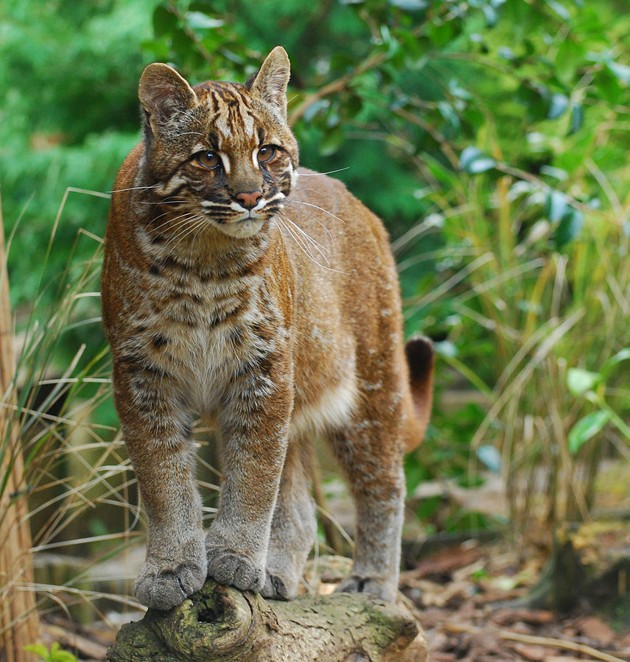
to an outdoor enclosure that contains an Asian golden cat—a beautiful
labrador-sized feline with rusty red fur. The scientists want the cat to
come through the hole and walk onto the platform that they've set up
inside the cage. As it steps, a metal plate will measure the forces
exerted by its footfalls.
The cat has other plans. We see its
tiger-striped face peer through the hole and then disappear. We wait.
Nothing. “It probably knows we're here,” says John Hutchinson,
one of the expectant researchers. We move to the side so as not to be
seen, leaning our heads around the wall of the cage like characters in a
cartoon. We are, I realize, trying to out-stealth a cat. It's going
about as well as you'd expect.
Golden cats normally live in the
jungles of southeast Asia, but this one currently resides in
Hertfordshire, England, within the grounds of a charity called the Cat Survival Trust.
The Trust's twelve-acre site, manned by volunteers, is home to several
species of wild cats, including unwanted animals from various zoos and
smuggled individuals seized by customs officials. One
block of large enclosures houses the bigger species—snow leopard, puma,
jaguar, and the extremely rare Amur leopard. Nearby, another block is
home to smaller ones like the serval (big ears, expert leaper), leopard
cat (spotted coat, huge eyes), caracal (orange coat, tufted ears),
jaguarundi (bizarrely weasel-like), and ... er... a raccoon (definitely
not a cat). The enclosures aren't labelled and its entrance looks like a
farm shop; this isn't a tourist attraction. The only visitors allowed
are members and school groups—and, occasionally, scientists.
Hutchinson's
team still isn't having any luck with the golden cat. Postdoc Andrew
Cuff walks round to the outdoor section to try and flush the animal in,
while undergraduate student Luke Grinham mans the equipment. But the cat
simply prowls around, watching the hole, twitching its tail nervously,
and ignoring the rain that starts to fall.
“Meow?” says Grinham.
Asian golden cat (Karen Stout / Flickr)The earliest known cat—Proailurus,
literally “first cat”—lived around 25 million years ago and weighed
between 10 and 15 kilograms, about the size of a modern ocelot or golden
cat. The family later diversified into around 40 living species (hidden ones are still being discovered).
Most are small, and prey upon rodents and other little victims. But
several lineages (including the puma, cheetah, and the other 'big cats')
independently evolved to be big, and can now tackle prey much larger
than themselves.
Today, cats span a huge range of sizes. The
rusty-spotted cat of India and Sri Lanka weighs just one kilogram, while
the mighty Siberian tiger is 300 times heavier. And yet, these animals
are surprisingly similar. “It's famously said that a lion is just a
scaled-up house cat,” says Anjali Goswami from University College London, who works with Hutchinson. “That's very weird.”
Their
legs are especially odd. When animals get bigger, their posture
changes. Their legs tend to straighten, becoming stiffer and more
pillar-like to better support their weight. Not so with cats. When a
lion strides across the savannah, it has essentially the same posture as
the domesticated tabby that slinks over your lap. Lions, tigers, and
leopards—oh my—are, as Hutchinson writes, the only large, crouching mammals. “You
can imagine walking around like this takes a lot of exertion,” says
Hutchinson. “We still don’t really understand how they do that without
suffering problems.” Odder still, “their muscles don't increase enough
in size to compensate for how much bigger they are,” says Goswami. “They
definitely get weaker as they get bigger, relative to their body size.”
Why? No one knows. It could be that a permanently crouched posture is
useful for stalking and pouncing. Perhaps it allows them to accelerate
forwards more easily, or makes them more agile.
The team is now
trying to solve the mystery of the crouching tiger by guiding different
cat species over force plates—fancy 3-D bathroom scales that will
measure the forces they produce with each step. Meanwhile, a camera will
record the positions of their legs. By combining this information, the
team can work out how cats differ in their movements, and whether the
big ones have any biomechanical tricks that compensate for their
unexpected postures.
Hutchinson is an old hand at such studies. He has guided rhinos, emus, elephants, salamanders, horses, and penguins
over force plates before. Each species presents its own challenges.
Giraffes were especially easy; cats, less so. The tigers of Colchester
Zoo were terrified of the force plates and the researchers
themselves—were, in turn, terrified of the tigers. But after a lot of
chicken bribes (and a few rubber mats that were torn apart by the
animals), the team got the data they needed. Here's what it looks like when things go well: a tiger strides purposefully through a wooden walkway and over a force plate embedded in the floor:
Having
captured data for panthers, pumas, tigers, and cheetahs, the team are
now trying to study smaller cat species, and the Cat Survival Trust has
several. “We’re mostly playing it by ear because we don’t know how these
animals are going to behave,” Hutchinson tells me. “It’s unpredictable
what’s going to happen here so we’re going to start with a relatively
easy animal.” He
meant the golden cat. Dispirited by its refusal to cooperate, the team
tried their luck with Pudding, a rambunctious four-month-old Eurasian
lynx with a spotted coat, tufty ears, and large doleful eyes. In the
wild, his long legs and large feet would be ideal for padding through
snow. In captivity, they're great for mauling a dead chicken, and
killing a broom that's propped up against his cage. Unlike the other
golden cats, Pudding is well acclimated to people. “We'll get something
with him; he should perform again and again,” says Hutchinson.
The
problem is that, acclimation aside, Pudding is still a cat—an innate
master of not doing what you want him to do. He pounces on the force
plates. He walks around them. He steps on to them but then leaps off. He
mooches on top of them. He bites the power cables. Hutchinson asks if
he can go in the cage and try to lead Pudding around. Sure, says the
keeper, “but he's got a thing for trying to sever your spinal cord.” The
keeper goes in with Pudding's teddy—a well-chewed soft toy lynx!—and
tries to lead him around, but he leaps and twists and runs, instead of
purposefully walking over the plates like the Colchester tiger. “We need
a bored cat,” says Hutchinson.
As we watch, I ask him if this
study will lead to any medical insights that would be important for cat
owners. It won't. It's simply about the evolution of these endearing
animals. “It’s a basic science project,” he says. “It’s
curiosity-driven.”
Curiosity, huh? Maybe that’s why the cats aren’t cooperating.
Barbara Thorpe left most of her $200,000 inheritance as a trust to care for the abandoned cats of Dixfield, Maine
But locals who have been caring for the strays claim the trustees have been withholding money for 13 years
One carer spends $9,000 a year on cats, but says the trust pays out just $300 a year, on average
The suit also alleges that one trustee upped her housekeeping charges from $8 to $100 an hour after Thorpe was placed in care
By
Associated Press
Published:
1 February 2016
Cat
lovers in Dixfield, Maine, have teamed up with the town itself to take
a local woman's estate trustees to court as part of a 13-year dispute
over money that she left to local abandoned cats.
Although
Barbara Thorpe wished to leave the lion's share of her $200,000 estate
to pay for food, shelter and veterinary care for the stray cats of
Dixfield when she died in 2002, plaintiffs in the case — including the
town itself — claim that her trustees are refusing to put money in the
kitty.
Thorpe's
will named her friend, Gertrude Crosby, as her sole representative, and
requested that she give money to a number of friends and institutions,
including $5,000 to a Shriners Hospital for children. Once that was
done, and estate expenses were paid, the remaining $147,978.63 plus life
insurance proceeds were to be used to create a memorial trust to care
for local strays.
Brenda Jarvis is one of five Dixfield,
Maine locals who are suing the trustees of Barbara Thorpe's estate,
accusing them of refusing to pay the money that Thorpe left to local
cats in her will. Thorpe left almost $150,000 to the strays of Dixfield,
hoping it would be used to pay for their food, shelter and care
But
a group of local cat carers — Noreen Clarke, Brenda Jarvis, Caroline
Smith, Valerie Warriner and Donna Weston — say they've struggled to get
the money they need to act out Thorpe's wishes, and the town of Dixfield
backed them in a suit filed last week.
Jarvis told The Sun Journal that the trustees had paid out about $300 a year to care for the cats, including a check for $2,500.
But,
she says, the cost of caring for the animals is considerably higher —
she spends most of each day at outdoor shelters and a trailer she bought
to house cats, where she feeds, grooms and cares for them, and costs
can run to around $9,000 a year.
'I spend darn close to my entire Social Security check,' she said to The Sun Journal.
Caroline Smith, Jarvis's sister, has
been caring for local strays since 1974, and continues to dedicate money
and time to their upkeep - but in court she and the other carers say
that their expenses are not being met by Thorpe's trustees, whom they
say are reluctant to part with money, and are taking it for themselves
Other
members care for these animals or run their own shelters, including
Warriner, who keeps 40 cats and estimates that she spends $800 a month
on their upkeep.
They
plan to move the animals to a dedicated three-bedroom farmhouse donated
by a friend of Jarvis's, but say it will require a major renovation.
The
suit claims that the trustees — named as Gertrude Crosby, Bentley
Crosby and Charlotte Mesko, and attorney David Austin, who drafted
Thorpe's will and began representing the Crosbys after she died — have
billed excessive amounts for maintaining the trust, and have failed to
properly invest the money in it.
Valerie Warriner looks after 40 cats
and claims to spend around $800 a month on her charges, but the court
papers filed by her group say that on average Thorpe's trust pays out
just $300 per year
The
complaint also alleges that the Crosbys have taken money intended for
the cats for themselves, claiming that when Thorpe moved to a nursing
home in 2001 Gertrude upped her charges for housekeeping from $8 an hour
to $100 an hour, and paid her husband Bentley $40 to help.
They continued charging these fees after Thorpe died.
It
adds that Austin conspired with the Crosbys to stop Thorpe's bequest
to the cats from being enacted, and charged more than $13,000 in fees.
The suit claims
that as well as restricting the money given to cat carers in Dixfield,
those overseeing the trust have billed unreasonable amounts, with one
charging $100 an hour for housekeeping after Thorpe's death
Representatives of Dixfield have
chosen to side with Jarvis and her friends, saying that their continuing
care of stray cats was in the interests of the town
Dixfield's
cat carers have been joined in their fight by the town itself, after a
Board of Selectmen unanimously agreed that it was in the town's
interests to deal with the area's abandoned cats.
Town
manager Carlo Puiia told The Sun Journal that they agreed that Thorpe
had intended for the money to go towards Dixfield's cat enthusiasts,
some of whom had been helping cats there for decades.
Jarvis and sister Caroline Smith, in particular, have been caring for local strays since 1974.
This
isn't the first time the case has seen the inside of a court: in 2004, a
complaint was filed to a probate court, with the same charges. The
judge at that time ruled that Austin had invoiced fairly but that the
trustees' fees were unreasonable, and capped their fees at 10 percent of
the total trust.
The trustees' attorney, Neal Pratt, told The Sun Journal on Sunday that his clients 'vehemently deny any wrongdoing.'
The court case remains ongoing, but
the catwomen of Dixfield continue to keep their work ongoing — and the
cats are keeping their chins up
The confirmation was made by an expedition into the Alatash National
Park in northwest Ethiopia, on the Ethiopia-Sudan border. Supported by
the Washington, D.C.-based charity, the expedition in November last year
was led by Hans Bauer, a lion conservationist working for Oxford
University’s Wildlife Conservation Research Unit (WildCRU).
Bauer and his team found original and undisputable evidence of lions
in the region, successfully obtaining camera trap images of lions and
identifying lion tracks, Born Free said in its statement. The team also
concluded that lions were likely to exist in the larger, adjacent Dinder
National Park across the border in Sudan.
“Alatash is a huge region that very few people have visited,” the
statement said. “Though lions are thought to have been present there for
centuries, and locals knew of their existence in the area, the
international community was unaware. The International Union for
Conservation of Nature (IUCN) only considered Alatash a ‘possible range’
for the species.”
Camera trap photo of lion in northwest Ethiopia courtesy of Born Free USA.
WildCRU’s Bauer, the expedition leader, said: Lions are definitely
present in Alatash National Park and in Dinder National Park. Lion
presence in Alatash has not previously been confirmed in meetings at the
national or international level.
“Considering the relative ease with which lion signs were observed,
it is likely that they are resident throughout Alatash and Dinder. Due
to limited surface water, prey densities are low and lion densities are
likely to be low. We may conservatively assume a density in the range of
one to two lions per 100 km2 [38 square miles]. On a total surface area
of about 10,000 km2 [about 4,000 square miles], this would mean a
population of 100-200 lions for the entire ecosystem, of which 27-54
would be in Alatash,” he said.
“The confirmation that lions persist in this area is exciting news,”
said Adam M. Roberts, CEO of Born Free USA and Born Free Foundation.
Lions were thought to be locally extinct in Sudan, so the new findings
are encouraging, he added. “Now that the expedition is complete, the
next step is to communicate with the governments of Ethiopia and Sudan
and look at the needs for conservation in the area so that this
previously undiscovered lion stronghold can be protected.”
Born Free USA leads campaigns against animals in entertainment,
exotic pets, trapping and fur, and the destructive international
wildlife trade. Its mission is to end suffering of wild animals in
captivity, conserve threatened and endangered species, and encourage
compassionate conservation globally. The charity brings to North America
the message of compassionate conservation, the vision of the United
Kingdom-based Born Free Foundation, established in 1984 by Bill Travers
and Virginia McKenna, stars of the iconic film Born Free, along with their son, Will Travers. Born Free USA and Born Free Foundation have just announced its Year of the Lion 2016 initiative and the 50th anniversary of the film, Born Free.
Study by Manhattanville College in New York polled 263 US adults
It found those who owned pets were more satisfied than those who didn't
Study also found dog owners scored higher in well-being than cat owners
They were additionally more conscientious, less neurotic and agreeable
By
Sarah Griffiths for MailOnline
Published:
1 February 2016
The question of whether dogs are better than cats has always divided owners.
Now a study has given canines the edge by claiming that they come with more benefits for their owners compared to felines.
In
particular, the research suggests dog owners are more conscientious,
less neurotic and marginally more extroverted and agreeable than cat
owners.
The question of whether dogs are
better than cats has always divided owners. Now a study has given
canines the edge by claiming that they come with more benefits compared
to felines. The research suggests dog owners are more conscientious,
less neurotic and more extroverted and agreeable than cat owners (shown)
The
research, by a team at Manhattanville College in New York, may seem
controversial to cat owners, but it also found that owning any pet
boosts satisfaction.
The researchers recruited 263 adults in the US aged between 19 and 68 using Amazon's Mechanical Turk.
Mechanical Turk is a marketplace where people can carry out tasks for various businesses that computers typically can't do. As part of the study, participants completed an online questionnaire about pet ownership, personality, and their wellbeing.
The research, by a team at
Manhattanville College in New York, may seem controversial to cat
owners, but it also found that owning any pet boosts overall life
satisfaction (shown above)
This chart shows dog owners were
significantly more conscientious and less neurotic than cat owners,
shown in the graph above with extroversion. Interestingly, there was
little difference in openness between owners
Elsewhere, it found dog owners were
happier (stock image) than cat owners, which can be partially explained
by personality, emotion regulation style and need satisfaction
__________________________________________________________________________________
CATS VS DOGS: HEARING
Any
owner will tell you their pet has selective hearing, ignoring commands
but coming running at the merest hint of food. But which one has the
best?
While dogs' hearing is two or three times better than a human's, cats win hands down.
An
experiment by vet Dick White found that while both animals can hear a
noise at 50 kilohertz - 10kHz is within human hearing - a cat responds
to noises at 60kHz.
That's
because it has a very erect and mobile outer ear. Mr White said: 'It
acts like a radar dish to collect the sound waves and directs them down
to the tympanic membrane (eardrum).'
The
cat's middle ear chamber is also relatively larger than a dog's which
is why it's thought to be able to hear a wider range of frequencies.
But
in the wild it needs to - the small animals moggies prey on tend to
make high-pitched noises which helps the cat locate their dinner. ____________________________________________________________________
Some
64 per cent of those questioned owned a pet, with 94 per cent looking
after either a cat - 41 per cent - or a dog, at 53 per cent.
The
researchers found that while pet owners didn't significantly differ
from non-pet owners when it came to happiness, negative emotions or
emotion regulation strategies, they were 'more satisfied with life than
non-owners.'
They also found dog owners scored higher in well-being than cat owners on all measures.
'Dog
owners were significantly more conscientious and less neurotic than cat
owners,' explained the research team, led by Katherine Jacobs Bao.
'Dog owners were marginally more extroverted and agreeable than cat owners.'
Elsewhere,
it found dog owners were happier than cat owners, which can be
partially explained by personality, emotion regulation style and need
satisfaction.
Interestingly, there was little difference in openness between cat and dog owners, according to the study.
The research was presented at the Society for Personality and Social Psychology Convention in San Diego.
This is not the first study to link owners' emotional traits with pet ownership.
A
previous study by the University of California, Berkley, found cat
owners were more anxious than cat owners, as well as more extroverted.
Dr Bao told Cnet:
'Personality likely influences our choices to adopt a pet and which pet
we choose, but our personality is not fixed, so it could also be
influenced by our relationships with others, including our pets.'
Last
month, BBC documentary 'Cats vs Dogs' claimed dogs seem to love their
owners more than cats, which are known for their independent
personalities.
Previous
studies have found that dogs and their owners both produce oxytocin
when together - the same hormone that pregnant women release during
birth and breastfeeding to help them bond with their baby.
CATS VS DOGS: HIGH ACHIEVERS WHEN IT COMES TO JUMPING
Taking
a similar-sized dog and cat, Matthew Pead, of the Royal Veterinary
College, sought to discover which species can jump the highest.
The cat was a clear winner - soaring 50 inches (127cm) into the air while the dog only managed 44 inches (112cm).
The highest cat jump ever recorded is 77inches (196cm).
Cats can jump higher than dogs
(pictured), soaring 50 inches (127cm) into the air while the dog only
managed 44 inches (112cm) in one experiment
'The dog is probably performing at the limit of what he can do,' said Dr Pead, 'whereas I think the cat's taking it easy.'
Given that both jump with the same technique, why is the cat so much better?
'The
cat's got an incredibly long reach,' Dr Pead explained. 'They have
relatively long bones in relation to their size - that gives them long
levers, and long levers with long muscles means that you can generate a
lot of force (to jump up with).'
Cat
bones are also much lighter than dogs' because they contain larger
cavities. Their spines are more supple, increasing their ability to
crouch then explode into a jump.
'The cat can pretty much push itself straight up in the air like a rocket,' he added.
In the show, US neuroscientist Dr Paul Zak tested cats for the hormone.
A total of 10 dogs and 10 cats had saliva samples taken before playing with their owners for ten minutes.
Afterwards, another saliva sample was taken and tested for the presence of oxytocin.
The results were astonishing: dogs showed an average increase in the hormone of 57.2 per cent, but cats just 12 per cent.
'From this sample it's true to say that these dogs love their owners five times more than the cats do,' Dr Zak said.