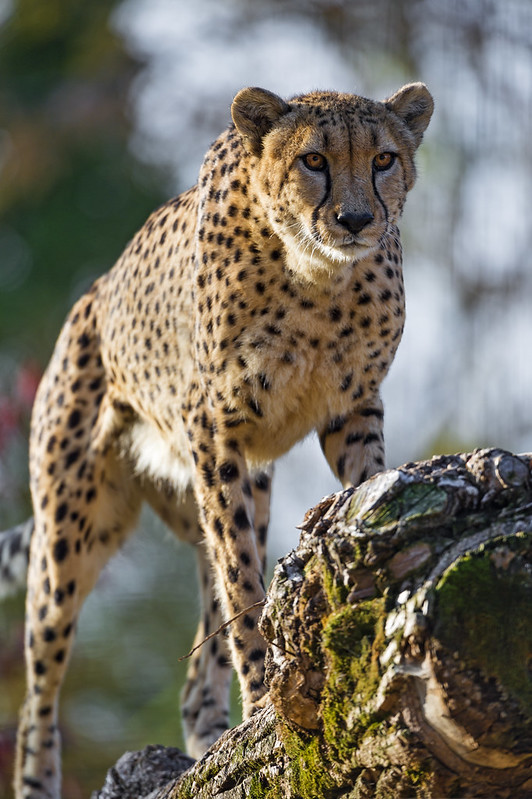
Mountain lion caught on video about 100 miles from Mississippi state line as cats continue to migrate toward Mississippi
When
it comes to big cats, Mississippi and Tennessee are much alike. There
hasn't been a confirmed sighting of a panther in either state in over
100 years — until recently.
According to WSMV.com
in Nashville, a video of a mountain lion was recorded Nov. 24 in
Humphreys County, Tennessee, which is about 100 miles from the
Mississippi line. The video was taken by a game camera that appeared to
have been placed near a scrape made by a white-tailed deer.
"It's
one of the best videos I've ever seen as far as a trail camera goes,"
Doug Markham of the Tennessee Wildlife Resources Agency told WSMV.
WSMV
also reported that sightings of mountain lions have been confirmed in
Tennessee in Carroll and Obion counties. Carroll County is roughly 80
miles from the Mississippi line.
With those
confirmations, Tennessee joins two bordering states where big cats have
returned. Both Louisiana and Arkansas have had multiple confirmed
sightings in recent years.
According
to the Florida Fish and Wildlife Conservation Commission, the Florida
panther, which is largely confined to southern Florida, once roamed
throughout the Southeast, including Mississippi. Now their cousins are
moving in from the West, where they are commonly referred to as mountain
lions. And, given the distance they have migrated eastward, they could
already be in Mississippi.
"I can't say there's not one,
two or three roaming around the state," said Richard Rummel, the Exotic
Species Program director for the Mississippi Department of Wildlife,
Fisheries and Parks. "They'll probably show up here as they expand
eastward.
"We've definitely got the food for them."
On the other hand, Rummel said, there is nothing that says mountain lions are here, but he hopes cameras change that.
Mountain
lions prey on a variety of animals, and among them is the white-tailed
deer. Given that predators and their prey generally inhabit the same
areas, that would put mountain lions in the same areas as deer. In
Mississippi, where there are deer, there are often trail cameras.
"There are thousands, if not tens of thousands, of trail cameras in the woods," Rummel said.
In
the event someone thinks they have found a mountain lion paw print,
Rummel suggests taking a photograph of it with a common object such as a
pocket knife or money next to it for size reference. Also, notify
MDWFP at (601) 432-2400 if a mountain lion is spotted, sign of one found
or video captured.
To see the full report from WSMV.com and video of the Humphreys County mountain lion, click here.
There's a great big cat roaming the western end
of the Santa Monicas, according to the National Park Service. An adult
male puma previously undocumented by biologists was captured and
collared by Park Service biologists in November, bringing the possible
total of adult male cats in the Santa Monicas to three.
The mountain lion, dubbed "P-45," is thought to be about two or three
years old. He's a big fella; at 150 pounds, P4-5 is larger than all but
one other mountain lion found in the Santa Monica Mountains National
Recreation Area since Park Service biologists started studying the
range's big cats in 2002. (The first puma recorded, P-1, also weighed in
at 150 pounds.)
According to Park Service biologist Jeff Sikich , P-45 has been
spending his time since being collared on November 21 roaming the
relatively undeveloped west end of the range toward Ventura.
Biologists
think the Santa Monica Mountains may only hold enough territory for one
or two adult male pumas, raising the possibility that P-45 may have
displaced one of the range's two other known males.
The famous and much-photographed P-22
lives in Griffith Park at the far eastern end of the range, separated
from the Santa Monica Mountains NRA by the developed Hollywood Hills and
Interstate 405. Another male, P-27, maintains a range in the Santa
Monicas west of Sepulveda Pass. A third, P-12, was last known to occupy
the same part of the range as the newly discovered lion. P-12 made news
when he successfully crossed the Ventura Freeway from the north in 2009
to find territory in the Santa Monicas.
P-12's radio collar stopped working some years ago, but he's been
spotted via camera trap on occasion, and has fathered several litters of
kittens, including one photogenic but ill-fated litter of kittens
two of which have succumbed to the main perils facing mountain lions in
the Santa Monica Mountains: P-32 was killed attempting to cross I-5
near Castaic in August, while his sister P-34 succumbed to chronic
poisoning from household rodenticides in September.
Until P-12 is spotted again, biologists won't know whether the
larger, younger P-45 muscled P-12 out of the west end of the Santa
Monicas.
"During the course of our study, we've only been aware of one or two
adult males at any given time in the Santa Monica Mountains." said
Sikich. "We're very interested to learn whether there are now three
adult males or whether P-45 successfully challenged one of his
competitors."
The National Park Service is tracking 11 mountain lions in the Santa
Monica Mountains. The range, isolated from nearby puma habitat by urban
development and freeways, is essentially an incubator for puma
inbreeding; with only very limited and dangerous access to other
habitat, lions in the Santa Monicas have only very limited connection to
their colleagues north of the 101. An attempt by Caltrans and wildlife
advocates to design a wildlife crossing near Liberty Canyon in
the western San Fernando Valley is in progress, but it will be several
years at best before that migration corridor can be reopened to the big
cats.
The Park Service is conducting DNA tests to determine whether P-45
was born locally, or whether he made the dangerous crossing into the
range from elsewhere.
Nearly one hundred of the big
cats have died since the 2008 recession raised the value of gold, says
National Geographic grantee Anthony Cummings.
A captive
jaguar looks into the camera in Georgetown, Guyana. Nearly a hundred of
the big cats have been killed in the past decade.
Photograph by Richard Wareham Fotografie, Alamy
By Christine Dell'Amore, National Geographic
PUBLISHED
As gold fever grips Guyana,
a small country in South America, people are coming more and more into
contact with one of the most secretive of the big cats: The jaguar.
Since the 2008 global recession, gold mining in the heavily forested
nation has skyrocketed, with miners and loggers setting up camp in
remote forests that are already home to jaguars, according to University
of Texas-Dallas geographer Anthony Cummings.
And since he was starting from scratch, Cummings had to go to the source.So in December 2014, Cummings went to Guyana and conducted more than
85 interviews with people involved in the new mining or logging
operations. He asked them when jaguars have been killed in the past
decade, and also if the big cats had killed or injured people. (Learn more about National Geographic's Big Cats Initiative.)
A gold miner blasts soil into a sluice with a water hose in Mahdia, Guyana.
Photograph by Randy Olson, National Geographic Creative
We talked to Cummings about his preliminary findings, which he
presented in August at the International Congress for Conservation
Biology in Montpellier, France.
What did your results show, and did they surprise you?
Over the past decade, upward of 90 jaguars have been killed in
Guyana—that’s what my data suggested talking to stakeholders,
[including] miners, loggers, and hunters. One gold miner was killed by
jaguar, and two persons were injured by a puma or a jaguar. These events
amplify the level of fear of big cats among the Guyanese population.
Around 65 percent of the people I spoke with suggested they had some
fear of big cats.
Their reaction is, 'If I see a jaguar or puma and I
have access to a gun, I'm going to kill it.' This is one of my biggest
concerns—how to educate people to react when they see a big cat, and
what measures they can put in place to keep cats away from their homes,
other places of dwelling and livestock. (See "Pictures: Jaguars Spotted on Colombian Plantation—A First.")
For the second question of where incidents are being reported, I
found a stronger [pattern] of big cat killings around areas that
livestock, primarily cattle, are reared. That’s not surprising, it’s
very similar to what we see throughout Latin America. More surprising is
what I saw for big cat killings in gold mining areas—it's a much more
dispersed pattern across the landscape. Given the nature of Guyana with
its highly forested landscape, reaching gold miners for conflict
resolution and educational purposes becomes a lot more challenging and
this is what I want to address going forward.
What is gold mining like in Guyana, and how does it impact jaguars?
When the global economy crashed between 2007 and 2008, what happened
on the other side of the coin is the price for gold started to go
through the roof. All precious metals tend to do well when there’s an
economic crisis. The price of gold almost increased
substantially. Because of the higher demand for land for gold mining,
the chances of being able to have a profit has substantially
increased—the scale of gold mining has gone upward and in fact gold
mining is the highest driver of deforestation in Guyana. As that has
happened,more people have had encounters with jaguars.
There are three levels of gold mining in Guyana: Small scale that is
very manual labor intensive—taking an axe and pick, going into the
forest and riverbed to seeing what gold can be found—medium scale, and
large scale, in which larger companies with more capital investment and
equipment essentially removes vegetation and all overburden to access
the gold below.
The small and medium scale miners gold miners take dogs and poultry
into the forest with them as they are often moving into terrain where
food supply can be problematic. Showing up with a dog introduces a new
dynamic for a jaguar who essentially says, 'Lunch has shown up.' It’s a
challenge: the gold miner needs the dog for protection and hunting
services because he’s so far from a grocery or town, but he’s
introducing this easy target for the big cat. We're just beginning to
map all these variables and working through solutions.
I want to underscore the point that gold miners recognize that they
can do more for the environment. All of the miners I spoke with are
extremely enthusiastic to work on ways to reduce big cat interactions.
Their attitude is 'If we could do better we would do better.' This is
therefore one of my biggest concerns: How to keep them engaged in
conservation while maintaining their high sense of pride in their craft.
(See National Geographic's big cat pictures.)
I was surprised to hear that you discovered there's apparently a
demand for jaguar meat and parts. Is that something that could be a
concern?
Absolutely, it remains the biggest surprises I've had. [According to
my independently verified interviews], recent immigrants to Guyana [and
also Guyanese] have been eating big cat meat. I was born and raised in
Guyana, I have never heard of anyone eating cat meat. My initial
reaction was, 'You guys are messing with me.'
Is the jaguar dwindling in Guyana due to human activity?
There is some concern, but I think it extends to all wildlife on the
whole. The simple answer though, is that we need to have a better sense
of the current population. Now that I have a sense of the conflict side,
we need to attempt to answer the question of how many jaguars we have
in Guyana and what patterns are associated with their distribution
across the landscape. I've never seen a big cat live in the forest of
Guyana, and I've been in the forest a lot. (See "'Indomitable' Jaguars May Have Lessons in Survival for Us.")
Big Cat Week is this week. What do you want our readers to know about your work with jaguars in Guyana?
The most important thing I want readers to understand, especially the
global audience, is that their actions and decisions have an impact on
biodiversity and wildlife in places they don’t necessarily think about.
The global economic crash we think of as a North American problem, but
it translates down to the ground in little towns across the world.
The second big thing is people are not necessarily always against
conservation—in fact they’re ready to embrace conservation. But we need
to figure out ways to work with them, understanding they have their own
livelihood challenges. And we've got to figure out how to take care of
their needs if they’re going to help us to protect and conserve
wildlife.
Cute
and cuddly as they may be, domestic cats are still deadly predators,
and their introduction into new territories can spell disaster for
native populations. In Australia, scientists believe that cats (like the
one seen slinking above) have played a large part in the local
extinction of many small native mammals, including select species of
sugar gliders and mice, since their arrival on the continent.
Unraveling
how the felines arrived in the country—and when—could give researchers a
better understanding of their impact on the ecosystem. In a new study,
published today in BMC Evolutionary Biology, researchers
analyzed DNA from 269 cats from six different locations in mainland
Australia and seven surrounding islands. Despite existing theories,
which postulated that cats may have arrived in the area as early as 1650
onboard the ships of sea cucumber fishers, the DNA analysis suggests that cats arrived in Australia from Europe in the early 1800s.
This time period coincides with European settlement of the area, and
the researchers believe that the felines arrived on boats where they
were used to control rodents and other pests during the voyage.
The
researchers report that they found no evidence of a distinct cat lineage
from Asia, but that Asian cats may have begun breeding with the
European founders later in time as cats were ferried between the two
continents along trade routes. Because of their isolated nature, the
island cat populations (including on Dirk Hartog, Flinders, and
Tasmania) have had less opportunity to mate with domestic breeds or
other local populations that have since been brought to the region. As a
result, the researchers conclude that the island populations more
closely reflect the original founding cats, whereas the genetics on the
mainland have become more muddled with time.
For starters, our pet felines' personalities are linked to their color, says Gary Weitzman, veterinarian and author of How to Speak Cat.
A woman and her cat share a sweet moment. Photograph by G. Dzhevelieva, National Geographic Your Shot
By Carrie Arnold, National Geographic PUBLISHED
Despite ruling the Internet, cats remain mysterious creatures.
A paradoxical blend of needy and aloof, cuddly and conspiratorial,
one of the world’s most popular furry friends continues to delight and
befuddle those of us (myself included) who live with them.
So after writing How to Speak Dog for National Geographic Books, it seemed natural to follow it up with a feline version. The result is his new book, How to Speak Cat.
In honor of Big Cat Week,
National Geographic recently talked to Weitzman about the crazy things
that cats do. The interview has been lightly edited for length and
clarity.
You’ve been a veterinarian for 25 years, so you’ve probably pretty
much seen it all in terms of cat behavior. But was there anything new
that you learned while writing the book?
There’s the basic kind of facts that I learned, like Guinness Book of
World Record-type things, that I really didn’t know. [For example], the
oldest living cat, [now deceased], was 27 years old out here in Point
Loma, California. (Watch a video on why cats are so secretive.)
But I learned that scientists think that cats respond better to
women, because women have higher-pitched voices than men. These facts
are in bold print on every other page in the book, and nearly all of
them surprised me.
Besides starring in YouTube videos, do cats have any other remarkable abilities that you learned about while writing this book?
Cats can see in the dark six times better than humans. That’s not
something you learn in vet school, and you don’t learn that working in a
shelter or working with animals for decades. But six times better than a
person—that’s pretty impressive. (Also see "How Cats and People Grew to Love Each Other.")
A cat’s breed can certainly affect its appearance, but can it affect a cat’s personality?
Definitely. The color of coat is linked to behavior. For example,
tortoiseshell cats, torties, can be independent and they usually like
just one person, and they can be pushy about what they want. Torties and
calicos and Abyssinians all have strong documented links between their
coat color and personalities. More anecdotal is the orange tabby, who is
the poster child for the most gregarious. But personality really seems
to go with coat color.
When people ask you questions about their cat’s seemingly bizarre behavior, what are their most common issues?
One of the biggest questions I get is why does my cat become a
psychotic rocket and suddenly go from 0 to 60 and zoom around the living
room. We don’t really know for sure, but indoor cats especially have a
lot of pent-up energy that they can’t exercise, whereas wild cats have
hunting, stalking, and waiting on edge to keep them busy. It’s an energy
release. That’s really what it is. The other question is why is my cat
not using the litter box correctly, which is, not to be funny, the
number one question I get. (See National Geographic readers' pictures of cats.)
Speaking of wild cats, how similar is our average house cat to its wild ancestors?
They’re very, very similar. Domestic cats have only been around for
half the time that dogs have, so you can see almost the same behavior
among lions, tigers, and leopards that you do among domestic cats. That
is, perhaps, one of the biggest draws of these animals—we can live
harmoniously with them and still get to watch Mutual of Omaha every day.
They’re still part wild. They haven’t gone to finishing school yet.
(See "Our Most Stunning Pictures of Big Cats.")
With so many big cat species endangered, can our love for domestic cats help save their wild cousins?
Look at the almost universal outrage over the death of Cecil the Lion this summer.
People love cats. Cats, hands down, own the Internet. That’s the
leverage that we have to try and stop some of the astonishingly bad
practices towards the other cats on our planet.
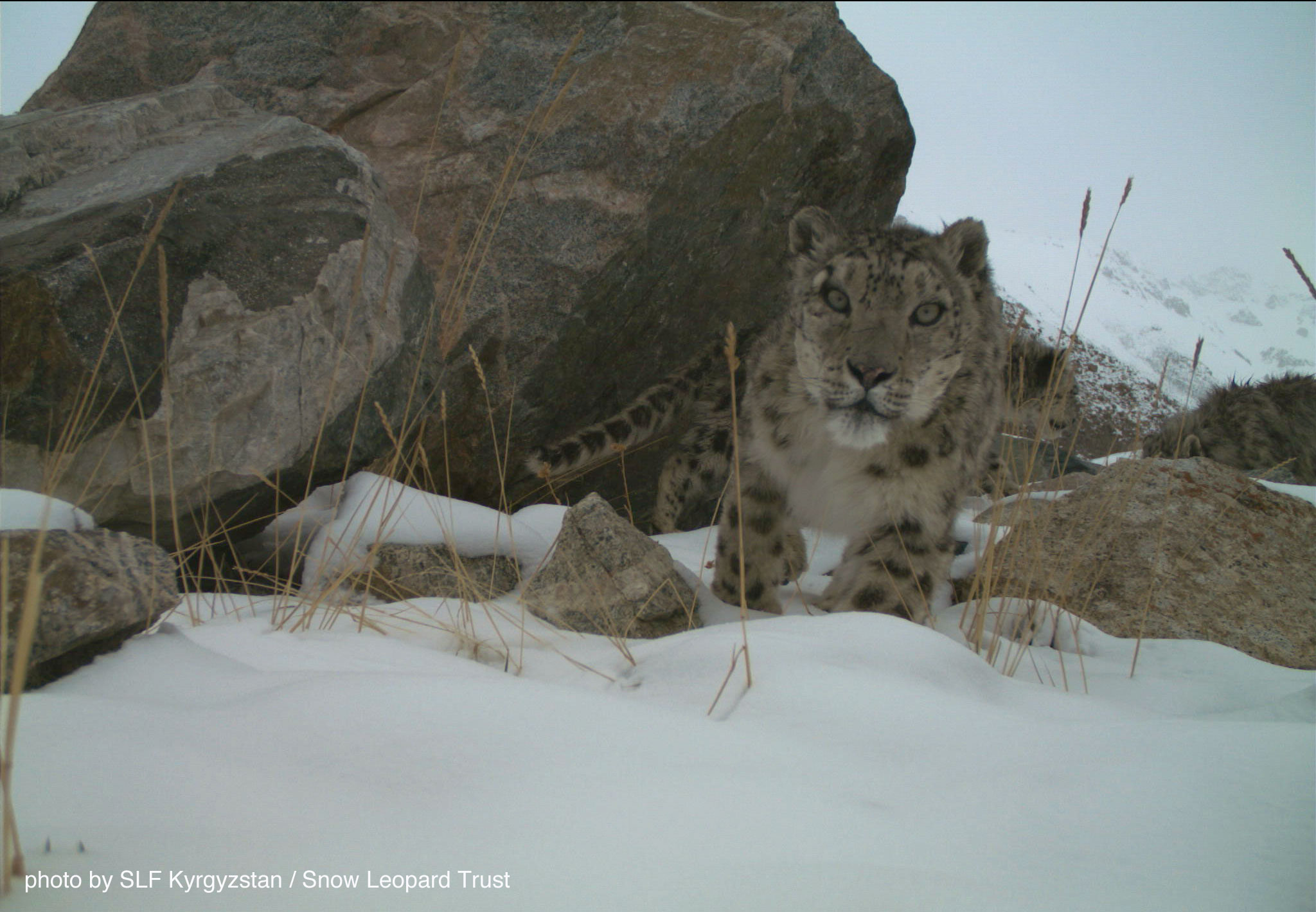
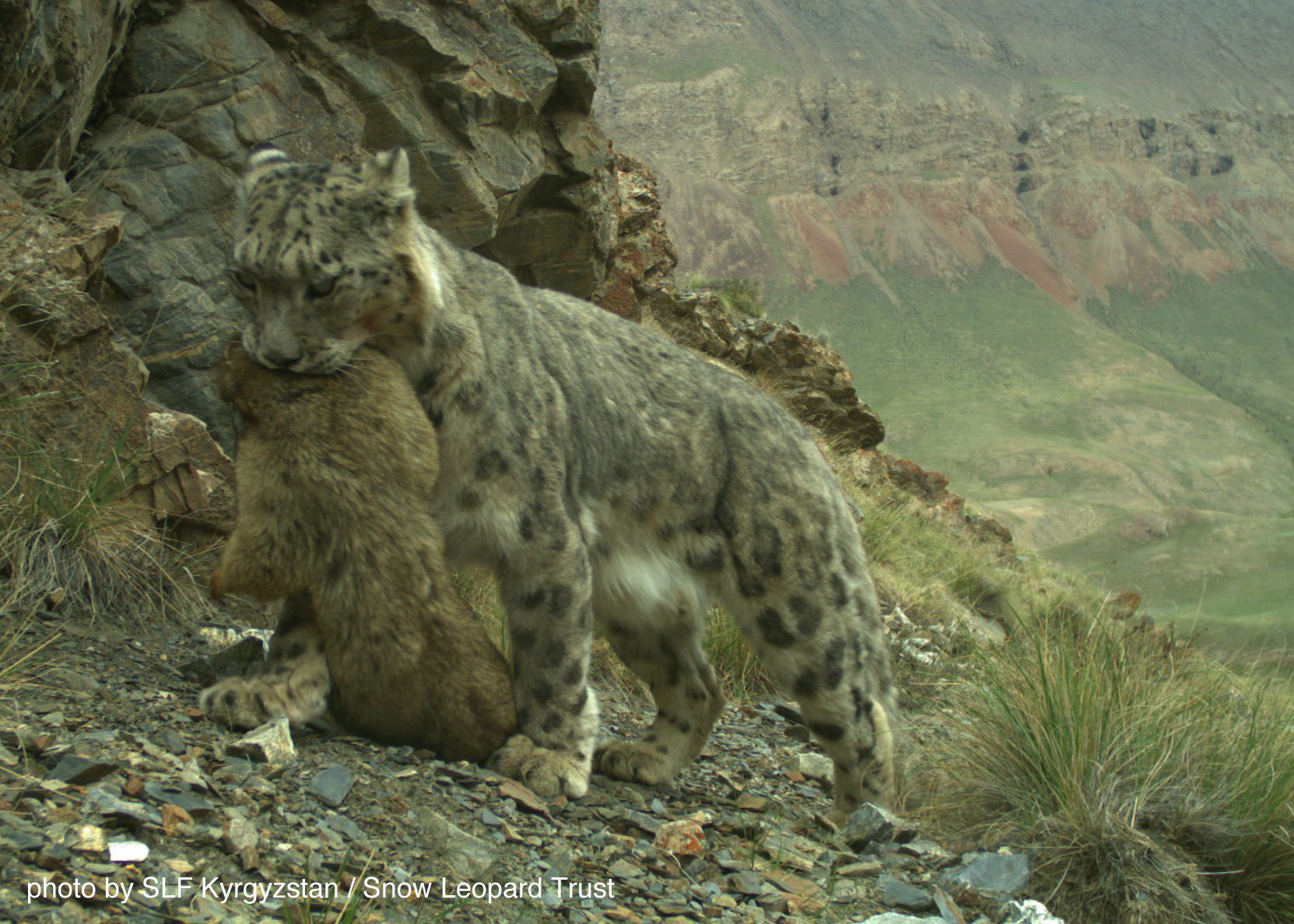
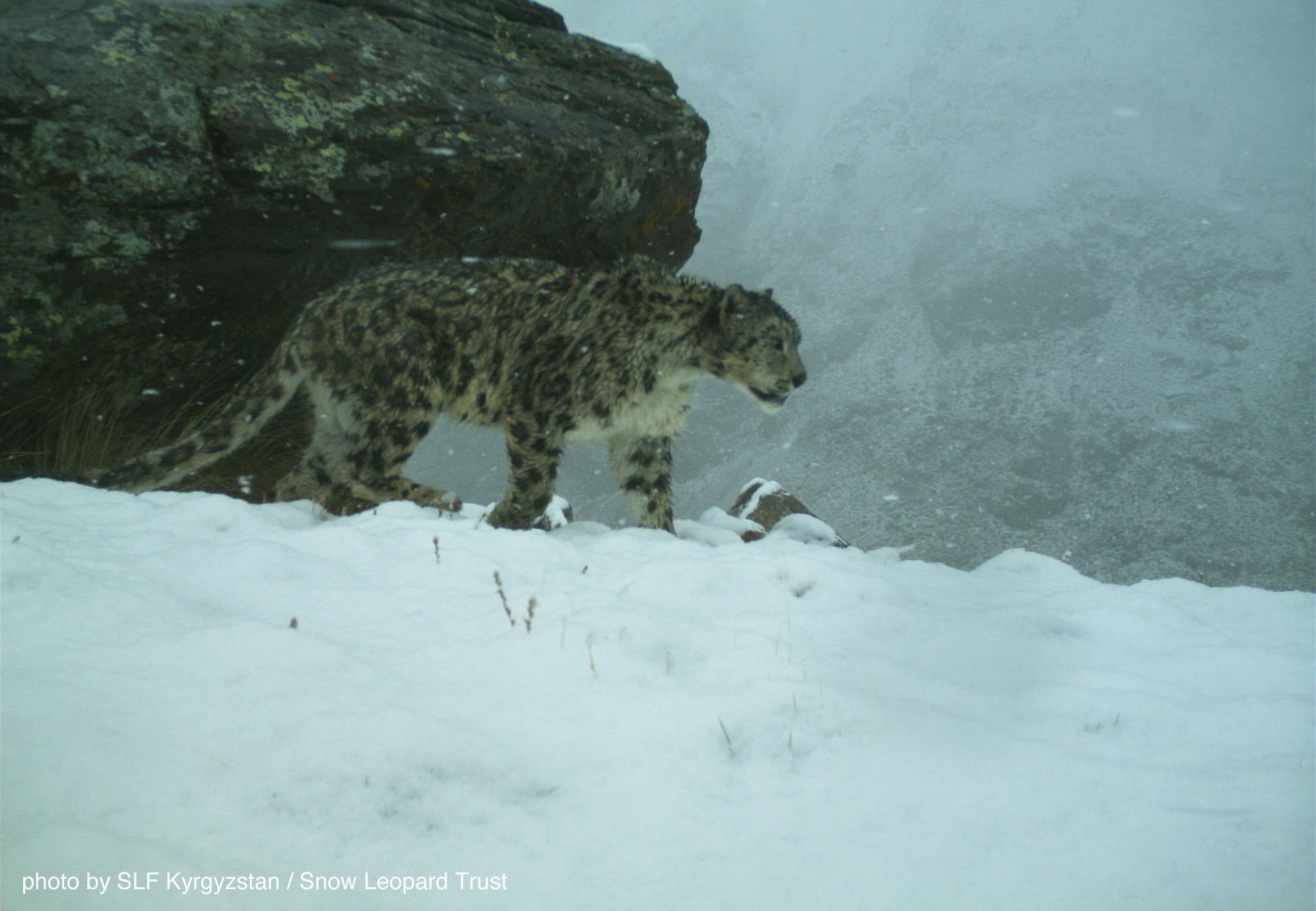
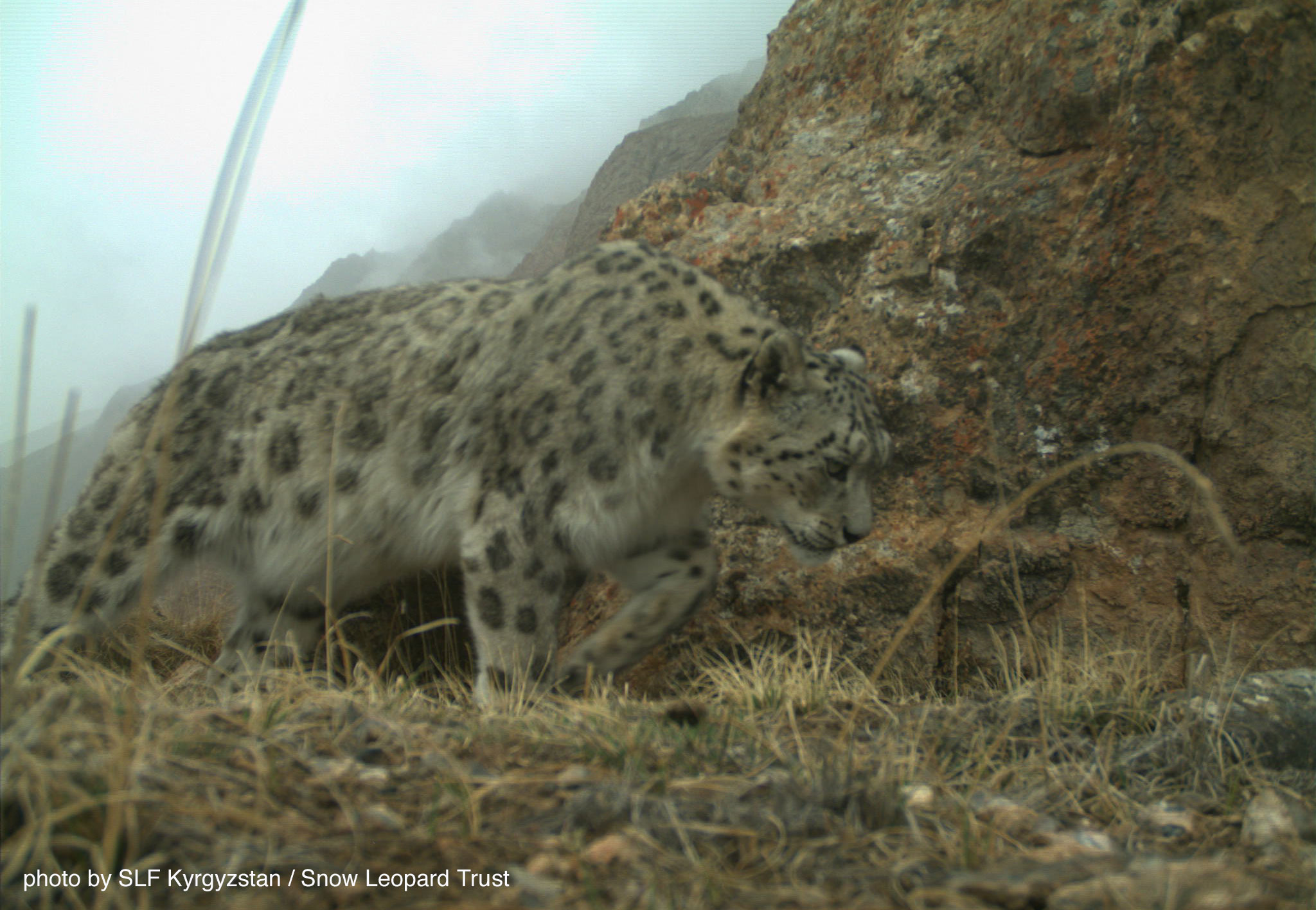
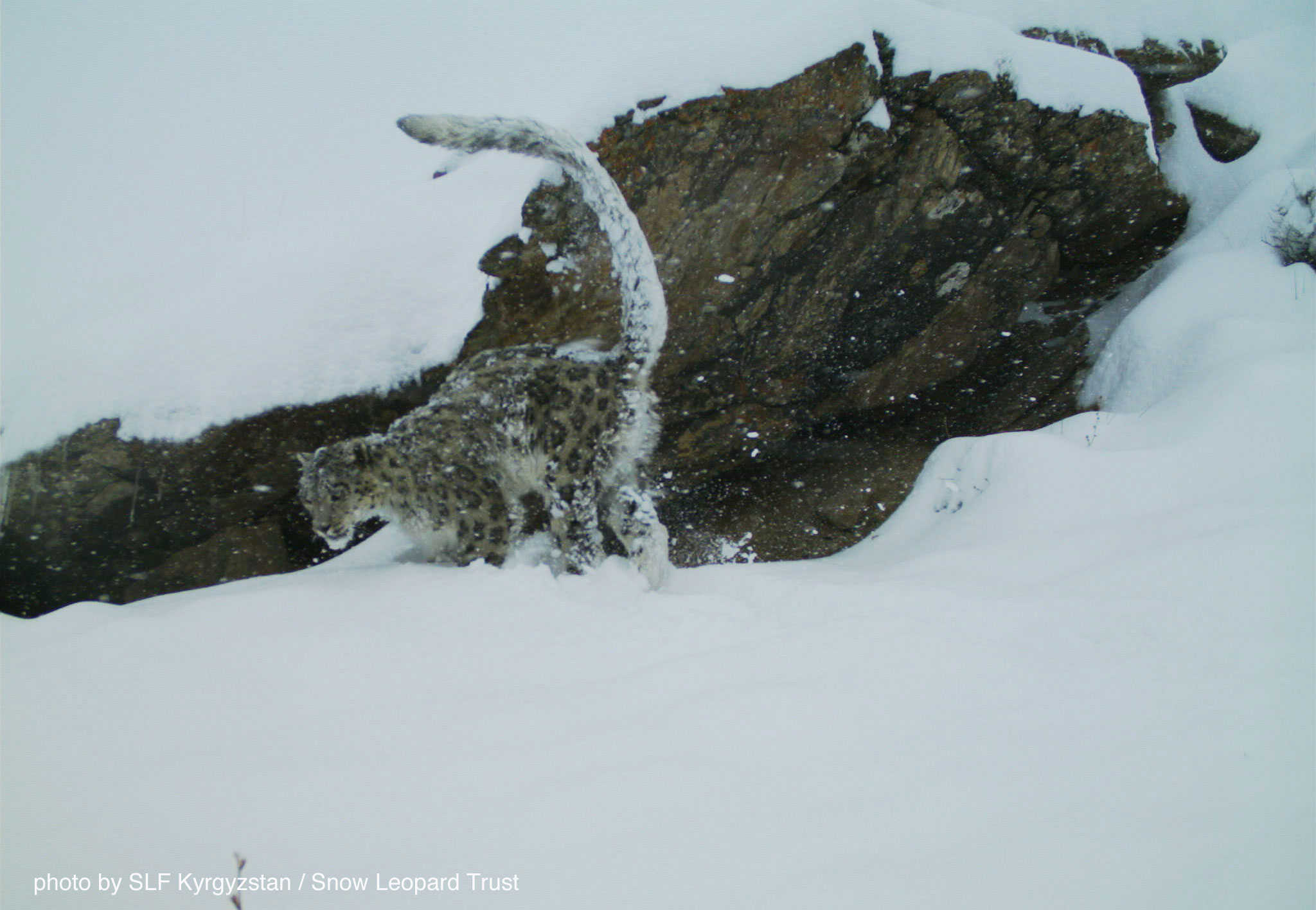
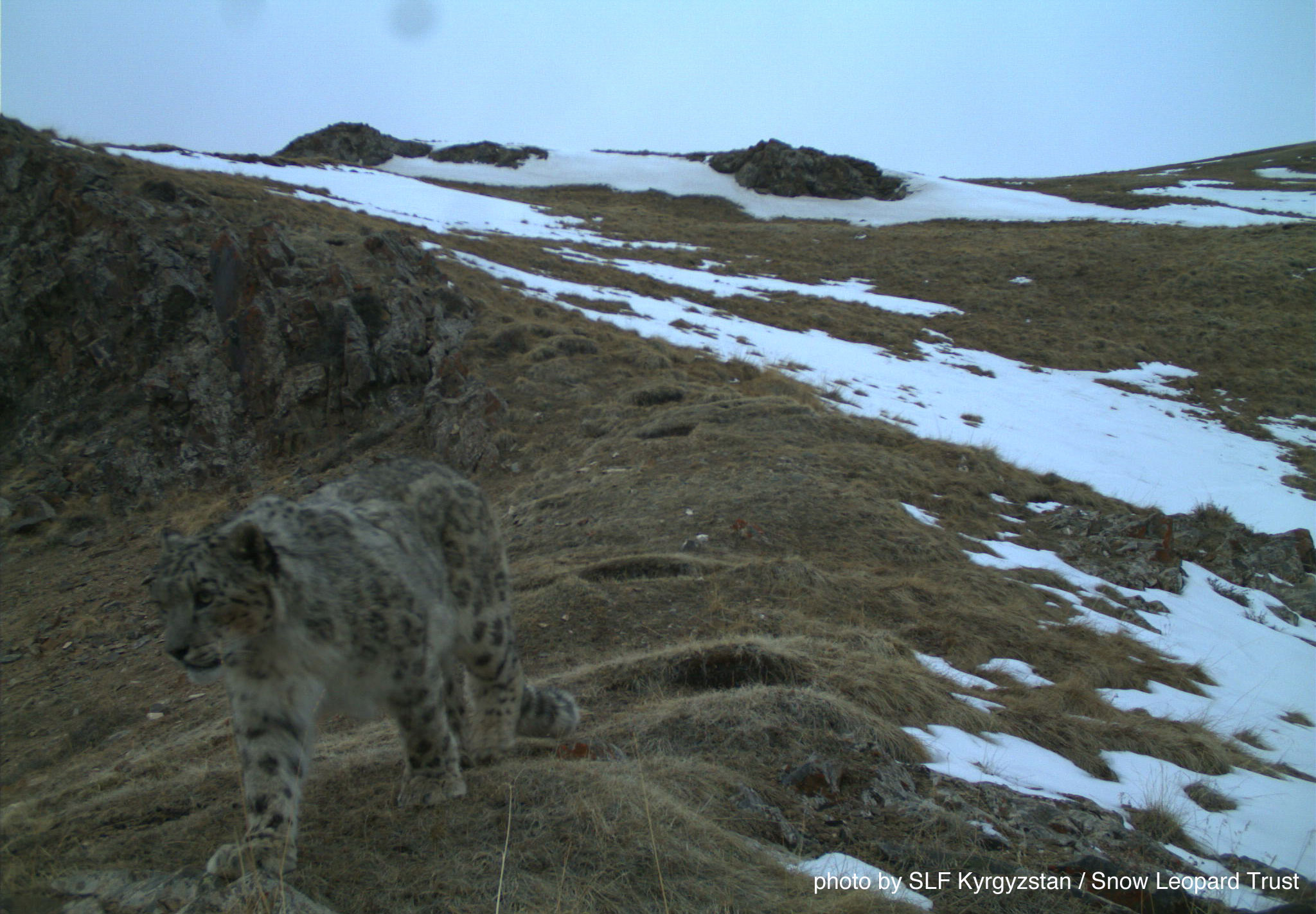
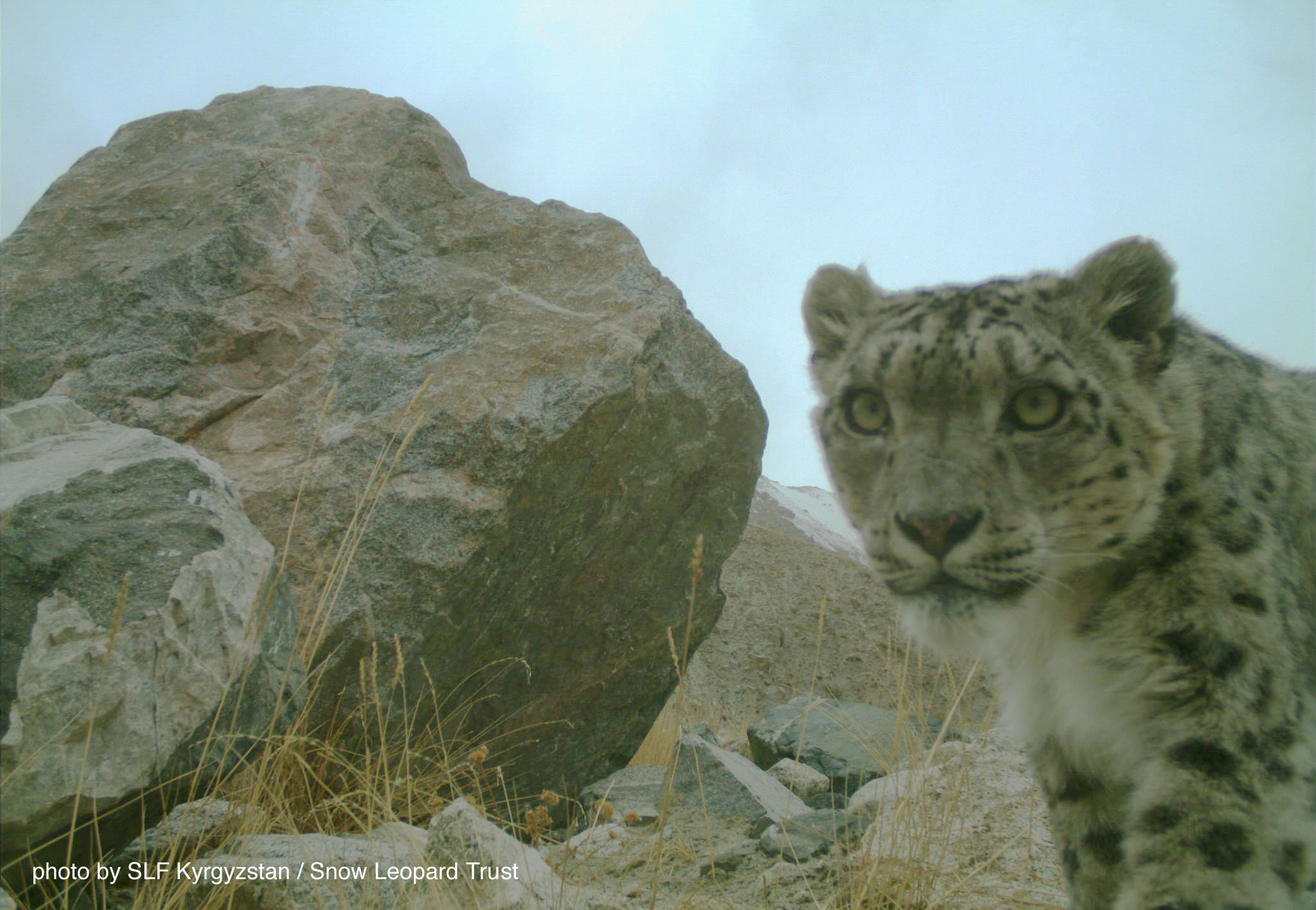
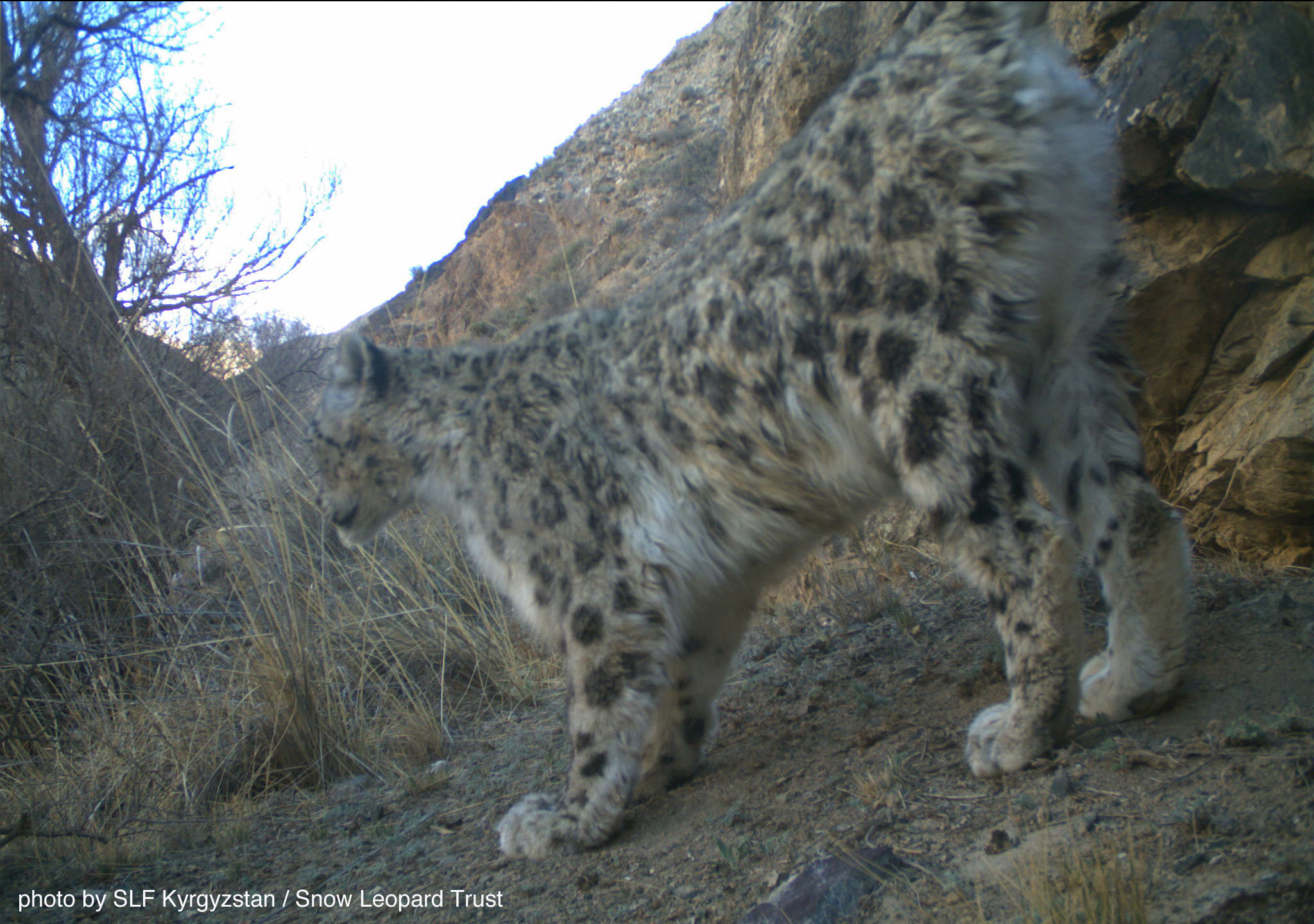
A few weeks ago, Kuban Jumabai uulu, our Kyrgyzstan Program
Director, traveled to Sarychat-Ertash Reserve to collect research
cameras deployed earlier this year. The pictures he found on these
cameras offer breathtaking glimpses into the secretive world of one of
the world’s rarest cats, the elusive snow leopard!
During the trip, Kuban also trained five rangers
from Kyrgyzstan’s Chon-Kemin National Park on snow leopard sign
identification and the basics of camera trapping to empower them to
conduct snow leopard surveys on their own.
Joining them were Udayan Rao Pawar, a young Indian photographer who
was named Wildlife Photographer of the year in 2013 by BBC, and Ilya
Domashov, a field researchers with the Global Snow Leopard &
Ecosystem Program secretariat.
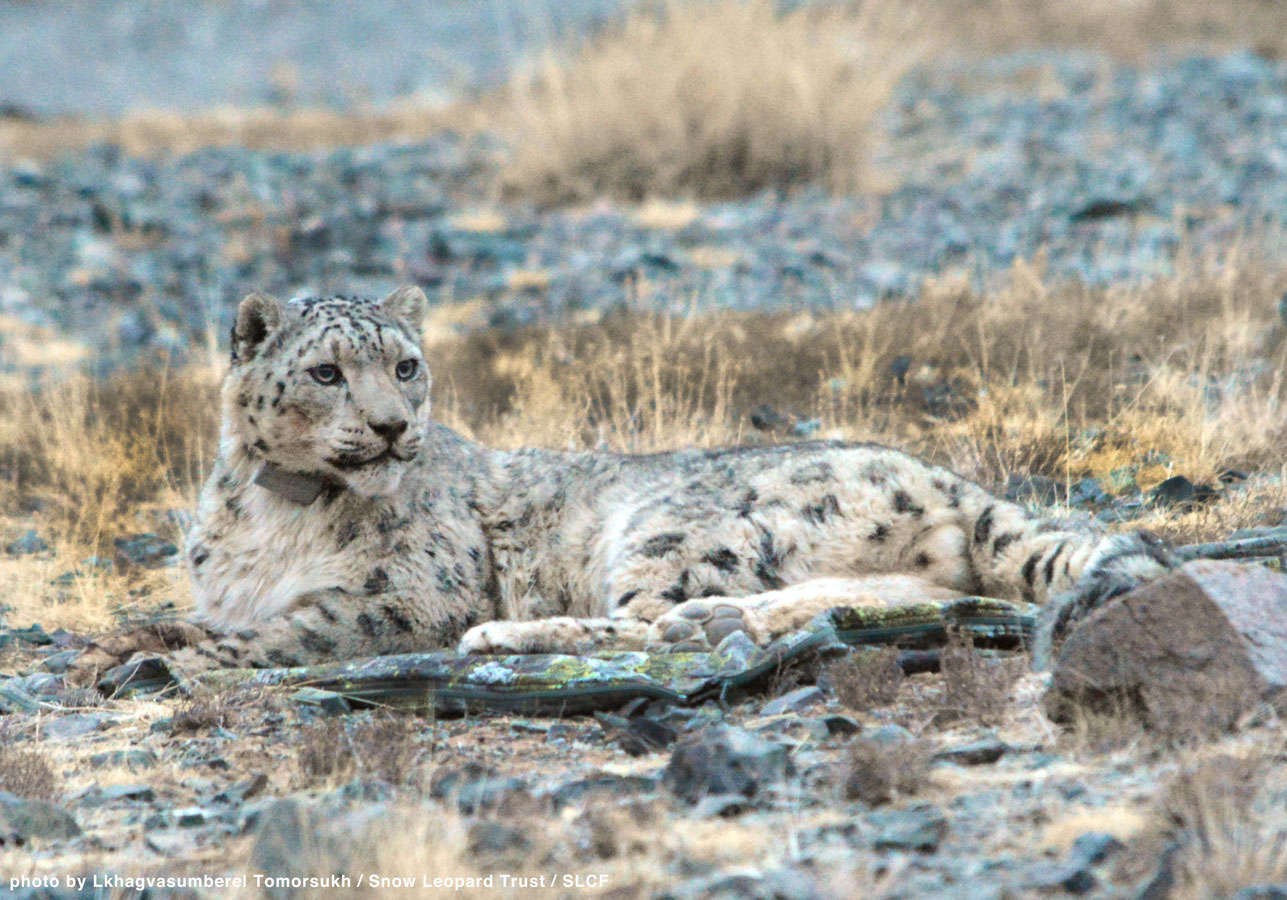
Since this spring, we’ve been following Tsetsen, a male snow
leopard in Mongolia’s Tost Mountains, with a GPS collar. He’s the 20th
cat we’ve tracked in our ongoing long-term study on the snow leopard’s
ecology and behavior. His latest location data reveals just how
extensive (and, presumably, exhausting) a snow leopard’s wanderings
across its home range can be.
Tsetsen, shortly after being fitted with his GPS collar.
In October and November, Tsetsen covered a distance of 283 km (176 miles) – the distance between Seattle and Camas, or between London and York. Perhaps even more impressively, he climbed up over 7,100 meters
(and the same amount back down again) in this time period. This
altitudinal gain is equivalent to climbing up and down 2000 stories of
an average skyscraper. In other words, climbing up and down the Burj Khalifa, world’s tallest building, 12 times over.
Tsetsen’s elevation profile for October and November 2015.
These feats aren’t anything out of the ordinary for Tsetsen, who is a
very steady wanderer, and a somewhat predictable cat in many ways. His
patrols across his home range follow a pretty repetitive pattern, and
the area he uses overlaps almost perfectly with the range another male
snow leopard, Ariun, used to keep previously.
A clever system for identifying runaway indoor cats is being promoted by a popular Web comic artist.
The
idea is that when someone sees a dog running around outside, they
assume it is lost but when someone sees a cat outside, they often assume
it is an outdoor cat. By putting an orange collar around the neck of an
indoor feline, if it is seen outside the collar is reflective and, the
website claims, "it brands your indoor cat as a convict... it signals to
the people of the world that your cat belongs inside."
The Kitty Convict Project says
in the US more than 7 million pets go missing every year. Of those, 26
percent of missing dogs and less than 5 percent of lost cats are
reported and returned home.
This new system comes from The Oatmeal, a popular Web comic. Its creator, Matthew Inman, created and crowdfunded the game "Exploding Kittens" and is hoping to make things right with cats.
"It's our form of cat atonement. Catonement," Inman writes.
If
you have an indoor cat, dress it in orange so other people know it has
escaped. If you see a cat outside with an orange collar (or scarf, or
party hat), try to catch him or her and report the sighting.
"End the cat nudity. Embrace the orange," the website says.
The Kitty Convict project is selling customized orange collars to promote the concept. The website says they are selling them at a profit loss. Catonement.
Image caption
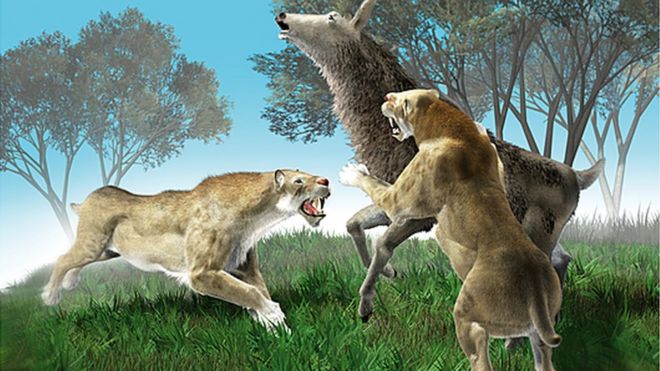
The European sabre-toothed cat was about the size of a modern tiger or lion.Image copyrightSPL
Our ancient human cousins may have fought off big cats with spears, according to archaeological evidence.
The sabre-toothed cat lived alongside early humans, and may have been a fearsome enemy, say scientists.
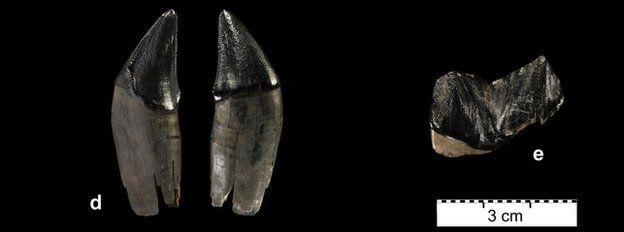
Several
feline teeth - and a chunk of arm bone - were uncovered at a site in
Germany known for the oldest discovery of human spears.
The 300,000-year-old animal fossils are described as "spectacular".
The sabre-toothed cat - once known as the sabre-toothed tiger - lived from about 55.8 million to 11,700 years ago.
The predator had enormous teeth, which it used to rip through flesh.
Dr
Jordi Serangeli, of the University of Tubingen, Germany, said the
remains proved for the first time that the sabre-toothed cat was living
in Europe alongside early humans.
"We can say that the humans -
and the sabre-toothed cat - were living 300,000 years ago in the same
area, in the same landscape," he told BBC News.
"The humans were hunters but they were not alone; they had to defend themselves from all the big carnivores."
Human hunters
Homo Heidelbergensis was among the first type of early human to use wooden spears.
Scatterings of animal bones found in their camps suggest they used the spears to hunt animals like the horse and deer.
The
latest find of five teeth and a bone from two individual sabre-toothed
cats at a former coal mine in Schoningen near Hanover gives a new
insight into the perils faced by early humans.
Tooth (d) and humerus fragment (e) from sabre-toothed cat, Homotherium latidens
Image copyrightMINKUSIMAGES"The discovery illustrates the possible day-to-day
challenges that the Schöningen hominins would have faced and suggests
that the wooden spears were not necessarily only used for hunting, but
possibly also as a weapon for self-defence," Dr Serangeli, and
colleagues at the University of Leiden, report in the Journal of Human Evolution.
The
cat's humerus bone - worked by humans into a rudimentary hammer- is the
first example of its kind anywhere in the world, he added.
'Killed the cat'
Dr
Mark Roberts of UCL, London, is an archaeologist at the Boxgrove site
in southern England, which was home to one of Britain's oldest known
human occupants, Homo heidelbergensis, 500,000 years ago.
Evidence
shows "hominins (humans and their ancestors) were already the top
predator at this time; they were able to kill and butcher, without
interruption and competition, large animals such as rhino, bison, horse
and giant deer", he said.
But it is uncertain if humans around at the time used weapons to kill the sabre-toothed cat, he added.
"If
it could have been demonstrated that hominins killed the cat then that
would have been very interesting but without more skeletal material that
is impossible to demonstrate."
The Schoningen excavation is a
cooperation between the University of Tübingen and the State Service for
Cultural Heritage of Lower Saxony.
If one Michigan lawmaker is successful, large carnivores will be able to breed at Michigan zoos.
Republican
Sen. Rick Jones of Grand Ledge announced he plans to introduce a bill
allowing breeding programs for carnivores to begin at five Michigan
zoos, including Battle Creek's Binder Park Zoo, according to a Tuesday
news release.
The release said such breeding was made illegal in
the state because of the inhumane conditions created at exhibits found
at roadside attractions. Binder Park and the other zoos mentioned in the
bill — Detroit Zoo, Lansing's Potter Park Zoo, Grand Rapids' John Ball
Zoo and Saginaw's Children's Zoo at Celebration Square — are members of
the American Association of Zoos and Aquariums.
Other groups would
be allowed to breed the animals if they comply with safety, animal
welfare and conservation mandates in the bill.
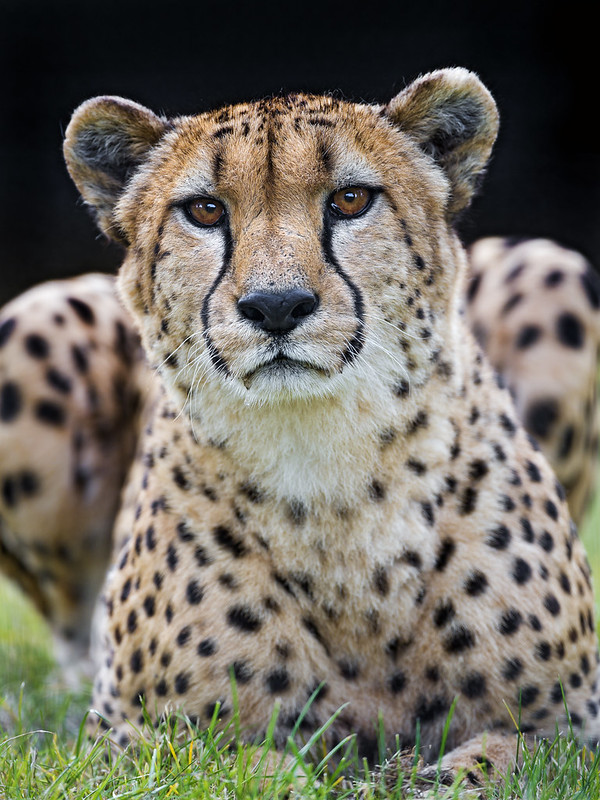
Animals outlined in the legislation include lions, cheetahs, tigers, jaguars, leopards and bears.
Binder
Park Zoo has long had a cheetah exhibit, and opened a black bear
exhibit in 2014. The zoo is planning on building an African lion habitat
in 2016 after fundraising is complete.
For more on Binder Park
Zoo programs, go to www.binderparkzoo.org or call 979-1351. For more on
the pending legislation, go to www.senatorrickjones.com.
Photos courtesy of en.wikipedia.org and Lwp Kommunikáció on flickr.com
Two scientists at the University of Georgia started a “frozen zoo”
to preserve the world’s endangered species in case of a future
extinction.
Climate change has been an issue since the 1960s. More than 95
percent of Alaska’s glaciers are thinning, retreating and stagnating
according to the weather.com article, “Before-and-After Glacier Photos Show Devastating Climate Effects” by Nicole Bonaccorso.
During my lifetime the world has been scarred by pollution, something
that began within the last 200 years and will take hundreds of years to
repair its devastating effects.
One of the many effects of pollution is an increase in the rate of endangered and extinct species.
The University of Georgia is now building a “frozen zoo.” The
university’s Regenerative Bioscience Center will store genetic
information about endangered animals according to CNN article,
“Scientists build ‘frozen zoo’ to save endangered species” by Jason
Evans. The idea came from RBC director Steven Stice and Animal and Dairy
Science Associate Assistant Professor Franklin West.
“Cells from the skin of a sedated animal are extracted in a noninvasive procedure,” according to Stice and West in the CNNarticle,
“Researchers convert those cells into stem cells by introducing a
series of specialized reprogramming genes. From there those stem cells
can be made into sperm or eggs.”
This is amazing work. This could mean even after a species becomes
extinct, scientists would be able to create new life by combining the
sperm and eggs they have created with the reprogrammed skin cells.
The RBC has confirmed sperm has been created from pig stem cells
according to the CNN article. Since then, Stice and West have moved on
to reprogramming cells of big cats. Big cats were chosen because
scientists have a good grasp on their biological makeup.
Cats like the Javan Tiger have already gone extinct. More than 80
percent of threats to big cats are human activities, according to the seethewild.org. In many countries they are a source of food for the people there and, for many, their only source of income.
For people who live in countries where animal resources are a major
income to many of the natives; it is difficult to impose the idea
animals should live, while you and your family starve. Since we cannot
control people’s instincts something like this is important because it
gives us hope this technology and process will give way to better
alternatives and solutions in the future.
“‘Every year one of these animals gets hit by a car and they’re at a
point where they’re breeding brothers and sisters together because the
gene pool has shrunk,’” West said to CNN during his interview for the article.
The cells are kept in tanks of liquid nitrogen. This is called
cryopreservation, a process where cells, whole tissues or any other
substances susceptible to damage caused by chemical reactivity or time
are preserved by cooling to sub-zero temperatures.
“Essentially the genetics are immortal,” West said toCNN
during the interview for the article. “You could go in 20, 30, 200 years
theoretically, you could thaw these stem cells out, and turn them into
sperm and eggs.”
The fact the stored cells have an immortal survivorship gives me hope
research will continue or someday be put to work for the whole world to
see. Research like this should be getting more recognition than it has.
A lot can come of this and that is what I am hoping for. The world has
been talking about climate change and its effects. Even though it will
take years to rebuild our climate and change the demise of the animals
we have all put in danger this “frozen zoo” would help make conserving
them a reality.
Instead of asking big corporations for grants and other sources of
income, Stice and West created a crowdfunding page to gather donations.
“With the ‘GeorgiaFunder,’ I saw a great opportunity for us to tap
into monetary resources left by the gaps of industry and government
funding,” Regenerative Bioscience Center’s marketing and Development
Coordinator Charlene Betourney said to CNN during his interview for the
article. “‘This type of ‘interactive funding’ also allows our research
teams a greater level of transparency and engagement with the general
public.’”
It is cool to see researchers taking charge. Betourney is right; this
way feels more genuine than a big corporation sponsoring the work being
done. No matter how West and Stice are getting funding, it is crucial
their research is something being introduced.
Even though this is not the first “frozen zoo,” it is important to
give credit to scientists for the work they are doing. Instead of
sitting back, like the most of us, they are getting out there and trying
to preseve the little bit of nature we have left.
As traditional pastures dry
up, Mongolian herders are forced to move livestock into the big cat’s
territory. Now conservationists are stepping in.
After being
tranquilized, an adult female snow leopard named Tenger is fitted with a
GPS tracking collar. World Wildlife Fund researchers in Mongolia hope
the information they get from Tenger and other collared snow leopards
will lead to protected areas for the rare and increasingly threatened
cats.Photograph by Hereward Holland
By Hereward Holland, for National Geographic
PUBLISHED
Just as the last of the blushing light
drained from the sky in western Mongolia, the “ghost of the mountain”
struck at the foot of sacred Jargalan mountain where the rocky snow line
gives way to a dry and treeless expanse of steppe.
“I saw my animals were very afraid, they were running from
something,” said Myagmarjan Maamkhuu in his yurt-like tent, or ger, the
day after the incident. “When I got closer, I saw the snow leopard with
one of my sheep.”
It was Tenger, a mature female well known to Maakkhuu. “Of course we
were angry at first, but we’ve got used to it,” he said, offering me
milky tea served in a bowl as his wife and three young sons sat by our
side. “We don’t go looking for revenge.”
Maamkhuu tends more than a thousand livestock—sheep and goats mainly
and a few horses—and this sheep, he said, with a zen-like lack of angst,
was the third one he’d lost that week to snow leopards. In a bad year,
the elusive spotted cats take up to 30 of his animals.
A shepherd
herds his flock of sheep and goats in the foothills of Jargalan
mountain. More than a third of Mongolia’s 2.6 million people are nomadic
or seminomadic, but their pasturelands are disappearing. Photograph by Hereward Holland
A local folk song celebrates Maamkhuu’s home, the Altai Sayan mountains of western Mongolia:
Snow melts, springs flow,
And fresh green grasses grow,
Cuckoos sing,
Indeed, mysterious, old, beautiful Altai Sayan.
But the bucolic haven of that ode is fast becoming a fantasy. More
than a third of Mongolia’s 2.6 million people are, like Maamkhuu,
nomadic or seminomadic herders, and their pasturelands are disappearing.
During the past 30 years, the region’s average annual temperature has risen by 3.8 degrees Fahrenheit (2.1 degrees Celsius).
The result: a desertifying landscape with degraded lower-altitude
pastures that have traditionally nourished herders’ sheep and goats.
It’s so bad that around a quarter of the country has turned into desert,
while some 850 lakes and 2,000 rivers have completely dried out over
the past 30 years, according to the United Nations Convention to Combat Desertification (UNCCD).
Herders like
Myagmarjan Maamkhuu are now grazing their flocks at higher elevations
where pastures are richer. But snow leopards are preying on their
animals, and some herders are retaliating against the cats. Photograph by Hereward Holland
So Maamkhuu and other herders are taking their animals to better
pastures at higher elevations. On those mountainsides, their sheep and
goats are eating grasses that sustain wild argali (blue) sheep and
ibexes, themselves the main food supply of snow leopards.
Inevitably, the big cats are now preying on the domesticated animals.
To protect their livelihoods, herders are hunting snow leopards, whose
numbers are now as low as 4,000, with perhaps a quarter of them in the
Altai Sayan mountains.
The cats are a barometer of environmental conditions in a swath of
territory that spans 12 countries and holds the headwaters of 20 major
river basins inhabited by more than two billion people. Rapid warming in
this region is disrupting people as well as wildlife.
If climate change isn’t slowed, more than a third of snow leopard
territory might become unsuitable for the cats, according to the World
Wildlife Fund (WWF), which has been helping to conserve them for many years.
The cats are a barometer of conditions in a territory that spans 12 countries inhabited by more than two billion people.
To date, WWF says, only 14 percent of snow leopard habitat has been
studied with a view to putting conservation measures in place.
Ultimately, the goal is to gather enough information to demarcate zones
of protection that would be off-limits to herders and their animals.
To Track a Sheep Thief
Last month, I joined a team of WWF researchers led by Ochirjav
Munkhtogyokh on a two-week expedition aimed at trapping snow leopards,
attaching GPS collars around their necks, and releasing them. During the
past three years, Munkhtogyokh's team has placed remote cameras all
over Jargalan mountain, and they’ve recorded the presence of 37 snow
leopards, including ten cubs.
I arrived after the first week. By then, a dozen cable traps had been
laid to catch cats. The traps, designed to prevent pain or injury,
consisted of a thick cable tied in a slip knot and placed on a
spring-loaded pressure pad.
Hours after Tenger had attacked Maamkhuu’s sheep, the team had placed
four cable snares around the half-eaten carcass, which was wedged on a
hillside against the bank of a dry riverbed. They’d positioned a remote
video camera trap nearby to document the snow leopard should she return
for another meal.
Snagging Tenger would be a bonanza because she’d been geotagged
before, in 2013. That first GPS device had stopped sending data after
nine months, and ever since Tenger has roamed the rocky escarpments with
a mountain of data locked up in her collar—information about her daily
habits and movements and the extent of her home range that would inform
efforts to map out a protected area for snow leopards.
The World
Wildlife Fund team set a trap next to one of Maamkhuu’s sheep that
Tenger had killed. They hoped she’d come back for another meal and get
snagged so they could put a new GPS collar on her. And that’s what
happened.Photograph by Hereward Holland
Nine days into the expedition, the team hadn’t seen hide nor hair of
Tenger—or any other snow leopard. But the next morning when we went to
check on the sheep carcass, most of the remains were gone. Sure enough,
as the video footage from the camera trap showed, Tenger had returned to
eat the rest of the sheep. Yet she’d eluded the cable snares.
Back at base camp, Munkhtogyokh opened his laptop. He wanted to show
me how herders are avenging attacks on their livestock. In one frame, a
snow leopard limps along with a metal hunting trap locked around its
front paw. It pauses, sniffs the ground, and staggers out of camera
range.
According to Munkhtogyokh, 5 of the 37 snow leopards they’d recorded
had either lost a front paw or been caught in snares set along snow
leopard trails.
Ochirjav
Munkhtogyokh and his team from WWF scour the mountainside for signs of a
snow leopard, as well as their prey base, argali sheep and ibex. Photograph by Hereward Holland
He said he’d seen two cubs with their mother, whose front paw was
caught in one. She was struggling to keep up with her young, he said.
“Snow leopards catch animals with the two front legs. When one paw is
cut, it’s a tragedy. How is she going to feed herself and her cubs?”
More Sheep Kills
By the penultimate afternoon of the expedition a snow leopard had picked off three more sheep from Maamkhuu’s flock.
“We could go to the place where there are no snow leopards and stay
there during the winter, like the mountain to the east, but on that
mountain there is no grass, Maamkhuu said. “It’s bad for livestock—it
would be hard to deliver our lambs.”.
In a bad year, the elusive spotted cats take up to 30 of his animals.
Maamkhuu waved me over to his telescope, through which I could make
out a bloody carcass lying in a gully of grey rock and patchy scrub far
down the valley. A few feet away, a long fluffy tail was sticking out
from behind a bush, slowly twitching. It was Tenger, guarding the dead
sheep and waiting for nightfall when she’d eat.
Twilight bled to dusk, and the WWF researchers arrived. Tenger
retreated up the hill, and the team set about laying more cable traps.
The following morning we returned to the carcass. Crouching next to
her kill was Tenger, a cable-snare looped around her front right paw.
The team quickly tranquilized her and, after a gentle prod with a stick
to make sure she was asleep, took vital measurements, such as her
weight, and swapped the old tracking collar for a new one.
Maamkhuu’s
wife, standing on the ridgeline at right, surveys the family’s flock of
sheep and goats near their home on Jargalan mountain. A warming climate
in Mongolia threatens both their way of live and the survival of snow
leopards.Photograph by Hereward Holland
“I’m very pleased that we caught the same snow leopard,” Munkhtogyokh
said, kneeling over the motionless Tenger. “It’s much better than
catching a different one.” That’s because the cache of information
stored in her original collar and the promise of all the fresh data
they’ll get from the new one will go a long way toward helping them map
out a protected snow leopard area.
The mission is urgent. A further 7 degrees Fahrenheit (4 degrees
Celsius) of warming is predicted in Mongolia by the end of the century,
according to Tuya Tserenbataa, a climate change expert with the
Mongolian government.
“There’s an old proverb,” Tserenbataa said. If you talk about bad
things, then they will happen. But if we don’t do anything now, life
will become very difficult.”
If the predicted warming comes to pass, life will become even harder
for Maamkhuu and other herders in Mongolia—and no less hard for the
dwindling numbers of snow leopards.
The information from Tenger, Munkhtogyokh said, is “very significant both scientifically and practically. Very significant.”
The Exotic Feline Rescue Center in Center Point, Indiana, wants
hunters’ deer. Home to about 200 rescued big cats, the center feeds
3,000 to 4,000 pounds of meat a day to its hungry residents. “They start
feeding at 8:30 in the morning and they’re not done until anywhere
between 4:00 and 6:00 at night,” center director Joe Taft told WTHI. Taft says he would welcome any donations of “extra deer or big scraps” left over from processing.
The EFRC gets most of its meat donated by livestock farmers, but there’s
expense and time involved in going out to pick up the meat. With the
recent addition of ten new cats and the coming of cold weather, the
center’s need for meat is increasing. Taft hopes donations from hunters
can help make up any shortfall.
Founded in 1991, the EFRC takes big cats from circuses, zoos and
private owners who can no longer take care of them. In some cases, they
rescue abused cats. “When we get them back here, they’re hungry,” says
Taft.
Binghamton’s
harsh winter weather is approaching, and no one is happier than Tushar
the snow leopard, who lives at the Binghamton Zoo.
Also known as Panthera uncia,
snow leopards are built for the cold. Their natural habitat range is
located in Central Asia, stretching from northwest China to Tibet and
the Himalayas where the mountains are covered in snow. Snow leopards
make their homes in rocky mountainside dens where they sleep and
eventually raise their young. Their thick coat has layers of wooly
insulation underneath long protective hairs to keep their bodies warm.
Snow
leopards’ tails can be up to 3 feet long, and the big cats stay warm by
wrapping their tails around themselves at night to protect their noses
and lungs from freezing when they sleep. They also have large chest
cavities and large nasal cavities that help them warm the air before it
hits their lungs. Acting as snow shoes, their enormous paws keep snow
leopards walking on top of the snow, and their paw pads grip rocky
frozen ground for traction.
Snow leopards are most active at dawn
and dusk, making them a crepuscular species. They typically live up to
15 years in the wild and 20 years in captivity. Like most other big
cats, they mark their territory by scratching trees with their powerful
claws and urinating to leave their scent. Snow leopards are carnivores
and usually feed on wild sheep, musk deer, hares and other rodents. They
are apex predators, so they maintain the ecological balance in their
habitats. Apex predators are those that have no natural predators, so
they are the top of the food chain. They are crucial to their ecosystem
because they promote stability by controlling competition between their
prey species.
The snow leopard is an endangered species, meaning
that they are at serious risk of extinction. There are fewer than 6,000
snow leopards left in the wild. Major causes of species extinction are
deforestation, habitat loss and poaching. Humans poach snow leopards for
their thick coats, which can be sold on the black market for a huge
profit. It takes six to 10 snow leopard pelts to produce one fur coat.
Luckily,
an organization called the Snow Leopard Trust is working to reduce
poaching and raise awareness. This organization sells products made in
Central Asia, the leopard’s home region, to provide the native people
there with an alternative income. Rather than hunting snow leopards,
native families can use these services to earn an income by selling
products through the Snow Leopard Trust.
Shop the Zoo Store
Looking
for the perfect holiday gift for the animal lover in your life? You’re
in luck, because the Binghamton Zoo will be at the Oakdale Mall during
the month of December for all your holiday needs.
Merchandise such
as animal paintings, memberships, adoptions, plush toys and more will
be available starting Friday through Dec. 24. Pick up those perfect
stocking-stuffers and wild presents for your loved ones!
The ZooMobile also will be making appearances from 3 to 6 p.m. with your favorite zoo critters on the following days:
• Dec. 5-6
• Dec. 12-13
•Dec. 17-18
• Dec. 19-23
You can also purchase animal adoptions, gift certificates, and membership online at rossparkzoo.com. — Written by Mary Joncas, Binghamton Zoo


 A captive
jaguar looks into the camera in Georgetown, Guyana. Nearly a hundred of
the big cats have been killed in the past decade.
A captive
jaguar looks into the camera in Georgetown, Guyana. Nearly a hundred of
the big cats have been killed in the past decade. A gold miner blasts soil into a sluice with a water hose in Mahdia, Guyana.

 A woman and her cat share a sweet moment.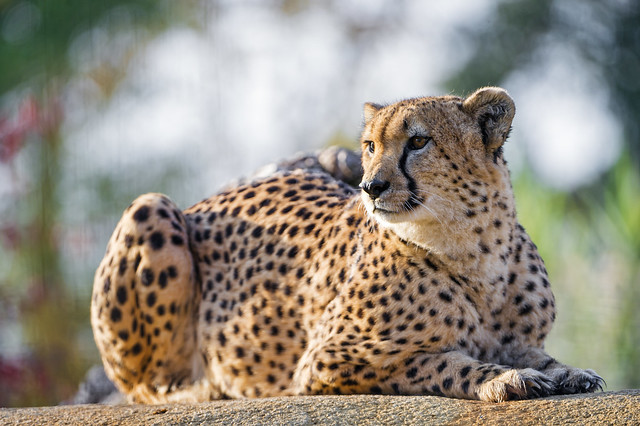



 After being
tranquilized, an adult female snow leopard named Tenger is fitted with a
GPS tracking collar. World Wildlife Fund researchers in Mongolia hope
the information they get from Tenger and other collared snow leopards
will lead to protected areas for the rare and increasingly threatened
cats.Photograph by Hereward Holland
After being
tranquilized, an adult female snow leopard named Tenger is fitted with a
GPS tracking collar. World Wildlife Fund researchers in Mongolia hope
the information they get from Tenger and other collared snow leopards
will lead to protected areas for the rare and increasingly threatened
cats.Photograph by Hereward Holland
 A shepherd
herds his flock of sheep and goats in the foothills of Jargalan
mountain. More than a third of Mongolia’s 2.6 million people are nomadic
or seminomadic, but their pasturelands are disappearing. Photograph by Hereward Holland
A shepherd
herds his flock of sheep and goats in the foothills of Jargalan
mountain. More than a third of Mongolia’s 2.6 million people are nomadic
or seminomadic, but their pasturelands are disappearing. Photograph by Hereward Holland

 The World
Wildlife Fund team set a trap next to one of Maamkhuu’s sheep that
Tenger had killed. They hoped she’d come back for another meal and get
snagged so they could put a new GPS collar on her. And that’s what
happened.Photograph by Hereward Holland
The World
Wildlife Fund team set a trap next to one of Maamkhuu’s sheep that
Tenger had killed. They hoped she’d come back for another meal and get
snagged so they could put a new GPS collar on her. And that’s what
happened.Photograph by Hereward Holland
 Ochirjav
Munkhtogyokh and his team from WWF scour the mountainside for signs of a
snow leopard, as well as their prey base, argali sheep and ibex. Photograph by Hereward Holland
Ochirjav
Munkhtogyokh and his team from WWF scour the mountainside for signs of a
snow leopard, as well as their prey base, argali sheep and ibex. Photograph by Hereward Holland
 Maamkhuu’s
wife, standing on the ridgeline at right, surveys the family’s flock of
sheep and goats near their home on Jargalan mountain. A warming climate
in Mongolia threatens both their way of live and the survival of snow
leopards.Photograph by Hereward Holland
Maamkhuu’s
wife, standing on the ridgeline at right, surveys the family’s flock of
sheep and goats near their home on Jargalan mountain. A warming climate
in Mongolia threatens both their way of live and the survival of snow
leopards.Photograph by Hereward Holland