Friday, May 23, 2014

Thursday, May 22, 2014

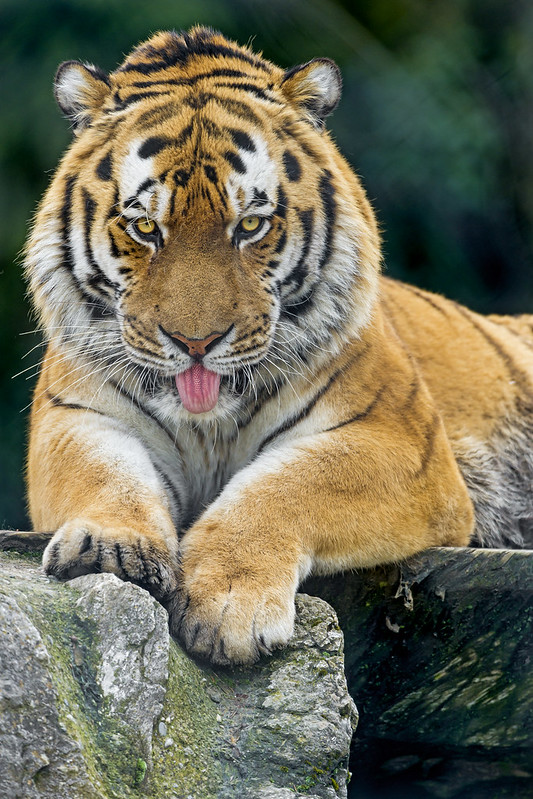
Chitwan National Park starts special research on tigers

Assistant Conservation Officer at the Park, Tikaram Poudel, said that the park has started research on tiger activities in the park through camera trapping method till four years. As many as 15 cameras have been used to capture the activities of tigers .
The research has been limited to Khoriya Source to Dumariya and Bankatta to Bote Simara of the Park.
Poudel said that different activities of tigers including regular activities, behavior, breeding condition, health condition and relation to other animals, would be enquired from camera trapping for four times once a year till four years.
The park said that the research will be completed after four years after collecting the pictures trapped through cameras.
This is the first time, the country has started such type of special research. As per the recent census, there are 120 tigers in the park. RSS
source

Wednesday, May 21, 2014

World's Oldest Cat Is A Party Animal, Eats KFC
Posted:

The world's oldest living cat has a taste for KFC and kebabs. Poppy, now blind and deaf and feisty as ever, is pretty much the coolest cat to grace the Internet since yesterday. Guinness World Records crowned her the oldest living cat at the young age of 24 -- or 114 in human years, according to SWNS.
She was born in February, 1990. Her family isn't sure exactly how she was able to hold on for so long, but one of her secrets is eating KFC chicken, kebabs, fish and chips and canned cat food, NBC News reports.
Just look at that birthday cake!

"Poppy is definitely the top cat and she is still quite feisty," said Jacqui West, Poppy's owner, at her home in Bournemouth, England. "If one of the other cats tries to eat her food she will bite them on the ear."

Poppy has a long way to go if she wants to be dubbed the OLDEST CAT OF ALL TIME, however. Creme Puff, who lived in Austin, Texas, made it to 38 years and 3 days, and died in 2005. The average cat lives about 15 years, NBC News reports.
source
Party on, Poppy.
Tuesday, May 20, 2014
Monday, May 19, 2014
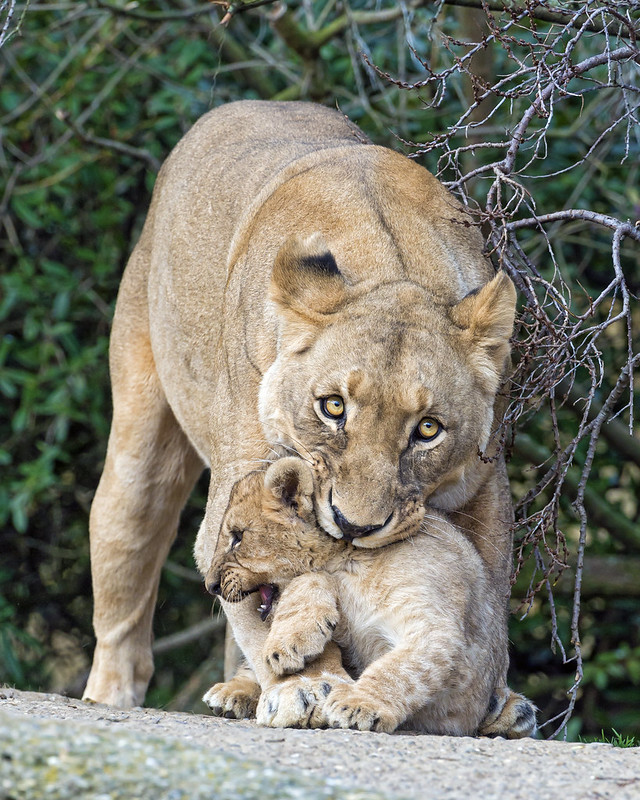 Mom's got a mouthful of cub
Snubbing lion hunters could preserve the endangered animals
Date:
May 14, 2014
Source:
University of California - Davis
Summary:
A
change in longstanding cultural practice in Tanzania is saving some
endangered lions from being killed by hunters. For hundreds of years
young men from some ethnic groups in Tanzania, called "lion dancers"
because they elaborately acted out their lion killing for spectators,
were richly rewarded for killing lions that preyed on livestock and
people. Now when a
lion dancer shows up he might be called a rude name rather than receive a reward.
lion dancer shows up he might be called a rude name rather than receive a reward.

A Tanzanian lion dancer does the lion dance, which captures the adventures of the lion killer.
Credit: Adi Swami
For hundreds of years young men from some ethnic groups in Tanzania, called "lion dancers" because they elaborately acted out their lion killing for spectators, were richly rewarded for killing lions that preyed on livestock and people. Now when a lion dancer shows up he might be called a rude name rather than receive a reward, according to a new UC Davis study.
Some
villagers are snubbing the lion killers, calling them "fakers" and
contemplating punishing them and those who continue to reward them, said
Monique Borgerhoff Mulder, anthropology professor at UC Davis. That's
because the lion hunters are killing lions that are not a threat to
people or livestock and live in a national park.
This surprisingly rapid change in a long-standing cultural practice has positive implications for efforts to save lions, said Borgerhoff Mulder, lead author of "From avengers to hunters: Leveraging collective action for the conservation of endangered lions." The paper was published in the May edition of the journal Biological Conservation.
Traditionally, after killing a predatory lion using only a spear and shield, the hunter would travel from village to village, perform the dance and be showered with gifts including livestock and even a night with young women in the village.
"This change in behavior offers an intriguing solution to the problem of illegal hunting insofar as the community is policing itself," Borgerhoff Mulder said. "It is a real opportunity to work with a community that is changing its customs in a way compatible with a conservation goal."
A change coming from within the community will also be more long-lasting than rules and regulations from the outside, she said.
The study interviewed 198 households with 73 reporting being visited 128 times by dancers between 2001 and 2010. The households rewarded 96 dancers (75 percent) and did not reward 33 (25 percent). Although most households are still rewarding the dancers, 96 percent stated that the nature of lion killing had changed, and 72 percent said that the young men were killing lions just to acquire wealth. "The hunters are going deep into the national park, the border of which is 8 to 10 miles away," Borgerhoff Mulder said. "People are saying they are cheats and are not going to give them gifts any longer. The community has found a reason for policing itself. This is a rare instance of wildlife conservation and community actions working in tandem."
This surprisingly rapid change in a long-standing cultural practice has positive implications for efforts to save lions, said Borgerhoff Mulder, lead author of "From avengers to hunters: Leveraging collective action for the conservation of endangered lions." The paper was published in the May edition of the journal Biological Conservation.
Traditionally, after killing a predatory lion using only a spear and shield, the hunter would travel from village to village, perform the dance and be showered with gifts including livestock and even a night with young women in the village.
"This change in behavior offers an intriguing solution to the problem of illegal hunting insofar as the community is policing itself," Borgerhoff Mulder said. "It is a real opportunity to work with a community that is changing its customs in a way compatible with a conservation goal."
A change coming from within the community will also be more long-lasting than rules and regulations from the outside, she said.
The study interviewed 198 households with 73 reporting being visited 128 times by dancers between 2001 and 2010. The households rewarded 96 dancers (75 percent) and did not reward 33 (25 percent). Although most households are still rewarding the dancers, 96 percent stated that the nature of lion killing had changed, and 72 percent said that the young men were killing lions just to acquire wealth. "The hunters are going deep into the national park, the border of which is 8 to 10 miles away," Borgerhoff Mulder said. "People are saying they are cheats and are not going to give them gifts any longer. The community has found a reason for policing itself. This is a rare instance of wildlife conservation and community actions working in tandem."
Story Source:
The above story is based on materials provided by University of California - Davis. Note: Materials may be edited for content and length.
The above story is based on materials provided by University of California - Davis. Note: Materials may be edited for content and length.
Journal Reference:
- E. Fitzherbert, T. Caro, P.J. Johnson, D.W. Macdonald, M. Borgerhoff Mulder. From avengers to hunters: Leveraging collective action for the conservation of endangered lions. Biological Conservation, 2014; 174: 84 DOI: 10.1016/j.biocon.2014.03.012
University
of California - Davis. "Snubbing lion hunters could preserve the
endangered animals." ScienceDaily. ScienceDaily, 14 May 2014.
<www.sciencedaily.com/releases/2014/05/140514153237.htm>.
Sunday, May 18, 2014
For now Rocky's just a big cat, not bobcat, can go home
Who's the daddy of a 38-pound hybrid bobcat that was wandering
around in early April? The answer to that question may never be known,
but for now, this big kitty gets to go home to his owner.
VPC
STAFFORD TOWNSHIP, N.J.— Who's the daddy of a 38-pound kitty that was wandering around this area in early April? The answer to that question may never be known. For that reason Rocky, a cat who's supposed to be a cross between a bobcat and a Maine coon but was suspected of being a purebred bobcat, can go home. That was Municipal Court Judge Damian G. Murray's surprise ruling Friday as Rocky's owner, Ginny Fine, waited to hear results of a DNA test on her 3-year-old feline.
If the DNA test had revealed that Rocky was pure bobcat — males can weigh as much as 40 pounds while male Maine coon cats can tip the scales at more like 25 pounds — Fine would not have been allowed to have him back. New Jersey bans residents from owning "potentially dangerous species" as pets, which includes nondomestic cats, and she would have had to qualify for a special permit generally not issued to nonprofessionals.
But a bobcat hybrid is just considered a big kitty under state law. Elsie (one of her domestic cats) has been walking around the house, looking in all the rooms for him. ~~Ginny Fine, Stafford Township, N.J.
The test could not determine who Rocky's father was, and the Montana breeder from whom Fine obtained Rocky was not required to keep records of the animal's lineage, Murray said. "The bottom line is Rocky goes home," the judge said. The ruling caught Fine off guard. But she's ecstatic despite having just pleaded guilty to letting the animal get loose and being fined $1,000. "I'm shocked," Fine said later. "I was not expecting that."
She said her house cats, Elsie and Checkers, will be happy to see Rocky, who has been declawed.
"They miss him terribly," Fine said. "Elsie has been walking around the house, looking in all the rooms for him."
Animal control officers brought Rocky to Popcorn Park Zoo a day after Fine had lured him back home. He had gotten loose March 25. Murray ordered that Rocky be kept in an enclosure that officials from New Jersey's Division of Fish and Wildlife will inspect periodically. "It is something I don't have a problem doing if I can have the cat back," Fine told the judge.
Outside the courtroom, she said the enclosure already has been constructed with money donated by people who want to see Rocky return home. Animal Control Officer Kelly Karch said it will be inspected Monday In imposing the $1,000 fine, Murray said the hunt for Rocky incurred labor expenses for police officers, who were "all over this town, hunting through the woods" for Rocky. It was the second time Rocky had run away.
Fine also had to pay $216 in restitution to Stafford Veterinary Hospital for tranquilizer medication used during an attempt to capture Rocky the second time. But Rocky is still not out of the woods: Murray said he could be subject to seizure in the future if his father can be determined to be a bobcat.
Tigers in Grand Rapids: 3 big cats have arrived at John Ball Zoo


Name: Kuza. Sex: Male. Age: 3. Weight: 450-plus pounds. Kuza is Yuri's
brother and also comes from to Grand Rapids from Rosamond Gifford Zoo in
Syracuse, N.Y. Unlike Yuri, Kuza is cautious and timid. When the tigers
got a cardboard box with meat treats for their first birthday, Yuri
ripped into it while Kuza shied away. (Photo courtesy of Catherine N.
Stolz)

Part of John Ball Zoo's new Crawford Tigers of the Realm exhibit is
scheduled to open June 14, 2014. A trail and lower habitat area is
slated to open in 2015.

Krapinka was the last tiger on exhibit at John Ball Zoo. The female Amur
tiger in 2009 was moved to Roosevelt Park Zoo in Minot, N. D. In this
2007 photo, she strolls through the zoo's old tiger exhibit as
preschoolers from Legacy Christian School in Culterville watch.
(MLive.com file)

Urod was 17 years old when he died at John Ball Zoo in 2006, leaving one
female tiger who was moved out of the zoo three years later.

Nicole, an Amur tiger born at John Ball Zoo in 1998, died in March at the Oregon Zoo. (Photo by Michael Durham/Oregon Zoo)

Yuri, left, and Kuza toy with a snowman. The two 3-year-old male Amur
tigers have moved to John Ball Zoo in Grand Rapids and will be part of a
new Crawford Tigers of the Realm exhibit set to open in June. (Photo
courtesy of Catherine N. Stolz)
By
on May 16, 2014
on May 16, 2014
Nika, a female, and two males, brothers Kuza and Yuri, moved this week to the Kent County zoo at 1300 W. Fulton St. They will be quarantined for a couple weeks before the zoo’s new Crawford Tigers of the Realm exhibit opens next month, spokeswoman Krys Bylund said.
The exhibit in the zoo’s Idema Forest Realm is scheduled to open to the public Saturday, June 14.
Nika, a 9-year-old, came from Potter Park Zoo in Lansing. She is unrelated to the two male tigers now at John Ball Zoo.
Kuza and Yuri are 3-year-old brothers who came from Rosamond Gifford Zoo in Syracuse, N.Y. Each weighs about 450 pounds.
The new arrivals are Amur tigers, which are native to Siberia and have a life expectancy of 14 years for females and 16 years for males.
Barb Snyder talks about the upcoming return of tigers to the John Ball Zoo.
Saturday, May 17, 2014
Small Wild Cats Face Big Threats, but Receive Little Conservation Funds
Relative obscurity of small cats means they are overlooked by most wildlife conservation groups
Dipping through the underbrush, in the jungles of Borneo or Bangladesh, a fierce predator slinks. Orbed, glowing eyes glance out from an angular, feline face, as it soft-steps through the shadows. All creatures small — whether mammal, bird, or insect —flee at this predator’s approach. Indeed, it is only these smaller animals that have cause for fear: Our predator is about the size of a house cat. Photo Wikimeida Commons Hundreds of thousands of ocelots
were once killed for their fur. The 22 known small cat species around
the world received a tiny fraction of wildcat conservation dollars.
Photo Wikimeida Commons Hundreds of thousands of ocelots
were once killed for their fur. The 22 known small cat species around
the world received a tiny fraction of wildcat conservation dollars.Yet unlike a house cat, an encounter with a small wildcat is an exceptional rarity. Relatively few people can name wildcat species, and fewer still have laid eyes upon one outside of zoos. As with lions, tigers, and leopards, most small cats’ conservation status wavers between threatened and critically endangered. However, there’s a huge disparity in the amount of funding small cat conservation receives vs. big cat conservation.
According to the Small Wild Cat Conservation Alliance, a nonprofit dedicated to small cat preservation, the seven iconic big cat species have received 99.22 percent of all funding for cat conservation since 2007. In contrast, the 22 known small cat species around the world received 0.78 percent.
In all, there are 36 known feline species in the wild, spanning continents and habitats. Nearly three-fourths of these are near the size of a domestic house cat or slightly larger. Very little is known about most of these small cat species, which is partly why it’s hard to get funding for conservation projects dedicated to them.

One such conservationist is Dr. Jim Sanderson, founder and director of the Small Wild Cat Conservation Foundation. The foundation began in 1996, with a mission to ensure small cat survival in their natural habitats worldwide. The organization works with local partners in regions the cats reside.
Sanderson attributes the funding divergence to awareness. Everyone knows the larger, more iconic species, but their smaller relatives’ obscurity means they are overlooked.
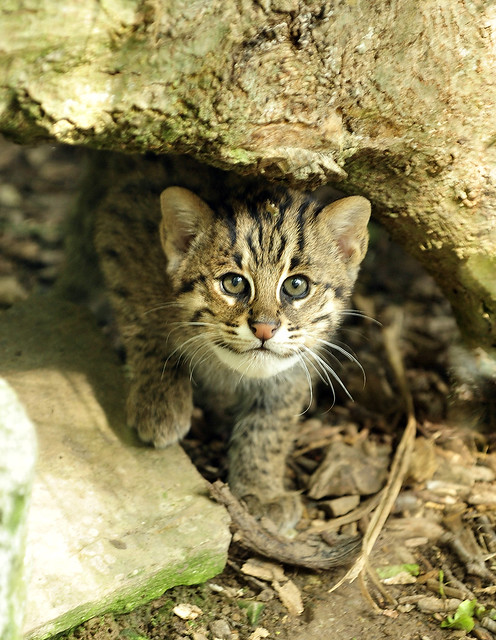
Photo by Ben Williams The Asian fishing cat is an adept swimmer and diver
As with innumerable other wild species, threats to survival come primarily from human development. Habitat loss is the primary driver of extinction for small cats. Sanderson points to timber harvesting, palm oil plantations, mining, and industrial shrimp ponds.
“In Borneo there’s a lot of illegal gold mining and river disturbance you have these dredges that are diesel-powered churning up the river bottom looking for gold. The river goes down brown. It’s destroyed. That takes away habitat from the fishing cat and the flat-headed cat,” he says.
The cats’ rarity and the exotic myths about them make them prime targets for poachers and traders who hunt them for their fur, believed medicinal value, and for the captive pet trade. In some places the cats are eaten or used for medicinal rituals by the locals, but more often, they are snared or poisoned in retaliation for killing chicken or other livestock. Feral dogs too, sometimes hunt down and kill wild cats. The cats, however, pose no threat to human safety.
The small cats’ plight speaks to a larger trend in conservation. Iconic species take the spotlight, receiving attention and funding, and the lesser-known species fall through the cracks. According to the United Nations Environment Program, an estimated 150 to 200 species go extinct every day. The International Union for Conservation of Nature estimates that a staggering 36 percent of Earth’s species are threatened by extinction.

Photo Wikimedia CommonsThe sand cat is the only felid found primarily in true desert.
“Often the need to engage in a campaign to protect a particular species is urgent and immediate,” Curry says. “Species with limited ranges and very high threat levels rise to the top of the priority list for obvious reasons.”
However, geographically strategic approaches can also have a high impact, she says “In addition to addressing the species that are in very hot water, we attempt to launch campaigns to safeguard as many imperiled species as possible over broad geographic areas,” she says. “In this time of rapid human population growth and increasing resource demand, every single species that we lose unravels a piece of the ecosystem that we all depend on for survival and wellbeing.”
Sanderson points to one simple thing that people can do to help small cats. “Read the labels.” For example, products containing palm oil generally contribute to the deforestation that is squeezing cats out. And buying shrimp raised in Thai industrial ponds deprives fishing cats of their habitats. Such thoughtfulness in consumer choices can help these species’ survive.“I hope we don’t have to have a crisis to mobilize funding. We want to keep moving in the right direction,” he says.
source
Lynx sighting

I’m outta here! Nickel Belt News photo courtesy of Wayne Pokrant
source
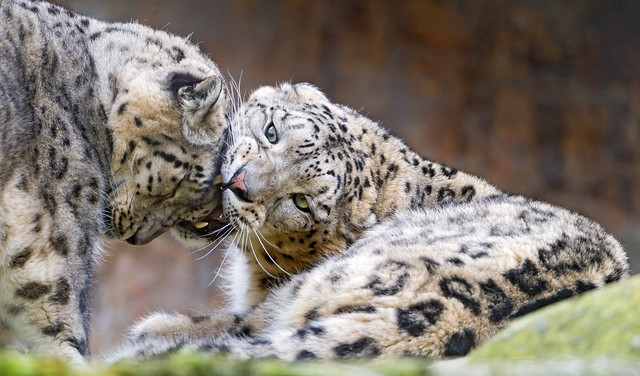
Porsche nixes tiger displays to promote new model

The quick action came after an exotic cats sanctuary in Tampa said it heard from another rescue organization in North Carolina that a nearby Porsche dealership was making inquiries about renting tiger cubs for a promotion around the new crossover SUV. Sounded like other dealers might have the same idea, too.
 Such
promotions are frowned upon in the animal-rights community because
cuddly cubs soon grow into full-size cats that breeders or private
owners can't afford to keep — making them someone else's burden, says
Susan Bass, public relations director for the Big Cat Rescue non-profit,
when reached for comment Wednesday. She says she reached out to Porsche
and got a call back from a marketing executive "who could not have been
nicer." She says he told her dealers are independent, but "we strongly
suggested that they do not have live tigers at any of their
dealerships."
Such
promotions are frowned upon in the animal-rights community because
cuddly cubs soon grow into full-size cats that breeders or private
owners can't afford to keep — making them someone else's burden, says
Susan Bass, public relations director for the Big Cat Rescue non-profit,
when reached for comment Wednesday. She says she reached out to Porsche
and got a call back from a marketing executive "who could not have been
nicer." She says he told her dealers are independent, but "we strongly
suggested that they do not have live tigers at any of their
dealerships."People for the Ethical Treatment of Animals also got involved and says in a blog post that it received the same assurances from Porsche.
Porsche did not respond immediately to a request for comment.
Source
Wednesday, May 14, 2014
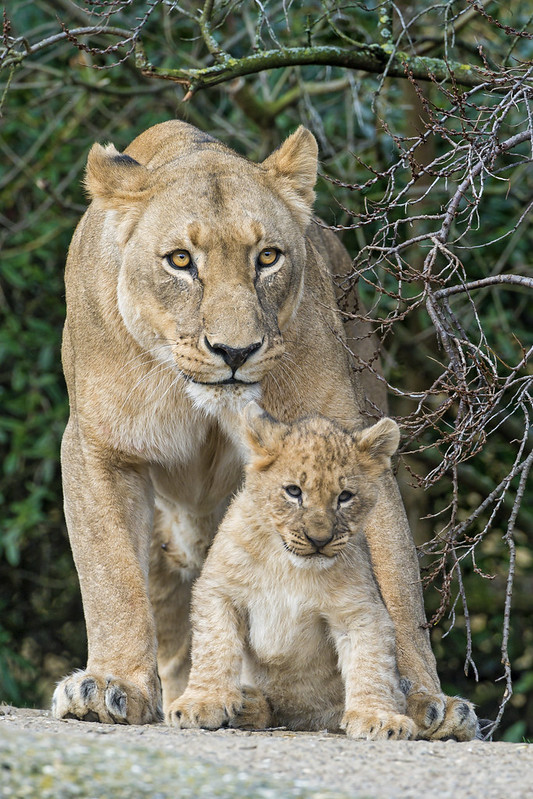
The Lion Guardians
Across Africa today wildlife is disappearing, and its story is grim. Yet there is one powerfully bright spot, Namibia, where its people have made the commitment to live with and protect their wildlife. “The Guardians” tells the story of Jantjie Rhyn, a farmer from one of Namibia’s vibrant communal conservancies. Despite the dangers of living with lions and other free-roaming wildlife, Jantjie and his community are committed to their protection because responsible tourism and national pride make his wildlife worth more alive than dead. He represents one in five Namibians that today are directly involved in conservation, making him a true guardian of Africa’s natural legacy. Namibians like Jantjie are showing the world how to improve wildlife and a community’s lives all at once.
source
Special thanks to @Adelheid16 on Twitter for the heads up!
Ethiopia's rare mountain lions
A German conservation group is compensating local farmers in Ethiopia’s
Kafa region,whose lifestock is often seized by rare mountain lions. In
return, the farmers are helping protect the big cats.
Project goal: documenting and protecting the lions of
Kafa (among the very few African lions not living in a savannah region),
preserving the rich biodiversity of the Kafa Biosphere Reserve and
ensuring balanced wildlife numbers
Duration: 2009 to 2014 under the NABU Cloud Forest Protection project, since 2013 - Nabu lion protection program
Implementation: in a pilot project, local farmers are compensated for their livestock seized by the lions. They inform NABU about lion sightings and their behaviour patterns
Size: Kafa Biosphere Reserve (780 square kilometers)
Funding: around 3.2 million Euros from the International Climate Initiative’s (IKI) forest protection program
Key species: African lion (Panthera leo)
The Kafa Biosphere Reserve in Ethiopia is known for its wild coffee, hippos and crowned eagle. But lions? Scientists were taken by surprise when a rare female mountain lion was sighted there two years ago. Now, a few of the beasts, including some from the former zoo and presidential palace in Addis Ababa, seem to be at home in Kafa’s mountain cloud forests. But, local farmers aren’t so happy with the big cats increasingly attacking their livestock during the dry season. German conservation group NABU is helping to compensate farmers and banking on their traditional reverence for lions to help protect the big beasts.
A film by Kilian Schütze
source
Duration: 2009 to 2014 under the NABU Cloud Forest Protection project, since 2013 - Nabu lion protection program
Implementation: in a pilot project, local farmers are compensated for their livestock seized by the lions. They inform NABU about lion sightings and their behaviour patterns
Size: Kafa Biosphere Reserve (780 square kilometers)
Funding: around 3.2 million Euros from the International Climate Initiative’s (IKI) forest protection program
Key species: African lion (Panthera leo)
The Kafa Biosphere Reserve in Ethiopia is known for its wild coffee, hippos and crowned eagle. But lions? Scientists were taken by surprise when a rare female mountain lion was sighted there two years ago. Now, a few of the beasts, including some from the former zoo and presidential palace in Addis Ababa, seem to be at home in Kafa’s mountain cloud forests. But, local farmers aren’t so happy with the big cats increasingly attacking their livestock during the dry season. German conservation group NABU is helping to compensate farmers and banking on their traditional reverence for lions to help protect the big beasts.
A film by Kilian Schütze
source
Artificial water supply for big cats in Gir forest
Water supply to 51 artificial water 'points' in the Gir forest has
begun from last week to help Asiatic lions and other animals quench
their thirst in the scorching summer, a senior forest official said
today.
There are 50-60 Asiatic lions in the east region of the forest.
The 51 artificial water points are located in the arid Tulsishyam, Tarasiya and Savarkundla regions in East division (Dhari) of the forest where there is no availability of natural water. Therefore, the supply is being done by tankers, Deputy Conservator, Gir forest (East Division, Dhari) Anshuman Sharma said here today.
There are a total of 180 artificial water points in the 728 sq km eastern Dhari division of the Gir forest.
There is no need to supply water daily to the artificial water points located in the vicinity of Machhundri and Raval rivers, separating east division from west division in Dhari range, he said.
"As there is good flow of water in the rivers passing through the Dhari range during this season, the lions prefer to quench their thirst with river water," he said.
"However, we ensure that all the artificial water points, whether they are located in remote forest areas or near the rivers, are filled with water," Sharma said.
Water pumping wind mills have also been set up in the remote areas to help keep the artificial water points filled during peak summers, he added.
There are 50-60 Asiatic lions in the east region of the forest.
The 51 artificial water points are located in the arid Tulsishyam, Tarasiya and Savarkundla regions in East division (Dhari) of the forest where there is no availability of natural water. Therefore, the supply is being done by tankers, Deputy Conservator, Gir forest (East Division, Dhari) Anshuman Sharma said here today.
There are a total of 180 artificial water points in the 728 sq km eastern Dhari division of the Gir forest.
There is no need to supply water daily to the artificial water points located in the vicinity of Machhundri and Raval rivers, separating east division from west division in Dhari range, he said.
"As there is good flow of water in the rivers passing through the Dhari range during this season, the lions prefer to quench their thirst with river water," he said.
"However, we ensure that all the artificial water points, whether they are located in remote forest areas or near the rivers, are filled with water," Sharma said.
Water pumping wind mills have also been set up in the remote areas to help keep the artificial water points filled during peak summers, he added.
Tuesday, May 13, 2014

Big cat’s trail on screen
May 13, 2014

Ajoba being collared by biologist Vidya Athreya
(right). Photo: Special Arrangement
“To know about an animal, you sometimes have to become one,” the character of wildlife biologist Purva Rao states in the film Ajoba,
which released in theaters on Friday. The film, that talks about
human-leopard conflict: an issue which has trespassed from the rural to
the urban areas, makes a pertinent point of the need to understand
animal behaviour.
The film starts begins with a leopard being trapped inside a well in
Maharashtra's Ahmednagar district. What follows is the leopard's 120-km
journey back to its own habitat over 29 days, closely watched by Dr. Rao
and her team, who have placed a chip in its body before releasing it
into the wild. Directed by 28 year-old Sujay Dahake, the film is
inspired by the work of Vidya Athreya, with Urmila Matondkar playing Dr.
Rao in her debut Marathi performance. Ajoba: meaning grandfather was the name Dr. Athreya's team gave the aging leopard.
Speaking to The Hindu on Sunday, Dr. Athreya said, “It was
important to show that animals are not a nuisance, and the film has done
that perfectly. Usually, the electronic media sensationalises the
issue, and does not go beyond the ‘man vs wild’ conversation.”
The idea of the film came to Mr. Dahake when he heard of another leopard
trapped in Junnar near Pune. It was then that he met Dr. Athreya, and
her animated description of Ajoba's journey that got him excited. “I
thought that the story had drama, and had to be told to the masses,”
Dahake told The Hindu. “I had found a hero in Ajoba. Here, nature
trying to tell you that it will not interfere with your life unless you
do so first,” the director said about the protagonist.
The journey and the process of following it was not easy for Dr.
Athreya, as it is not for Dr. Rao on screen. “Forest officials are
helpful, but they have political limitations. I had to work with that,”
she stated. “The characters in the film are an amalgamation of people
who have helped me and tracked Ajoba's journey,” she said.
Another conversation that the film manages to strike is that of the role
of women in unconventional careers, such as that of Dr. Rao's. She is
seen living in rural areas for days together, negotiating with male
forest officials and riding pillion with her assistants, all without the
tag of 'being a woman'. “I am a woman. But that has nothing to do with
how I work. If you're focussed, people will respect you for what you
are,” Dr. Athreya stated. For Mr. Dahake, that was a conscious decision
to portray the character in this way. “She smokes a beedi, and drinks
whiskey. She is not apologetic about the fact that she's not married. It
is what she has chosen for herself,” he states.
Spain's Last Lynx (Full video)
The Iberian lynx is on the brink of extinction. These majestic predators are top of the food chain in a land where hungry eyes are always watching. The threats of hunting have reduced their population to less than 200.
Sunday, May 11, 2014
Bangkok Tiger temple: Where the big cats don’t roar
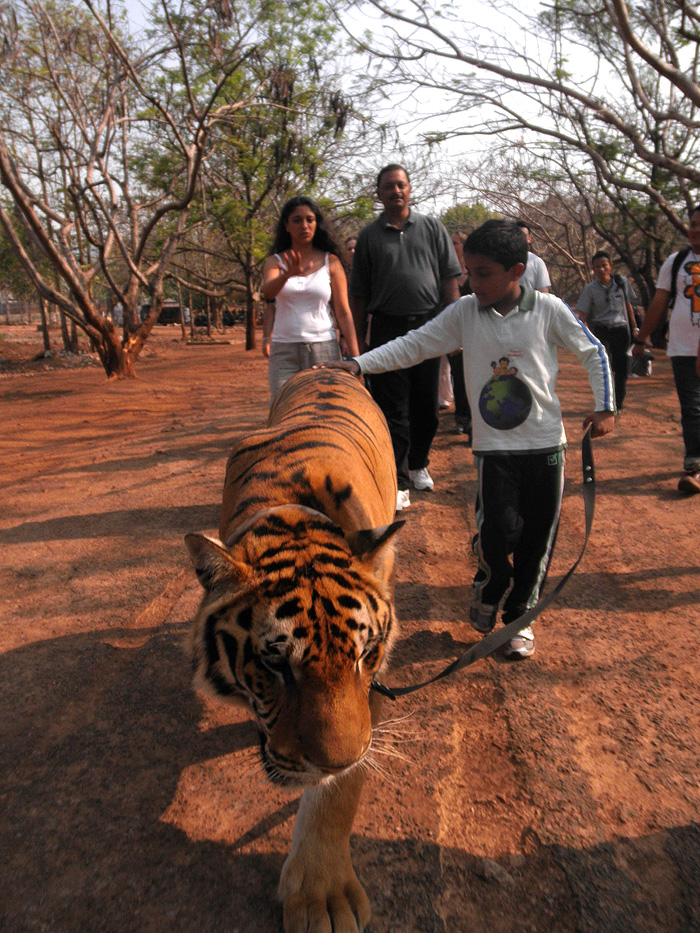
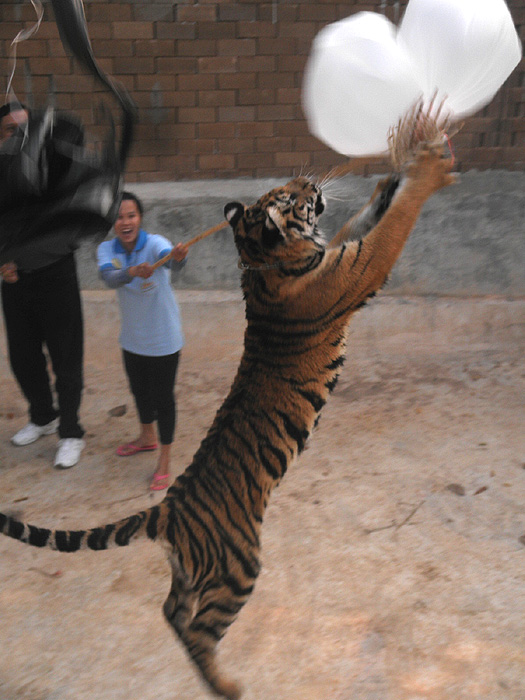
This exorbitantly priced tour started with a group of monks accepting an
offering of food from us before we were ushered into the sanctum
sanctorum to witness the incredible. A team of tiger carers (read:
keepers or trainers) juxtaposed with each magnificent tiger kept watch
to protect tourists from their unpredictability and instinct (I mean the
tigers’). An hour of cautious interaction with the larger cats made us
comfortable with cubs scratching us with their little paws and grabbing
us with their sharp yet unharming canines.
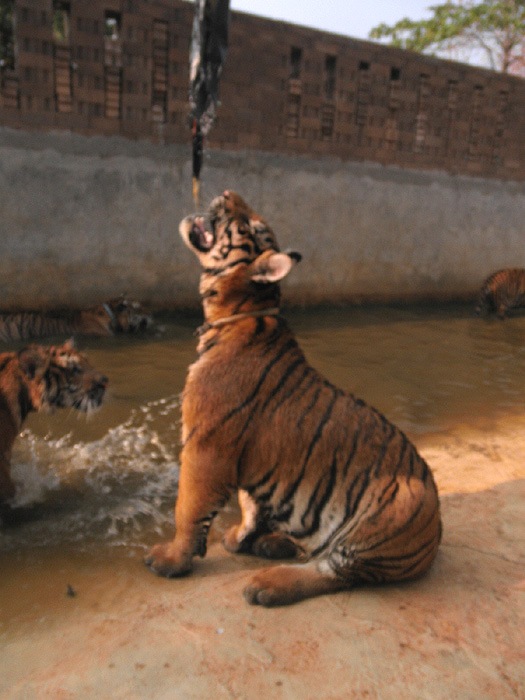
To keep the excitement of the promised experience, the monks coached us
convincingly on how to avoid getting attacked or eaten up by them.
“Don’t stroke it gently as it may think it’s a fly and flick you with a
power-paw shots. Don’t crouch in front of it or it may think you are a
child and they are known to attack children. Ddon’t turn your back to
them. Don’t look straight into their eyes lest it gets intimidated.” The
list was long. Our fear factor was adequately aroused. The next
incredible moment was a customary bathing and feeding of the beasts,
tamed into such subservience that their growls sounded like purrs. And,
they were eating out of our hands! Raised on cooked chicken only — so
that no instinct of attack, kill and eat is aroused — they could be
passed off as tigers promoting world peace.

The thrill or rather the shock of seeing obedient, disciplined and
domesticated tigers is unparalleled. We kept within fenced confines,
while the playful monks and trainers rolled about in rapturous interplay
with the tigers over a large rattle. It was made out of dustbin bags
full of plastic bottles tied to a staff, long enough to keep away from
any remnants of instinct it may still possess. They showcased amazing
stunts, incredible leaps, graceful acrobatics, and understood every
gesture of their masters perfectly.

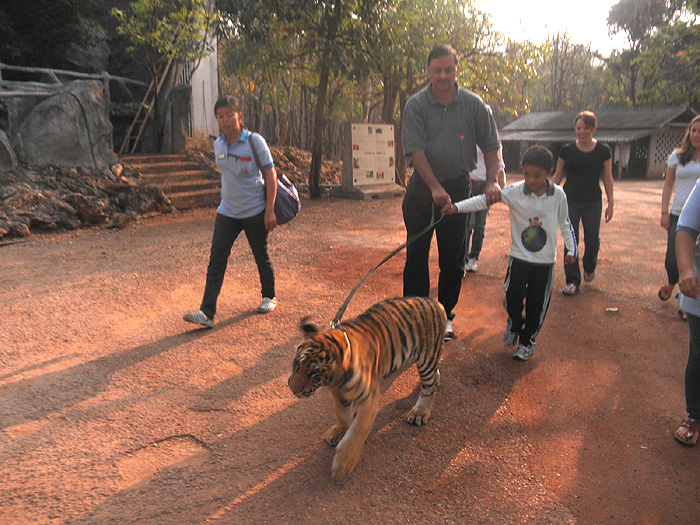
And the grand finale! We could actually hold a tiger by the tail even as
it allowed you to take pretty pictures, as your lips quivered and hands
shook at the possiblity of any change of heart the tiger may have. We
were lucky. Because either they didn’t care or it’s an ordeal they know
they will have to suffer every day, with a multitude thronging to the
temple.
All through, however, the slip-of-the-tongue of one monk stayed.
Something was amiss. My mind and heart were in constant debate over the
rumours and different opinions surrounding these tigers. Were they
sedated? Were they suppressed to be this calm? Is this too lucrative to
let go? How did a few small stray cubs adopted for care grow into such a
large family of over a 100? Should I have encouraged this seeming trade
that destroys the very dignity of the wild? Is this really just a
circus set in the jungles?


New Mexico Snow Leopard arrives at Micke Grove Zoo

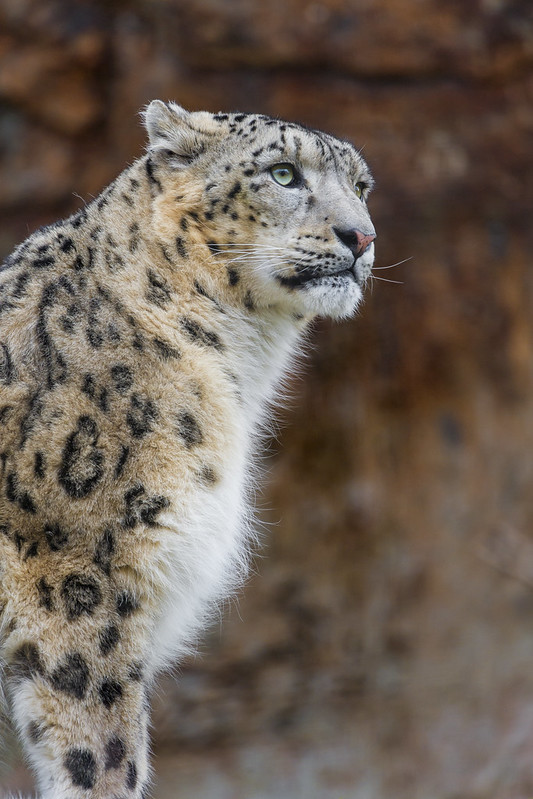
Micke Grove Zoo’s new female snow leopard is now on public display. The zoo is hosting a coming-out party today.
CRAIG SANDERS/The Record
LODI - Zoo officials are throwing a coming-out party today to celebrate a new snow leopard at Micke Grove Zoo. The big cat is actually more of kitten. It turned 1-year-old last Saturday. It was brought to the zoo in January. It
didn't go directly into its new home in the Paseo Pantera exhibit. The
animal was held in quarantine before being eased into the public eye.
The Snow Leopard First Day-Birthday celebration will include crafts, games and talks - all staying with the snow leopard theme. The party is from 10 a.m. until 3 p.m., but after 1 p.m., the Micke Grove Zoological Society will be giving out free snow cones.
The
snow leopard is an endangered species, and the zoo has housed them
since 1986. Nine have been born there, according to zoo officials. It's
estimated there are 2,500 to 6,500 snow leopards in the wild, according
to the zoo. Micke Grove got its latest leopard from the Albuquerque
BioPark in Albuquerque, N.M., through a recommendation from the Snow
Leopard Species Survival Plan.
The zoo's new
cat is a female. In an announcement, zookeepers say that visitors will
be able to watch the shy but curious animal grow into a mature adult. The enclosure used to be home to Monte, a mountain lion. Illness forced the zoo to euthanize the animal last year. Ling-shan, another snow leopard, was put down in 2012. The animal was 20 years old and had cancer and other illnesses.
But
there has been an influx of cats at the zoo in recent months. The zoo
moved a bobcat out of quarantine and into public exhibit in January,
about the same time the snow leopard cub arrived.
Officials are hoping to raise money to finish a new enclosure for snow leopards.
The
county-owned zoo is inside Micke Grove Regional Park at 11793 N. Micke
Grove Road outside Lodi. Zoo admission is $5, but for children 3 to 13,
it is $3. Children 2 and younger get in free. For more information, go
to mgzoo.com.
Saturday, May 10, 2014
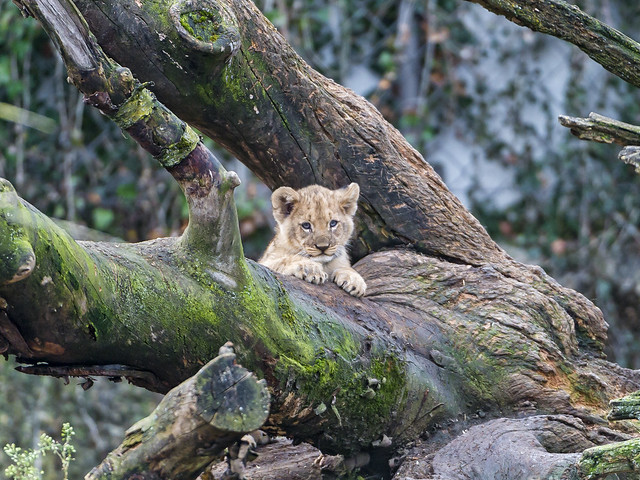 The Once and Future King
Friday, May 9, 2014
Persian Leopards: Large Cats with a Small Chance for Survival
February 7, 2014
|
In the past 40 days alone, seven rare Persian leopards (Panthera pardus saxicolor) have been killed or injured by poachers, food poisoning and cars, according to Iranian media reports.
The destiny of the leopard most recently harmed illustrates the cruelty of these incidents. The wretched cat was found in a forested area in the north of Iran with one front leg cut off by a foot-snare trap. After transporting the large male to a veterinary center, radiography showed that he was suffering from more than 50 small pellets and bullets scattered throughout its body and could not move due to spiral cord damage. There is no hope that the leopard’s condition will improve, according to an interview with its wildlife veterinarian.

The Persian leopard, as one of the mascots of the Sochi Olympics, is
the largest member of the cat family in Iran. Due to differences in
local environmental conditions there is a lot of variation in both the
size and coloration of these animals. The type that inhabits the
northern regions of Iran, specifically the montane forests of the
Caspian region, is one of the largest leopards in the world. Its height
at shoulder can measure up to 75 centimeters with a weight of up to
60-90 kg, according to
the Encyclopedia Iranica. The Persian leopard is officially considered
an endangered subspecies included on the Red List of the International
Union for Conservation of Nature and Natural Resources (IUCN).
Despite being a flagship species, there is no reliable data about the population size, mortality or fertility rate of this powerful cat. In 2002, an article published in the journal, Zoology in the Middle East, guesstimated that 550-850 individual leopards inhabited Iran, which is known as one of the strongholds for most of the remaining members of the subspecies. According to some reports, the population of the Persian leopard has drastically declined across its range, mainly because of the decimation or disappearance of ungulates, which are its main food source. And food scarcity increases the potential for conflict between humans and leopards.
A survey published in Proceedings of the International Annual Symposium on Sustainability Science and Management showed that 71 Persian leopards were killed by illegal hunting or poisoned between 2007 and 2011 (12 of the cats have been killed in the last 11 months alone, according to Iranian media), but such surveys only capture the tip of the iceberg. The actual number of killings is much higher than reported.

Some national NGOs of Iran received technical and financial aid from
international counterparts in order to carry out studies focusing on the
Persian leopard. Some attempts at camera-trapping were carried out in
order to estimate the population size of the leopard in different
protected and non-protected areas. Also, awareness-raising programs have
been conducted to increase local people’s attention to the role of the
leopard in local ecosystems. For instance, an NGO investigated and reported
that seven leopards inhabit the Bamu National Park in the Fars Province
of Iran. The NGO also educated students who live in villages
surrounding the park about the importance of saving the big, spotted
cat. One of the important roles that the leopard plays is controlling
the population size of Indian crested porcupine, the biggest rodent in
Iran, and wild boar, which might become pests of agriculture.
Recently, the Cat Specialist Group of IUCN assisted the Department of Environment of Iran (DoE) in the compilation of a booklet, titled “Conservation Cats of Iran – a roadmap to a comprehensive approach for the conservation of the indigenous cat species of the I.R. Iran.” The effort involved all Iranian NGOs focusing on the conservation of wild cats. Despite many useful hints regarding the collection of different types of data (via observations, genetics, camera-trapping and so on), there is no mention in the booklet on how to use or analyze the gathered data. It should be noted, however, that conservation and management plans cannot be implemented without reliable results derived from sound data analysis.
The DoE is the main government organization responsible for protecting and conserving wild animals, according to game and fishery law. It is clear that implementation of any conservation plan requires monitoring data regarding the target species, such as direct or indirect observation, and killed or alive sightings. However, it seems that the DoE has no systematic recording database to keep track of the number and type of leopard deaths, which include car crash, deliberate poisoning, or illegal hunting.
It may well be that the DoE has, in fact, gathered and recorded this data, but they are not available for public access due to lack of transparency in the government. This is regrettable because spatiotemporal analysis of data collected about killed leopards could provide realistic insights about the causes and circumstances behind these incidents. More specifically, results of such analysis could reveal critical spots and regions where human-species conflicts concentrate. Instead of the DoE, a few NGOs are gathering these data with the aim of identifying main zones of conflict.
Apparently, the fate of the Persian leopard depends on the outcomes of NGO efforts, on one hand, and on the application of derived analysis outcomes by the DoE, on the other hand. Hence, an important future consideration is how far the government organization continues to cooperate with non-governmental organizations in the effort to save these majestic cats.
source
The destiny of the leopard most recently harmed illustrates the cruelty of these incidents. The wretched cat was found in a forested area in the north of Iran with one front leg cut off by a foot-snare trap. After transporting the large male to a veterinary center, radiography showed that he was suffering from more than 50 small pellets and bullets scattered throughout its body and could not move due to spiral cord damage. There is no hope that the leopard’s condition will improve, according to an interview with its wildlife veterinarian.
A leopard cub was saved by
Iranians in southwest city of Khorramabad while it was trapped inside a
well / Credit: Mehr News Agency
Despite being a flagship species, there is no reliable data about the population size, mortality or fertility rate of this powerful cat. In 2002, an article published in the journal, Zoology in the Middle East, guesstimated that 550-850 individual leopards inhabited Iran, which is known as one of the strongholds for most of the remaining members of the subspecies. According to some reports, the population of the Persian leopard has drastically declined across its range, mainly because of the decimation or disappearance of ungulates, which are its main food source. And food scarcity increases the potential for conflict between humans and leopards.
A survey published in Proceedings of the International Annual Symposium on Sustainability Science and Management showed that 71 Persian leopards were killed by illegal hunting or poisoned between 2007 and 2011 (12 of the cats have been killed in the last 11 months alone, according to Iranian media), but such surveys only capture the tip of the iceberg. The actual number of killings is much higher than reported.
A leopard killed in an automobile accident in Sefidkooh protected area near Khorramabad / Credit: Mehr News Agency
Recently, the Cat Specialist Group of IUCN assisted the Department of Environment of Iran (DoE) in the compilation of a booklet, titled “Conservation Cats of Iran – a roadmap to a comprehensive approach for the conservation of the indigenous cat species of the I.R. Iran.” The effort involved all Iranian NGOs focusing on the conservation of wild cats. Despite many useful hints regarding the collection of different types of data (via observations, genetics, camera-trapping and so on), there is no mention in the booklet on how to use or analyze the gathered data. It should be noted, however, that conservation and management plans cannot be implemented without reliable results derived from sound data analysis.
The DoE is the main government organization responsible for protecting and conserving wild animals, according to game and fishery law. It is clear that implementation of any conservation plan requires monitoring data regarding the target species, such as direct or indirect observation, and killed or alive sightings. However, it seems that the DoE has no systematic recording database to keep track of the number and type of leopard deaths, which include car crash, deliberate poisoning, or illegal hunting.
It may well be that the DoE has, in fact, gathered and recorded this data, but they are not available for public access due to lack of transparency in the government. This is regrettable because spatiotemporal analysis of data collected about killed leopards could provide realistic insights about the causes and circumstances behind these incidents. More specifically, results of such analysis could reveal critical spots and regions where human-species conflicts concentrate. Instead of the DoE, a few NGOs are gathering these data with the aim of identifying main zones of conflict.
Apparently, the fate of the Persian leopard depends on the outcomes of NGO efforts, on one hand, and on the application of derived analysis outcomes by the DoE, on the other hand. Hence, an important future consideration is how far the government organization continues to cooperate with non-governmental organizations in the effort to save these majestic cats.
source

Subscribe to:
Posts (Atom)