Friday, May 9, 2014

Meet the former film-maker who turned her back on the big time to fight for Namibia's carnivores

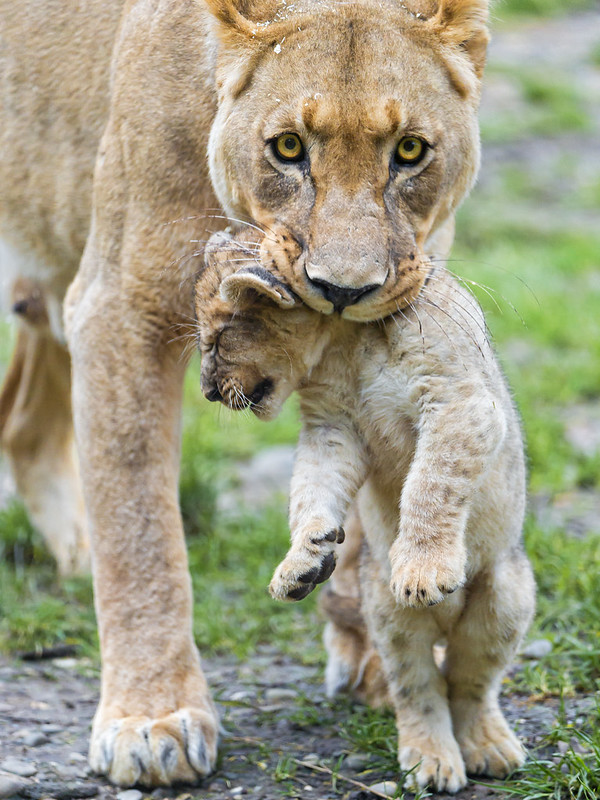
'People shoot the mothers and take the cubs. When they grow up, they sell them to hunting farms

  • Donna Hanssen was on the verge of a Hollywood career but decided to become a conservationist instead
  • One of the founders of the AfriCat Foundation, which began life in 1993 and has saved more than 1,000 big cats
  • Says the animals are threatened by poachers who kill the mothers and sell the cubs to hunting farms to be shot
  • More are at risk from farmers who fear for the lives of their animals if leopards, lions and cheetahs are around
By Ruth Styles
She was a promising film-maker on the verge of a stellar career. But rather than pursuing her Hollywood dream, Donna Hanssen chose to turn her back on the big time for a life on conservation's front line.

Outraged by figures that revealed Namibia's carnivore population had halved during the 1980s, she and her siblings launched AfriCat - a pioneering organisation that has saved more than 1,000 lions, leopards and cheetahs since 1993. 

But, says the veteran conservationist, while numbers are picking up, the animals are still under threat - both from poachers and from farmers who shoot the animals as they move across their land for fear of what might happen to their cows if they don't.

Scroll down for video
Hard at work: Donna Hanssen turned her back on a promising film career to dedicate her life to protecting Namibia's endangered lions, leopards and cheetahs

Beautiful: One of the rescued leopards living at the Okonjima Wildlife Reserve tucks into his lunch while perching precariously on a branch

Shocking: A leopard lies dead after being brutally beaten by angry villagers
Horrific: A dead lion is surrounded by a jubilant group of villagers
Shocking: A leopard lies beaten and bloody after being killed by angry villagers (left) and right, a jubilant group of villagers show off a lion they have killed


'What I love about big cats is their survival instinct, their independence, their patience and their beauty,' smiles Donna.'They're so essential for keeping the balance and they mostly take out the weak and the old, so that the strong are left to breed.'

As in other African countries, Namibia's big cats are coming under increasing pressure from human farmers and, although not to the same extent as rhinos and elephants, are also threatened by poaching.

Currently, the country is home to an estimated 6,000 cheetahs, 4,000 leopards and around 600 lions, while the number of African Wild Dogs - a species particularly loathed because of their vicious habit of ripping chunks of flesh out of living animals - is unknown but thought to be low.

Most of those rescued by the AfriCat Foundation are the victims of traps and snares; some of which leave the animal so injured, it can never be released back into the wild.

For the lucky ones, rescue means being given a new life in Etosha National Park, a stretch of wilderness in northern Namibia that covers 8,600sqm chunk of savannah and salt pan. 
New life: For the luckier animals rescued by Donna and her team, a new life at the gorgeous Etosha National Park in northern Namibia beckons

Healthy: Big cats, such as those relocated to Etosha by Donna and her team, help keep the springbok population in check and ensure only the strong breed

Safe: Etosha, one of the world's largest reserves, has been a haven for wildlife since 1907, when it was established by the German colonial authorities

THE AFRICAT FOUNDATION: HOW TO GET INVOLVED

The Africat Foundation is partially funded by guests staying at Okonjima Lodge. Exotic Travel and Safaris, which offers a 12-day tour that includes a night at the lodge and a chance to meet the animals at the reserve.
Packages include accommodation, meals and transfers, with prices starting at £1,874 per person. For more information, see exotictravelsafaris.com
South African Airways offers return flights to Windhoek from London Heathrow via Johannesburg from £1,010. See flysaa.com for more.
For further information on Namibia, please visit namibiatourism.com.na
For more on Africat, see africat.org
Those who can't be released go instead to the Okonjima Nature Reserve, a small stretch of land nestled among the Omboroko Mountains, which along with a small lodge, houses the AfriCat Foundation itself.

From Okonjima, Donna and her colleagues run a programme that encompasses the whole of Namibia and combines rescuing trapped wildlife with educating farmers and schoolchildren - much of it paid for using the proceeds of the on-site safari lodge.

'The secret to conservation is habitat,' explains Donna. 'If you've got the space, animals make it, they survive. But we're also dealing with farmers that have to survive. 

'They have to farm with leopards, cheetahs, elephants, spotted hyenas and brown hyenas and wild dogs whereas a farmer in Europe might at the most have to deal with a wolf of a bear. Or if they're in the UK, a fox.

'What we do is say to the farmer, "Take a week to come in Okonjima and we will show you how to keep the cattle safe without using traps or shooting the wildlife". We're trying to change their minds and methods - that's conservation.'

But while many have embraced the reforms championed by Donna and her team, others continue to take a harsher stance on dealing with wildlife - much to Donna's distress.

'The ugliest thing is the cruelty and the greed,' she says, sadly. 'To destroy nature as much as you can just for the benefit of your own pocket - just so you can make as much money as you can.' 

But that's not all. 'Cruelty is often a combination of ignorance and fear,' she continues. 'So people do horrible things to animals because they fear them, or because they don't realise, or ignore, the fact that animals get stressed.

'I've seen farmers keeping cheetahs in tiny cages in the baking, 50°C summer heat just to punish it for killing his calf. And then there's a new type of poaching, where people kill mothers just to take the babies and raise them like they saved them. Then, when they grow up, they sell them to hunting farms to be shot for money.'

Under threat: African Wild Dogs are increasingly endangered thanks to farmers who loathe them for their cruel method of killing their prey

Tracking: A team from Okonjima hunt for one of the cheetahs living onto the property. All are given electronic tags before being released

Relaxed: One of the tagged cheetahs at Okonjima relaxes in a patch of long grass after tucking into a springbok supper

Getting angry, she adds: 'It should be classified alongside human trafficking and illegal arms trafficking. Poaching needs to be attacked by a government level. We can't fight that battle. Farmers earn so much money passing on trapped animals to the poachers, it's impossible for us to fight.'

And it's not just the big cats that suffer appalling cruelty. Whipping out a sheaf of photos, Donna runs through some of the other horrors she and her team have come across.

One shows a baby pangolin being turned into soup ('a cultural problem' says Donna), a truly ghastly image of a pair of horses being worked into exhaustion by two children and kicked when they fall over, an elephant lying bloated and tusk-less after being mutilated by poachers and a snap of two adult lions dead and bloody in a trap.

Clearly, there is much for Donna and her team to do. For all that, she remains hopeful about the future and says she hopes that one day, people will give Africa's wildlife the respect and protection it deserves.

'In all the years that we've been doing this, we've managed to talk to around five per cent of farmers. If we have managed to change the minds of just that five per cent, then we're already happy.

'But hopefully, with the rise of the internet, more people will find out about what's going on and fewer animals will be shot. Hopefully the next generation of farmers will realise that killing isn't fun and that it certainly isn't a solution to their problems.'

Long road: Although Donna and AfriCat have enjoyed some spectacular successes, she says there is still a very long way to go

Tiny: Jackals are also helped by AfriCat but suffer less at the hands of farmers, who don't see them as a huge threat to their livestock

Wonderful: One of the leopards living on AfriCat's Okonjima property blinks sleepily in the sunshine

On the prowl: A rescued cheetah goes about its business at the Okonjima Wildlife Reserve in Namibia

Lights out: A dramatic red and black sunset over AfriCat's Okonjima reserve. The property is a three-hour drive from Windhoek


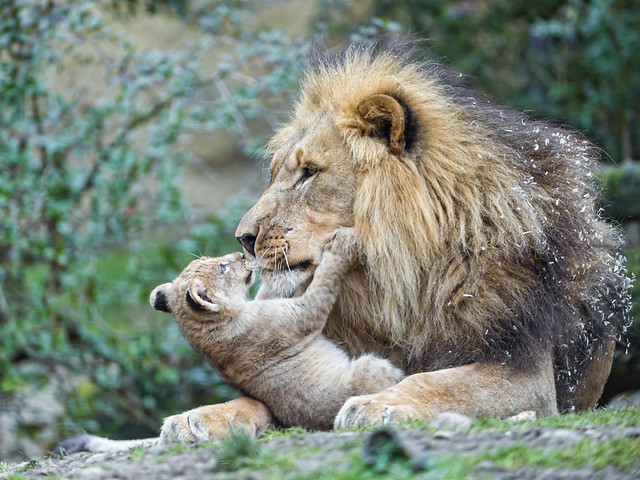
Zoo's Littlest Lion Cubs Take Their Swim Tests

Q
Tuesday, May 6, 2014
Beware of Stray Cats at the Philadelphia Zoo

The National Zoo's newest class of lion cubs passed an important exam Tuesday.
One by one, the four cubs were dropped into the moat that surrounds the lions' exhibit to take their swim reliability tests. The cubs were each able to keep their heads above water as they paddled to the shallow end of the moat and climbed onto dry land.

Excellent work, cubs! We hope you got gold star stickers afterward.

The 10-week-olds are the latest to ace the test. Their two older half-sisters also passed recently, and those older cubs could go on exhibit as early as Friday.

All lion cubs at the zoo must take the test to ensure they're ready to be on exhibit.

Majestic New Cat Species Discovered In Nepal


    Pallas's cat (Otocolobus manul)

By Stephen Messenger
Researchers studying snow leopard populations high in the Himalayas have announced the accidental discovery of a cat previously unknown to Nepal -- a majestic little cat that's at home in the highest mountain range on Earth.

The small feline, about the same size as a domestic house cat, was caught on film by various camera traps between 13,000 and 15,000 feet above sea level. On 11 occasions between 2012 and 2013, the cat was spotted prowling the rocky mountainside at night in search of food.


“The automatic cameras installed for the monitoring of snow leopards tracked a new species of cat which is hitherto unknown to conservationists working in the Nepal,” said Bikram Shrestha, coordinator of the Snow Leopard Conservancy program.“It has no Nepali name for it is completely a new animal to the country. We came to know the new animal to be Pallas’s cat after comparing photographs with similar species found in other parts of the world.”

Other populations and subspecies of Pallas’s cat can be found throughout central Asia; they are all listed under the IUCN Red List of Threatened Species. Conservationists are encouraged by the discovery, adding that this early evidence may only be the tip of the iceberg. “Other areas in Nepal also have the possibility of Pallas´s cat,” says Shrestha. “So, an in-depth study is needed regarding this new species.”

source

Court Acts Swiftly to Aid Rare Canada Lynx

Wildlife advocates’ win forces federal government to prepare long overdue recovery plan for threatened Canada Lynx.

Missoula, MT – In a critical win for the rare and elusive Canada lynx, a federal court in Montana found that the U.S. Fish and Wildlife Service’s 14-year delay in preparing a recovery plan for this threatened species was “unreasonable” and ordered a firm deadline for completing the federally mandated roadmap for recovery.

A coalition of wildlife advocates, represented by the Western Environmental Law Center, filed a lawsuit in March 2013 to spur the FWS to complete the required recovery plan for the cat, which was listed as threatened with extinction under the Endangered Species Act (ESA) in March 2000. By the FWS’ own admission, recovery plans are “one of the most important tools to ensure sound scientific and logistical decision-making throughout the recovery process.”

Yesterday, the Court ruled in the wildlife advocates favor, finding that “The history of this case causes a certain skepticism about the agency’s self declared deadlines for initiating recovery planning.” The agency has 30 days to submit a proposed schedule for completion of the recovery plan. “It’s long overdue,” said Matthew Bishop, an attorney with the Western Environmental Law Center who represents the coalition. “A delay of a year, two or even three might be reasonable given other priorities or a heavy workload, but not 14. At some point in time, the court has to step in and say enough is enough. Fortunately, that’s what they did in this case,” Bishop added. “We are pleased that the court recognized how important these plans are to prevent the extinction of lynx,” said Arlene Montgomery, Program Director for Friends of the Wild Swan. “Finally the Fish and Wildlife Service can get down to identifying and reducing threats to the cats’ long term survival.”

The Western Environmental Law Center is representing Friends of the Wild Swan, Rocky Mountain Wild, San Juan Citizens Alliance, and the Biodiversity Conservation Alliance.

The Court’s decision can be found here:
 http://www.westernlaw.org/sites/default/files/Order.Summary.Judgment.May_.8.2014..pdf

source

Thursday, May 8, 2014

Rare footage of elusive golden cat attacking a pangolin


Footage courtesy of Chester Zoo/Gashaka Biodiversity Project.

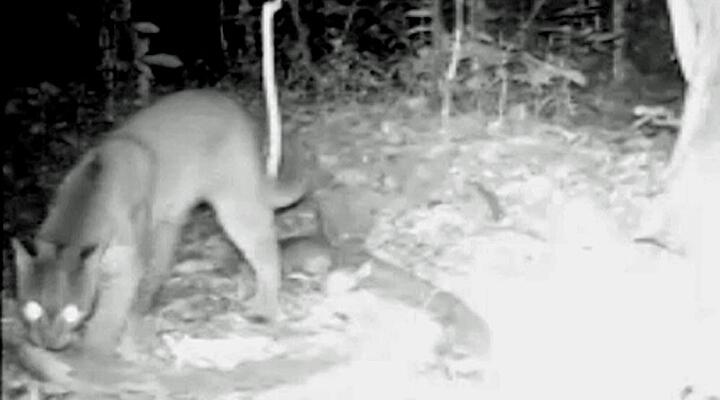
Camera traps set up to monitor chimpanzees in Nigeria's Gashaka Gumti National Park have captured rare footage of the elusive African golden cat attacking a pangolin.

Scott Wilson, Head of Field Conservation and Research at Chester Zoo, told BBC Nature: "The golden cat is the least known of Africa's felids, so any additional information and footage of it is exciting."

Africa's golden cat was caught on camera for the first time in 2002 and this is the first time it has been caught on camera in Gashaka Gumti National Park.

The cat leaps upon the pangolin, a long-tailed mammal covered in scaly armoured plates. But the pangolin then appears to escape by curling into a ball, a defensive posture, and rolling away, before the cat returns to inspect its potential prey.

It adds to the limited understanding of this rarely seen jungle cat, strongly suggesting that pangolin are a prey item. "Camera traps can tend to take a lot of video with nothing on... so when a rare species turns up it is always exciting - when they are exhibiting interesting behaviours, doubly so," Mr Wilson said.

Visit Chester Zoo's Nigeria Conservation Programme website to find out more.

Wednesday, May 7, 2014

Owning a cat is linked to a lower risk of heart attack

A feline lifeline?

By Deane Morrison
From M, spring 2008

If you own a cat, you know the downside: ripped couches, chronic disobedience, midnight yowling. But on the other hand, a cat may be good for your heart, according to a University of Minnesota study. Examining data on 4,435 adults, the researchers found that the relative risk of death from heart attack was 40 percent higher for those who had never owned a cat. Specifically, 3.4 percent of cat owners died from a heart attack during the course of the study versus 5.8 percent of non-owners.

Whether owning a dog confers the same benefit isn't clear; there wasn't enough data to draw any conclusions, says lead researcher and neurology professor Adnan Qureshi, who performed the study with others at the University's Zeenat Qureshi Stroke Research Center. He presented the findings in February at the International Stroke Conference in New Orleans. Two pieces of evidence led Qureshi and his colleagues to investigate whether owning a pet can benefit one's cardiovascular health. For one thing, various social factors have previously been linked to heart health. Also, he says, there was anecdotal evidence suggesting that pet ownerhsip can reduce the risk of heart disease, high blood pressure, and related conditions. "But does that translate to a protective effect?" he says. To find out, the researchers turned to the second National Health and Nutrition Examination Study, a large national database designed to identify risk factors for cardiovascular disease. "If we assume that cat ownership is directly responsible for the benefits, then the most logical explanation may be that cat ownership may relieve stress and anxiety and subsequently reduce the risk of cardiovascular diseases."

The study revealed that a lower risk of heart attack was associated not only with owning a cat, but with ever having owned one. The relationship held even after the researchers adjusted for classic cardiovascular risk factors such as blood pressure, diabetes mellitus, cigarette smoking, and high cholesterol. "If we assume that cat ownership is directly responsible for the benefits, then the most logical explanation may be that cat ownership may relieve stress and anxiety and subsequently reduce the risk of cardiovascular diseases," he says.

Although it may be tempting to conclude that getting a cat will improve your chances of avoiding a heart attack, the effect may be due to preexisting differences between cat lovers and the rest of the population. In other words, says Qureshi, the question is whether owning a cat directly reduces the risk of cardiovascular disease, or if people who own cats have personality traits that tend to protect against cardiovascular diseases independent of cat ownership.

This study can't answer that question, nor should it be construed as a recommendation to get a cat. But Qureshi wants to get to the bottom of the matter. He plans to examine more data from other studies to see whether they confirm the relationship between cats and heart health. If the relationship holds, new data may turn up other insights, such as what it is about pet ownership that may benefit people, especially those at high risk for cardiovascular disease.

Despite the uncertainties, however, it's clear that owning a cat has one thing going for it. "If this relationship is real, then, unlike other preventive measures such as angioplasty or medications, this seems to be very low risk and may not need to be evaluated like other medical interventions," Qureshi says. He should know. He owns a cat.

Philly Zoo's Big Cat Crossing gets a test run

A tiger tries out the the latest $2.3 million addition to the Philadelphia Zoo´s innovative animal trails. ( TOM GRALISH / Staff Photographer )
A tiger tries out the the latest $2.3 million addition to the Philadelphia Zoo's innovative animal trails. ( TOM GRALISH / Staff Photographer )
Story Highlights
  • The Big Cat Crossing was unveiled Wednesday and officially opens Saturday.
  • The $2.3 million project will give the zoo's big cats access to more areas.
  • Philadelphia is the nation's first zoo to so fully embrace the concept.
Last updated: Wednesday, May 7, 2014

Early reviews were positive from the tigers, on a test run on Big Cat Crossing, a 330-foot, $2.3 million addition to the Philadelphia Zoo's trails program. (TOM GRALISH / Staff Photographer)

Read more at http://www.philly.com/philly/news/science/20140507_Phila__Zoo_s_Big_Cat_Crossing_opens_Saturday.html#YZV4vGr8Pd8Gqif2.99
Early reviews were positive from the tigers, on a test run on Big Cat Crossing, a 330-foot, $2.3 million addition to the Philadelphia Zoo's trails program. (TOM GRALISH / Staff Photographer)

Read more at http://www.philly.com/philly/news/science/20140507_Phila__Zoo_s_Big_Cat_Crossing_opens_Saturday.html#YZV4vGr8Pd8Gqif2.99
Early reviews were positive from the tigers, on a test run on Big Cat Crossing, a 330-foot, $2.3 million addition to the Philadelphia Zoo's trails program. (TOM GRALISH / Staff Photographer)

Read more at http://www.philly.com/philly/news/science/20140507_Phila__Zoo_s_Big_Cat_Crossing_opens_Saturday.html#YZV4vGr8Pd8Gqif2.99


Suddenly, people walking along a main pathway at the Philadelphia Zoo jerked to a standstill.
Some gasped. "Tiger!" Just overhead, 320 pounds of gold and black fur stalked into view. No cage bars. No thick glass wall. Just barely visible mesh netting. The mesmerized visitors looked up.

He peered down. Those teeth! Somehow, when those big incisors are 14 feet above . . . gulp.
It was a test run for Big Cat Crossing, a 330-foot addition to the zoo's innovative trail system that is being unveiled Wednesday and officially opens Saturday.

The $2.3 million project will give the zoo's tigers, lions, pumas, jaguars, and snow leopards unprecedented access to more areas, more smells, and more views - including gawking humans.
Philadelphia is the nation's first zoo to so fully embrace the concept, which is considered transformative for both animal and visitor. The first trail - 1,735 feet - was a treetops runway for small primates. The next, at 200 feet, was big and sturdy enough, for on-the-move orangutans.


In 2015, hippos, giraffes, zebras, and the like will go where they have never gone before. "It's a game-changer," said Terry Maple, an expert on zoo animal welfare and a former Zoo Atlanta president. "It's going to change the way we build zoos in the future."

Most zoos have gone from barred cages to naturalistic "enclosures" and now incorporate various enrichment equipment designed to keep the animals engaged and active. But no matter how cleverly designed or enhanced, enclosed exhibits are still "pretty boring," said Jon Coe, who has worked extensively with the zoo. Founder of a Philadelphia design firm that specializes in zoos, Coe now is based in Australia. "Zoo animals suffer all around the world from a lack of physical fitness and behavioral competence," Coe said.

Eyeing the swan boats

The trail system is a way to give animals change, flexibility, and, above all, choice - tough to achieve in captivity. It allows them to get exercise and see interesting new things. Such as a sea of openmouthed humans, cellphones held aloft for a good shot.

With the new trail, the cats can travel out of the main exhibit area, over a major visitor path and down to the ground near the cafeteria entrance - prepare for gridlock there, too - and Bird Lake, where the initial cat travelers were "fascinated by the swan boats," said Andrew Baker, the zoo's chief operating officer. Or, perhaps, the meaty humans paddling them. 

(Nearby in their trail, the orangutans were not as pleased to see big cats in such close proximity.)
The zoo is incorporating the concept in other areas as well. Most mornings, pink flamingos cross a bridge to a new pond. In KidZooU, goats clamber up a stairway to an overlook.

Indeed, the zoo's new theme is "Zoo360" - as you move around the zoo, the zoo moves around you.
The switcheroos have to be done with caution, however. For instance, big cats pass through bacteria from their raw-meat diet. Plant-eating primates aren't adapted to that. So the big cats might get the run of the orangutan trail in winter, when the warm-climate primates are inside, and the passage will get a cleansing come spring.

'Serious exercise'

The whole notion stems from brainstorming by Coe and the zoo some years ago. By 2006, the zoo had begun animal rotations, moving, say, the panthers to the puma exhibit for a day. Coe began to wonder, "Why can't we hook everything in the zoo to everything else and let the animals have the run of the place?"

Now, he describes the idea even more simplistically. At a zoo conference in New Zealand in March, Coe asked the group: "How many of you have a dog? How often do you take the dog for a walk?"
When it comes to zoos, "how often do these animals get to go for a good walk, get an outing, get some serious exercise, see something new?"

Maple is reminded of a zoo director in Jakarta, Indonesia, who used to drive up to the orangutan enclosure in a horse-drawn carriage. The orangs would pile into the back and the director would drive them around the zoo.

Why?
Simple: They liked it. When Philly came up with its trails idea, "I said, 'Good Lord, this is exactly what we should be doing,' " Maple recalled.

The network of trails works for Philadelphia, in particular, because the zoo is small. With a railroad on one side and a major highway on the other, it has no place to expand but up. And now, Maple said, "zoo architects will begin to use this idea, and we'll see all kinds of iterations."
Keepers are studying what happens, and so far are seeing what they hoped for - more activity. They have also noticed novel behaviors, things animals can't do in a traditional enclosure. "As simple as it sounds, just straight, long-distance, high-speed running," said Baker.

Some animals scent-mark the trails - or worse. (Although the staff thinks it unlikely with the big cats, it can't rule out the possibility that some pedestrians will get dripped on.) And the small Bolivian gray titi monkeys have started belting out loud territorial calls. "We never heard it while they were indoors," Baker said.

The zoo hopes for a richer experience for the humans as well. They'll now see animals in unexpected places - more like an animal encounter in the wild. In conjunction with Big Cat Crossing, the zoo has proclaimed this the Year of the Cat, and through a companion exhibit, the staff is hoping to engage visitors in the palm oil issue. Worldwide, rain forests are being razed for palm oil plantations; that threatens the animals who live there, including tigers, Baker said.

'Carefree'

The first animals to try out Big Cat Crossing were two Amur tiger brothers, Wiz and Dmitri, youngsters who are both curious and adventurous. So far, they seem to like it - if "like" is something an animal experiences.

Tammy Schmidt, the zoo's curator of carnivores and ungulates, watches their body language.
Is the tail twitching nervously? Are they cautiously creeping up to the bridge way?
No. They're "up and walking, carefree, chuffing" to each other as they pass, "the tail just swinging along very expressively," she said. "Their mouth is open and just bringing in all the scents of the area and being catalyzed by the children walking by and seeing all these things that they see from a traditional area, but now they're walking amongst it."


Inquirer.com

Watch tigers try out Big Cat Crossing, the latest addition to the zoo's innovative trail system, at www.inquirer.com/tigers

source

The Internet, realized, with 24-7 online cat TV channel

Pluto.tv, an online television network, offers a round-the-clock channel full of nothing but cat videos. Don't fret, dog owners, there's also a channel for canines.
CNET test cat Archer
CNET test cat Archer is ready for his close-up, Mr. DeMille. Amanda Kooser/CNET
What do you do when you're all caught up on Cute Overload and you don't feel like trawling through the YouTube waters to seek out cute cat videos? You turn to Pluto.tv's Cats 24/7 channel. It's cats. All day. All night. Big cats. Roomba cats. Domesticated house cats. Cats, cats, cats.

It's OK if you haven't heard of Pluto.tv. The online service just launched at the end of March. It tries to replicate the regular TV-watching experience online. A guide-style set of television listings lets you scroll through and choose online stations like Indie Films, Sketch Comedy, and Commercials 24/7 (just in case you can't get enough of marketing).

Pluto.tv has equal-opportunity offerings for dog lovers. The Dogs 24/7 channel is just like the cats channel, but with a much higher canine-content quotient. If you're not picky about the species, then tune into the Crazy Animals channel.

I can absorb cat videos the way other people breathe air. I figured I would find Cats 24/7 entertaining, and at worst it might suck away all the productivity in my life, leaving me staring at my computer screen saying "awww" while forgetting basic things like eating and finishing my work on time.
Something else happened, though. I checked in while a show called "Cats Gone Viral!" was playing. Mostly, it's a collection of low-quality YouTube videos of cats doing cute or funny things. After a few minutes, I got bored and wandered away. I had seen most of the videos already, and the poor video quality combined with shaky-cam footage was more than I could take.

Not all hope is lost here. It was just one show. I went back for more. A show called "Putting Up With Humans" started promisingly with a high-quality short video of a person dressing up like a cat tree. Then it descended back into YouTube reruns for a bit. I guess it's not too surprising when you think about the sheer amount of cat content generated by the video-sharing site. You'll find the whole quality range on display, from an awesome video of fashion designers doing a photo shoot for a cat calendar to overly long videos of dogs barking at upset cats.

What I've learned is that Cats 24/7 is just like any other television channel. Some shows are fun, some shows aren't so hot. Still, I can think of no reality where having a constant cat channel is a bad thing.

(Via Geekosystem)

source 

Your Daily Cat

Tuesday, May 6, 2014

Your Daily Cat

Evolution in species may reverse predator-prey population cycles

Date:
May 5, 2014
Source:
Georgia Institute of Technology
Summary:
Populations of predators and their prey usually follow predictable cycles. When the number of prey increases -- perhaps as their food supply becomes more abundant -- predator populations also grow. When the predator population becomes too large, however, the prey population often plummets, leaving too little food for the predators, whose population also then crashes. Co-evolutionary changes in species may reverse traditional predator-prey population cycles, creating the appearance that prey are eating the predators, according to a new study.

Male lion attack huge buffalo bull. Credit: © Alta Oosthuizen / Fotolia


Populations of predators and their prey usually follow predictable cycles. When the number of prey increases -- perhaps as their food supply becomes more abundant -- predator populations also grow.
When the predator population becomes too large, however, the prey population often plummets, leaving too little food for the predators, whose population also then crashes. This canonical view of predator-prey relationships was first identified by mathematical biologists Alfred Lotka and Vito Volterra in the 1920s and 1930s.

But all bets are off if both the predator and prey species are evolving in even small ways, according to a new study published this week in the journal Proceedings of the National Academy of Sciences. When both species are evolving, the traditional cycle may reverse, allowing predator populations to peak before those of the prey. In fact, it may appear as if the prey are eating the predators.

Researchers at the Georgia Institute of Technology have proposed a theory to explain these co-evolutionary changes. And then, using data collected by other scientists on three predator-prey pairs -- mink-muskrat, gyrfalcon-rock ptarmigan and phage-Vibrio cholerae -- they show how their theory could explain unexpected population cycles. The new theory and analysis of these co-evolution cycles could help epidemiologists predict cycles of disease and the virulence of infectious agents, and lead to a better understanding of how population cycles may affect ecosystems. The research was supported by the National Science Foundation and the Burroughs Wellcome Fund.
"Our work shows that co-evolution can yield new and unique behavior at the population scale," explained Joshua Weitz, an associate professor in the School of Biology at Georgia Tech. "When you include evolution, the classic prey-predator dynamics have a much greater range of possible outcomes. We are not replacing the original theory, but proposing a more general model that opens the door to these new phenomena."

Evolution is often perceived as an historical event, noted Weitz, who also has a courtesy appointment in the Georgia Tech School of Physics. But organisms are evolving continuously, with certain phenotypes becoming dominant as environmental and other conditions favor them. In organisms such as birds or small mammals, those changes can be manifested in as few as ten generations. In microbial species with brief lifespans, evolutionary changes can happen within days or weeks.

Evolutionary changes can dramatically affect relationships between species, potentially making them more vulnerable or less vulnerable. For instance, if a mutation that confers viral resistance in a species of bacteria becomes dominant, that may change the predator-prey relationship by rendering the bacteria population safe from harm. More generally, co-evolutionary cycles can arise when predator offense is costly and prey defense is effective against low offense predators.  "With predator and prey co-evolution, you can see oscillations in which there are lots of prey around even when there are many predators, or lots of predators around even when there are very few prey," noted Michael Cortez, a postdoctoral fellow in the Weitz lab and first author of the paper. "When prey is abundant and there are few predators, it may be because there are lots of defended prey -- prey that the predators can't eat," he added. "When there are lots of predators around and few prey, it's because the prey are very good food sources and the predators are doing quite well."

In their paper, Weitz and Cortez simulated models in which the evolutionary process was sped up to show how their theory of co-evolution would affect predator-prey population cycles. Speeding up the process allowed them to break the cycle up into smaller segments that could be analyzed in more detail. They then used the earlier observations of the changing abundances of the three pairs of predators and prey -- leveraging data sets collected by other scientists -- to show how the models would apply. "Although the structure of the cycles in these three systems had been noted as unusual by the authors who observed them, there had been, as yet, no unified theoretical framework from which to make sense of such as radical departure from the classic signature of predator-prey interactions," Weitz said.

Scientists have long studied how the interaction between species affects overall populations in ecosystems. Weitz and Cortez believe their new model will give scientists a broader and more complete picture of the complex process. "This study identifies how adaptation between two species and interactions between their numbers can result in something different from what you would get if you just had the interaction between the numbers," said Cortez. "This is something that will show up across many ecological systems. We can now explain broad trends that occur in vastly different systems using a theoretical approach, and the fact that we can identify the mechanism responsible for it is unique to our study."

This research was supported by the National Science Foundation under Award DMS-1204401, and by the Burroughs Wellcome Fund. Any conclusions or opinions expressed are those of the authors and do not necessarily represent the official views of the sponsoring agencies.

Story Source:
The above story is based on materials provided by Georgia Institute of Technology. The original article was written by John Toon. Note: Materials may be edited for content and length.

Journal Reference:
  1. Michael H. Cortez and Joshua S. Weitz. Coevolution can reverse predator–prey cycles. PNAS, May 5, 2014 DOI: 10.1073/pnas.1317693111


Georgia Institute of Technology. "Evolution in species may reverse predator-prey population cycles." ScienceDaily. ScienceDaily, 5 May 2014. <www.sciencedaily.com/releases/2014/05/140505155139.htm>.

Mystery Big Cats in Japan’s Lost World


leop11
  •  May 6, 2014
  •  Brent Swancer
 
Within Japan’s Yaejima Island chain, southwest of Okinawa, lies the mysterious, remote Iriomote Island. The sparsely populated island is a land of dense mangrove swamps and unexplored, impenetrable, mist shrouded rain forests. It is easy for one to look upon this landscape and think they are in the deepest parts of the Amazon, or the jungles of Africa rather than in Japan. The island is home to many endemic species of flora and fauna that have evolved in isolation and are found nowhere else on Earth. If ever there was some forgotten lost world in Japan, then this mysterious place is it.

Iriomote Island
Iriomote Island

The island is already home to one unique enigmatic animal, the rarely seen Iriomote wildcat (Prionailurus bengalensis iriomotensis), an indigenous wildcat about the size of a house cat which was discovered in 1965. It is thought to be distantly related to leopard cats of the Asian mainland, from which the species diverged and subsequently evolved  in isolation on the island long ago, and is often referred to as a “living fossil.” The Iriomote wildcat inhabits mostly the remote jungles of the island and is so rare and elusive that most long term residents of the island have never even seen one. Indeed, many residents are not even aware that such a cat exists. Fewer than 100 of the Iriomote wildcats are thought to exist in the wild.

Iriomote wildcat
Iriomote wildcat

If accounts are anything to go by, then the Iriomote wildcat is not the only wildcat species to call the island home. In the thick interior of the island, a much larger cat is said to stalk through jungles.
Although Iriomote island wasn’t inhabited by humans in earnest until after World War II, hunters on the island occasionally brought back stories of encountering mysterious big cats roaming the wilderness long before the smaller known Iriomote wildcat was even discovered. The mystery cats were said to be anywhere from 1 meter (3.3 feet) to up to 2 meters (6.6 feet) in length, and similar in appearance to a leopard or jaguar, with prominent spots covering the body, although some reports describe stripes more like a tiger.

A common feature of sightings is the cat’s exceptionally long tail, which is described as being longer than the creature’s body length. The cats were known for being extremely agile climbers, with some accounts describing how they seemed to almost swing from tree to tree like some sort of primate rather than cat. The cats were also said to be powerful jumpers, able to leap up to 5 meters (16.5 feet) from a standing position.

These large cats came to be known by locals as the yamapikarya, which roughly translates into “the one in the mountain whose eyes shine,” as well as the dai yamaneko, or “giant mountain cat.” In addition to reports of mysterious large cats brought back by hunters before and during the early days of human habitation on the island, soldiers stationed on Iriomote Island during World War II also reported seeing the Yamapikarya on occasion, and there are even accounts of soldiers killing the beasts.
Artistic depiction of the Yamapikarya.
Artistic depiction of the Yamapikarya. 

The Yamapikarya is still occasionally sighted into the modern day. One such sighting occurred in the summer of 1978, when a hunter reported seeing a large cat lounging up in a tree. The eyewitness described the cat as having spots that were “oddly shaped,” and a long tail that hung down “like a vine.” After observing the cat for several minutes, the hunter reports that the cat seemed to suddenly realize it was not alone, after which it bounded down the tree and into the forest with what he said was extraordinary speed and agility. The cat reportedly did not make any sound during the encounter.

In 2003, a Mr. Shoichi Shimabukuro, who runs a fishing boat on the island, spotted a Yamapikariya while he was in the mountains setting wild boar traps. According to his report, he was setting the traps and found himself walking along a gravelly open clearing. After walking along this clearing for around 100 meters, he was surprised when a large, spotted cat, estimated at slightly over a meter long and with an exceptionally long tail suddenly leapt down from the top of a large boulder, landing right in front of him before disappearing into the underbrush. The eyewitness explained that the cat was very nimble and easily bounded 3 meters (around 10 feet) as it made its departure.

A feature on the Yamapikarya from a Japanese cryptozoology publication.

In September of 2007, the cat was seen by a Mr. Aiyoshi, who is a professor at Shimane University in Japan. According to his report, the professor was sitting on a beach on Sakiyama peninsula fishing for a research project when a dark shape appeared from the thick forest just 2.5 meters from where he sat. His first bewildered reaction upon realizing an animal was there was that a wild boar had crept out of the trees, but it became quickly apparent this was a large cat which he described as being a meter in length, with a very long tail and black spots, and looking similar to a clouded leopard. The professor reported how the cat stared right at him before calmly slinking into the shadowy forest once more. The man recalled being very frightened that the cat would attack him.

One of the more recent sightings occurred in 2010, interestingly during preservation efforts on the Iriomote wildcat. A worker was repairing and installing road signs alerting drivers to the wildcats, many of which are hit by cars, when he noticed movement in the nearby underbrush. Again, the movement was at first presumed to be one of the many wild boar found on the island, and the worker thought nothing of it until a large, spotted cat crept from the underbrush and furtively stalked along the road before entering the wilderness once again. In this case, the mystery cat was described as being 1.5 meters (5 feet) in length, with a tail 1.5 times that length. It was said to have orangish coloration and very large spots.

Iriomote Wildcat Crossing road sign.

At present, there are at least 47 recorded sightings of these mysterious big cats on the island, with most of the sightings occurring in the 60s.  The rarity of more modern sightings is possibly due to the alleged cats moving deeper into the inaccessible inland jungles due to increased tourism on the island.

What could possibly account for such sightings? The Yamapikarya is far larger and different in appearance than the known Iriomote wildcat, so it seems unlikely that there could be misidentifications. One of the most common theories is that there is possibly a remnant population of clouded leopards (Neofelis nebulosa) inhabiting the island.

This would certainly fit in with eyewitness descriptions of the mystery cats. Clouded leopards are typically somewhat comparable in size to what is described in the eyewitness accounts and have large spots that also match with reports of the Yamapikarya. The alleged Yamapikarya tend to be described as larger than typical clouded leopards, but this could be a result of geographic isolation or inaccurate size estimations. In addition, clouded leopards have unusually long tails and are highly nimble climbers and powerful jumpers, all hallmarks of Yamapikarya sightings reports.

Clouded leopard
Clouded leopard

The idea of a small, isolated population of clouded leopards on Iriomote island is not entirely farfetched. The island was once accessible to other clouded leopard habitats in Asia through a land bridge, so it is not inconceivable for some of the cats to have become present on the island. In addition, Iriomote island has plenty of food resources to support a large cat of this type.

Could a large cat such as the clouded leopard remain undiscovered on the island? Although only 289.27 square kilometers (111.69 square miles) in area, Iriomote Island nevertheless certainly seems to be a suitable habitat for such a creature to remain hidden. Currently, Iriomote island is approximately 90% jungle and mangrove swamps, and most of the interior of the island falls within state protected land, with around 35.5 percent of the land compromising Iriomote National Park.

Most of the inland jungles are devoid of any roads or even trails, and as such are accessible only on foot through dense foliage and underbrush. Much of this impenetrable jungle is unexplored.
The known Iriomote wildcat was not discovered until 1965, and it is a species more inclined to venture into the coastal areas where most human habitation on the island is located. Something that preferred the deeper, inaccessible and unexplored jungles of the island could feasibly remain undetected up into the modern day.

pic_forest5

What stalks through this lost world of Iriomote Island? Is there a unique species of big cat that we have not discovered yet lurking within the island’s swamps and jungles? Hopefully, if such a cat does exist, then it will eventually be protected and recognized as yet another unique animal on this majestic island.

source

Big cats may be moving to a town near you


Panther deaths are part of life Southwest Florida. The big cats have died here for thousands of years..
What's odd is that these normally reclusive, nocturnal animals are showing up more and more in more-urban settings, sometimes in the middle of the day. Last week, a 3-year-old uncollared female panther was killed by a vehicle near mile marker 134 along Interstate 75, just a few hundred yards from the city limits of Fort Myers.

The death marked the ninth by road kill this year and the 14th carcass recovered in 2014. At a time when the panther population is growing, and more and more cars are on Southwest Florida roads, a species that was once rarely seen or recorded is showing up more and more in urbanized settings.
Earlier this year a young male panther was captured at Clam Pass Park in North Naples and moved to the southern portion of the Corkscrew Regional Ecosystem Watershed, or CREW east of Naples. Last summer, a male panther spent several months living and feeding at Six Mile Cypress Slough Preserve not far from busy Colonial Boulevard and I-75. Biologists think that cat was killed by a car late last summer, which is about the same time the sightings of the Six Mile panther stopped being reported.
"We're keeping out fingers crossed because we hope it wasn't 'our' panther," said Mary Rawl, executive director of the Calusa Nature Center & Planetarium, where a panther was photographed by tourists on April 18. "I was afraid (of a panther being hit by a car) on Ortiz or Colonial, but on (Interstate) 75?"

What are the odds?

Take the number of panthers killed between Jan. 1 and May 1, carry those out through the remainder of 2014 and you get a record year for panther road kills and overall deaths, 27 and 42, respectively. The current records are 17 for road kills and 26 overall.

That kind of math, though, doesn't add up, said Florida Fish and Wildlife Conservation Commission panther biologist Darrell Land. "It just doesn't work that way," Land said. "You can go ahead and play the game, but I suspect you'll be wrong. It's kind of random chance. Sometimes they come in spurts. Sometimes you go weeks or months without having a road kill."

Land said biologists don't know the range of the uncollared female found dead Friday but that she had lived a somewhat urbanized existence. "It's very likely she was a resident cat in part of that area — that it was part of what she was using as her entire region," Land said.

Land said it's not surprising that a female panther was found dead in an area that was used by a male last summer. "What one panther likes, the next one should like it very well," he said. "And they are an adaptable animal. It's wrong to assume they'll only be found in the deepest, darkest places in Florida."
The female was north and east of the main panther travel, feeding and breeding grounds — which are Big Cypress National Preserve, Everglades National Park, CREW and Corkscrew Swamp Sanctuary.
Biologists say one of the next steps in the panther recovery process is having females occupy lands north of the Caloosahatchee River. Female panthers haven't lived north of the river in decades, and any females moving to the central and northern parts of the state would likely be another indicator that South Florida's wild lands are at panther capacity.

Saving the cats

Considered one of the most endangered mammals in the world, panthers likely number 150 or more, up drastically from just 20 years ago — when the big cats were on the brink of extinction and there were 30 or fewer living in the wild. Biologist with the Florida Fish and Wildlife Conservation Commission have worked for decades to rebuild the breeding population, releasing several female Texas cougars in the 1990s to increase genetic diversity.

Animal underpasses were built along problematic roads such as Highway 29 south of Immokalee and Corkscrew Road in Estero to the cost of about $4 million apiece. Groups such as the Florida Wildlife Federation have pushed for more underpasses on problematic roads. Recent underpasses — smaller but equally eff9*ective — now cost $1 million or less. More wildlife underpasses are being planned, but most can't be completed until those specific roads are being rebuilt or modified.

A wildlife passage is being built into the State Road 80 expansion east of LaBelle, and there are plans to build wildlife paths along the eastern stretches of State Road 82. "It's always up on our radar," said Land. "It really matters when a road is expected to be upgraded or modified. Last summer we completed a smaller design and integrated a wildlife crossing into Country Road 846 between Corkscrew Swamp Sanctuary and Immokalee."

Nancy Payton with the Florida Wildlife Federation said she thinks more needs to be done in these areas. "(The mortality numbers) tell me and probably others that there's a lot more work to be done on 846 for that to be a safer road for panthers and other wildlife," Payton said. "If panthers are getting killed, many other wildlife are getting hit on those roads."

Data from the panther deaths isn't wasted as biologists and support groups compile mortality numbers for the entire state each year and compare those during habitat evaluations and development proposals. "These incidents aren't happening in a vacuum," Payton said. "The information that is coming out of these deaths is helping other panthers as we plan for transportation needs."

Read:
Panther found near Collier County beach, relocated
Reporters Notebook: We were 'swangin' at panther release

Florida panther
(Puma concolor coryi)

Appearance: Males can measure up to 7 feet from tail to nose and weigh about 130 pounds on average. Adult females are about 6 feet in length and weigh 70 to 75 pounds. Lifespan in the wild is 10 to 15 years.
Habitat and range: Males occupy about 200 square miles and will often fight to the death over territory. Females require about 75 square miles. These cats once ranged throughout the Southeastern U.S. and are now found almost exclusively south of Lake Okeechobee.
Diet: Strict carnivores, adult panthers feed mostly on deer, feral hogs, raccoons and armadillos. Adults must eat a deer or hog once a week.
Reproduction: Adults reach sexual maturity by age 3. Gestation period is 92 to 96 days with females generally producing up to four kittens. Births are most common in spring but can occur at any time of year. Kittens weigh about 1 pound, are grayish-brown with spots and are born with eyes shut.

Sources: U.S. Fish and Wildlife Service, Florida Fish and Wildlife Conservation Commission, floridapanthernet.org

source 

Sunday, May 4, 2014

Your Daily Cat

Indian Army to Go on Rescue Prowl to Save the Big Cats

Published: 04th May 2014
They protect us from cross-border intruders, and soon they could be protecting the big cats from the poachers. The Indian Army would be keeping an eye on tigers in sensitive border areas of the country as the National Tiger Conservation Authori ty (NTCA) has approached the Ministry of Defence (MoD) seeking help in saving the cats by monitoring their movements using drones and CCTV cameras near high security zones, including those close to the Indo-China border.

The move comes after the NTCA, a statutory body under the Ministry of Environment and Forests, was denied permission by the MoD to carry out surveillance of tiger reserves using drones in areas near international borders and places housing defence installations and ammunition depots.

The tiger conservation authority is in the process of using drones, CCTVs and virtual fence to monitor movement of tigers in and around reserves. The advanced technology will provide virtual access to difficult terrains and dense forests in tiger reserves, which forest guards do not have access to. There are 44 tiger reserves in the country.  

The NTCA took up the matter with the MoD, asking the armed forces to help in tiger monitoring at places where forest officers won’t be allowed to fly drones. After initial discussions with senior defence ministry officials, the NTCA was asked to send a detailed proposal. “We are preparing a formal proposal which will be sent to the defence ministry by June. We have asked them if their men can fly the drones and collect information regularly in sensitive areas. They can inform the forest officers immediately if they have any suspicion or see human movement inside the core areas,” said a senior NTCA official.

The proposal will describe the kind of training and resources that will be required for the army men to handle equipment and perform the task. NTCA will also provide a list of tiger reserves in the country so that the defence ministry can mark areas which are sensitive and will be managed by its men. “The defence ministry had earlier objected to drone trials in Assam’s Kaziranga National Park, where a large number of one-horned rhinoceroses were killed by poachers last year. The ministry did not give us permission on security grounds,” said the official. 

The drone trials are now being done at the Panna Tiger Reserve in Madhya Pradesh and the results of initial trials have been very encouraging. Satisfied with the initial trails in Panna and the ongoing ‘Virtual Eye’ project in Corbett Tiger Reserve, the tiger conservation authority wants to replicate it in other places, but security clearance remains a major hurdle and the process takes months in some cases.

Drone trials are also being planned in either Corbett or Dudhwa tiger reserve in northern India and Sathyamangalam or Mudumalai tiger reserves in southern India in the months ahead.
Facing shortage of forest guards to man vast areas of tiger reserves and other protected sites, the NTCA is banking upon technology to save the big cats in India, which is home to the largest number of tigers in the world.  

According to 2010 tiger census, there are 1,706 tigers in the wild and a big threat of poaching looms over them due to high demand of tiger parts in the international market. In 2013, 67 tiger deaths were reported while till now (April 19) this year, 22 tigers have died of various reasons. The NTCA is in the process of counting tigers and the census is expected to be out by December this year.

source

Saturday, May 3, 2014

Your Daily Cats


Orson, San Diego Zoo's black jaguar, dies at age 21

Orson the black jaguarOrson, the black jaguar at the San Diego Zoo, has died at age 21. Orson, at the zoo since 1993, was a favorite of zoo patrons. 2014. Tony Perry


Sad news from the San Diego Zoo: Orson, the black jaguar who was a favorite of zoo visitors, has died at age 21.

Beset by a series of geriatric and mobility problems, Orson was euthanized Wednesday by zookeepers who had kept him on pain medicine in recent days but concluded that his condition was irreversible, officials said. A necropsy is planned.Orson came to the zoo in 1993 from the zoo in Phoenix. Although big cats are notoriously solitary, Orson, who weighed about 200 pounds in his prime, seemed to enjoy preening and posing for visitors.

His species is most notably found in South America and Latin America and in sparse spots in the American Southwest. At age 21, Orson was considered elderly. In the wild, jaguars average a lifespan of 12 to 15 years, officials said. Orson was the zoo's only black jaguar along Big Cat Row. The zoo's two other jaguars are the more common orange and tawny color.

Orson was tranquilized before the euthanasia injection was administered. "He went peacefully, calmly and surrounded by folks who cared for him," said Jacob Shanks, lead keeper for Sun Bear Forest.

source